Annapurna Bhandar Yojana 2026
What You'll Learn
- August 2026 instalment timeline - when the third ₹3,000 credit lands in your bank account
- The 7-step online application on socialregistry.wb.gov.in, plus the offline form route
- Eligibility, exclusions and documents - including why 27.8 lakh forms were rejected
- Status check, NPCI DBT linking and helpline 8282082820 for payment failures
Annapurna Bhandar Yojana 2026 - The Complete Picture
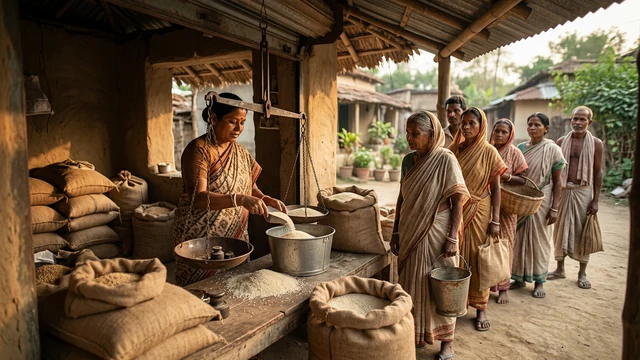
The Annapurna Bhandar Yojana 2026 is the West Bengal government's largest women-focused cash transfer programme, launched by Chief Minister Suvendu Adhikari on June 3, 2026. It replaced the Trinamool-era Lakshmir Bhandar scheme from June 1, 2026 and immediately raised the monthly assistance to a flat ₹3,000 per woman, paid straight into Aadhaar-seeded bank accounts through Direct Benefit Transfer (DBT).
In just two months the scheme has scaled at record speed. The first instalment on June 3 reached 28.25 lakh women, verified by The Hindu. The second instalment, credited on July 1, 2026, expanded paid coverage to roughly 1.1 to 1.3 crore women, according to ClearTax's tracking. The BJP government's stated target is close to 2 crore beneficiaries - which would make it one of the biggest state-run women welfare schemes in India, bigger than Lakshmir Bhandar's roughly 2.15 crore enrolled base.
Alongside the cash, the same cabinet meeting on May 18, 2026 cleared free travel for women on government-run state buses, as reported by The Statesman - a bundled welfare announcement that also included the 7th Pay Commission rollout. This guide covers every verified detail you need: the August payment window, eligibility rules, the exact application steps, document list, rejection fixes, DBT linking, and official helplines. Every figure below is sourced from official portals such as socialsecurity.wb.gov.in, the myScheme listing, or national outlets including Livemint, The Economic Times, News18 and The Hindu.
What is Annapurna Bhandar Yojana?
The Annapurna Yojana, implemented by the Women and Child Development and Social Welfare Department, Government of West Bengal, is a direct cash assistance scheme for the female head of a family. It was earlier announced under the working name "Matri Shakti Bharosa" before the cabinet finalised the Annapurna Bhandar branding. The department is headquartered at Bikash Bhaban, Sector 1, Salt Lake City, Kolkata 700091, and the scheme's administrative notification was issued on May 20, 2026.
Under the scheme, every eligible woman receives ₹3,000 per month - a sharp jump from Lakshmir Bhandar's category-based ₹500 to ₹1,500. The payment is fully DBT-based: money moves only into an Aadhaar-linked, NPCI-mapped bank account, which is why the state has pushed hard on bank seeding verification. The scheme lives on the myScheme portal (scheme code "aywb") and is operated through the state's Social Registry infrastructure.
The scheme was born out of a fraud purge. The earlier Lakshmir Bhandar programme had about 2.4 crore beneficiaries by early 2026, but the new government claimed nearly 30 lakh accounts were fake or ineligible, and a Special Investigation Team was set up on June 1, 2026. Annapurna Bhandar therefore re-verifies every applicant - even existing Lakshmir Bhandar beneficiaries - instead of blindly carrying the old rolls forward.
August 2026 Instalment - Latest Payment Update
The single biggest question right now is: when does the August ₹3,000 instalment arrive? Here is the verified position as of the first week of August 2026:
Livemint reported on August 1 that the August payout began flowing into verified bank accounts in the first week of August, deposited in phases rather than a single-day credit. A follow-up report on August 3 confirmed many beneficiaries were still waiting, with the state processing transfers batch by batch as verification clears. News18 has flagged that document verification for pending applications continues until August 30, 2026, which means payments for newly verified applicants keep getting released through the month.
| Instalment | Credit Date | Beneficiaries Covered | Status |
|---|---|---|---|
| 1st Instalment | June 3, 2026 | 28.25 lakh women | Paid on launch day |
| 2nd Instalment | July 1, 2026 | ~1.1-1.3 crore women | Paid |
| 3rd Instalment | August 2026 (phases) | Rising toward ~2 crore target | Ongoing - first week onward |
If your August money has not landed, do not panic. The state's message is consistent: check your status on the portal, confirm your NPCI Aadhaar-bank mapping, and wait for your verification batch. Accounts showing "Payment Pending" usually clear within 15 to 30 days, while "Payment Failure" almost always points to a DBT seeding problem - covered in detail below.
Annapurna Bhandar vs Lakshmir Bhandar - What Changed
The new scheme is not just a rename. It restructures eligibility, payout and verification. Financial Express first detailed the shift on May 24, 2026, and Business Today confirmed the changeover from June 1.
| Feature | Lakshmir Bhandar (TMC era) | Annapurna Bhandar (2026) |
|---|---|---|
| Monthly payout | ₹500-₹1,000 (General), ₹1,000-₹1,500 (SC/ST) | Flat ₹3,000 for all |
| Age band | 25-60 years | 25-60 years |
| Enrolled base | ~2.15-2.4 crore | Target ~2 crore verified |
| Verification | Legacy rolls, minimal checks | Fresh application + full document verification |
| Payment channel | DBT | DBT with mandatory NPCI/BASE Aadhaar seeding |
| Extra benefit | None | Free travel on state-run buses for women |
Existing Lakshmir Bhandar beneficiaries do not lose their money - but they must be re-verified on the new system. Reports from applicants show many were asked to confirm or resubmit details after June 3, and the state has clarified that women already receiving DBT successfully do not need to re-link their bank account; the ₹3,000 simply credits to the same account.
Eligibility - Who Can Apply in 2026
News18's eligibility explainer (May 27, 2026) and the scheme's highlights document set out a clear rulebook. Homemakers, widows, divorcees and unemployed women can all apply, provided they meet these conditions:
- Gender and role: Female head of the household
- Age: 25 to 60 years on the date of application
- Domicile: Permanent resident of West Bengal, proven through Voter ID (EPIC) or residence proof
- Bank account: An active, Aadhaar-linked bank account mapped on NPCI's BASE system
- Identity: Aadhaar card, voter card and a working mobile number registered in the applicant's name
Equally important are the exclusions. You are not eligible if you are a central or state government employee or pensioner, an income-tax payer, or the owner of a four-wheeler. These three filters drove most of the early rejections, alongside the citizenship and SIR 2026 electoral-roll deletions flagged by Goodreturns.
The Rejection Wave - 27.8 Lakh Forms and How to Fix Yours
This is the story most guides skip. After the first verification round, Livemint reported on July 13, 2026 that 27.8 lakh application forms had been rejected. Goodreturns put an overlapping figure of about 26 lakh rejections linked partly to citizenship doubts and SIR 2026 electoral-roll deletions. Families discovered that even wives of government employees had received ₹3,000 while some genuinely eligible poor applicants were struck off - causing widespread confusion.
The good news: the state is considering allowing rejected applicants to edit and correct their forms instead of filing a fresh application, according to Livemint's July 13 report. Most rejections trace to technical or data-entry issues rather than true ineligibility. The most common fixable causes are:
- Name mismatch between the form, Aadhaar and the bank account
- Missing or unverified income declaration from a competent authority
- SIR 2026 deletion - the applicant's name dropped from the electoral roll used for domicile proof
- Duplicate application from the same household
- Payment Failure status caused by an unmapped Aadhaar-bank link
Applicants in this situation should read our dedicated Annapurna Bhandar Payment Not Received: 10 Reasons and Fixes guide, then re-check status with their Application Reference Number before filing an appeal at the BDO or municipality office.
Documents Required - Keep These Ready
The application form runs 11 to 13 pages with eight sections (A to H), so preparing documents in advance saves real time. The Times of India and Livemint both confirm this core list:
| Document | Purpose | Mandatory? |
|---|---|---|
| Aadhaar Card | Identity and DBT seeding | Yes |
| Voter ID (EPIC) | Domicile and identity proof | Yes |
| Bank passbook | Account number, IFSC, branch for DBT | Yes |
| Passport-size photo | Application form upload | Yes |
| Registered mobile number | OTP login and alerts | Yes |
| Income certificate | Non-taxpayer declaration support | Asked in form |
Some earlier drafts mentioned a mandatory health-card requirement; the verified document list from TOI, Livemint and News18 rests on Aadhaar, EPIC, bank details, photo and mobile number. The official Family Level Data Collection Form PDF is downloadable from the Social Security portal and was last revised on June 10, 2026. For a page-by-page walkthrough, see our Annapurna Bhandar Form Download: 13-Page Fill-Up Guide.
How to Apply Online - 7 Steps on socialregistry.wb.gov.in
The official online channel is socialregistry.wb.gov.in. Note that socialsecurity.wb.gov.in now redirects to this portal - both domains are government-run, but stick to .gov.in addresses only, because fake Annapurna Bhandar lookalike sites have been widely reported. Apply early morning or late evening, since launch-day traffic has crashed the servers more than once.
- Step 1 - Open the portal. Type the address socialregistry.wb.gov.in into the Chrome address bar and open the citizen portal section.
- Step 2 - Select your district. Pick your district (for example North or South 24 Parganas, Howrah, Hooghly, Murshidabad, Malda), then your block or municipality.
- Step 3 - OTP login. Enter your mobile number, request the 6-digit OTP, and verify. Use Resend after 30 seconds if it does not arrive.
- Step 4 - Fill the form. Complete sections A-H: personal details, address, identity numbers, bank details, family composition, land holdings, occupation and income, and the final declaration.
- Step 5 - Upload documents. Attach Aadhaar, EPIC, bank passbook and your photo in JPG, PNG or PDF, keeping each file within the size limit shown on the portal.
- Step 6 - Submit and save your ID. Double-check every entry before submitting; edits are difficult later. Save the Application Reference Number generated on success.
- Step 7 - Verification and DBT. Your application moves to field verification. Once approved, ₹3,000 lands in your Aadhaar-linked account every month.
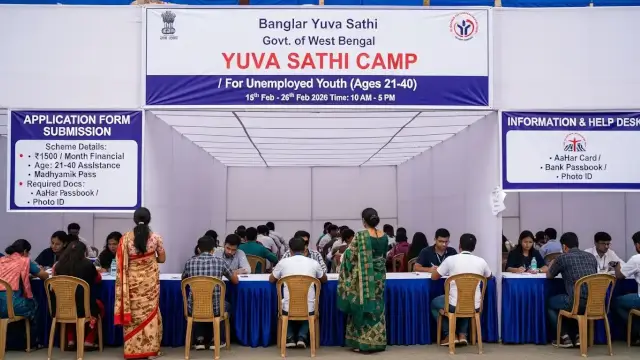
Offline applications are accepted too: you can submit the physical form at your BDO office, municipality, municipal corporation or a Duare Sarkar camp. One account or phone number is allowed per application, and the window remains open until August 29, 2026.
Status Check and NPCI DBT Linking
To check where your application stands, open the portal and use "Track Applicant Status" with your Application Reference Number. The Economic Times' July 1 guide lists the full flow: open the portal, open the status section, enter your details, and verify the bank account shown. Statuses typically read Submitted, Under Process, Approved, Payment Pending, Payment Failure or Rejected.
For DBT to work, your Aadhaar must be seeded to the correct bank account on NPCI's BASE (Bank Aadhaar Seeding Enabler) system. As Moneycontrol and Mathrubhumi explain, you can check and enable mapping at npci.org.in under Customer, then Bank Aadhaar Seeding Enabler (BASE), then Aadhaar Mapped Status, entering your 12-digit Aadhaar and completing OTP verification. Our step-by-step NPCI DBT Link 2026 guide walks through the whole seeding process, and the district-wise name list is live in our Annapurna Bhandar District Wise List 2026.
Need human help? The Annapurna Bhandar helpline 8282082820 operates Monday to Friday, 9 AM to 6 PM, per The Economic Times' helpline round-up of July 14, 2026. You can also approach the Department of Women and Child Development and Social Welfare at Bikash Bhaban, Salt Lake, Kolkata 700091, or your nearest Duare Sarkar camp.
Budget, Applications and the Verification Funnel
Behind the monthly ₹3,000 credit sits a budget line, an application funnel and a fraud purge. These three number blocks explain why some women were paid on day one while others are still waiting - and why the state says a tighter, verified list will pay more to those who genuinely qualify.
The ₹36,000 Crore Budget Line
The scheme has serious money behind it. In the BJP government's maiden West Bengal budget on June 22, 2026, Finance Minister Swapan Dasgupta earmarked ₹36,000 crore for Annapurna Bhandar for the 2026-27 financial year, as reported by PTI, The Hindu BusinessLine and The Economic Times. It is one of the largest single-scheme allocations for women's welfare in the state's history. The same budget set aside a separate ₹550 crore for the bundled free bus travel scheme for women, which started on June 1, 2026, with smart cards being issued to women travellers. The math explains the verification push. At ₹3,000 per woman per month, the annual cost works out to ₹36,000 per beneficiary, so the full budget line covers close to 1 crore women for the year. Every ineligible account that survives verification therefore costs the exchequer ₹36,000 annually - and the government keeps citing the alleged ₹5,400 crore welfare leak in the old rolls, reported by Times Now, to justify the purge-first approach.
Applications vs Rejections - The Funnel So Far
The intake numbers tell the real story. West Bengal received roughly 1.6 crore applications in the first window. Chief Minister Suvendu Adhikari said on July 1, 2026 that 26 lakh of those were rejected after scrutiny, largely over citizenship doubts and electoral-roll mismatches, according to Livemint. By July 13, the rejected count had climbed to 27.8 lakh forms. On the payout side, the launch-day instalment on June 3 reached exactly 28,25,769 women, per ClearTax's tracking, before the July 1 second instalment pushed paid coverage past 1.1 crore. Verification of pending applications runs until August 30, 2026, so the funnel keeps releasing newly approved beneficiaries into the payment system every week. Each new approval moves straight into the next DBT batch once NPCI mapping is confirmed, which is why the August instalment is landing in phases rather than on one day.
From Lakshmir Bhandar Rolls to a Verified List
The predecessor scheme had a long run. Lakshmir Bhandar was launched in August 2021 as monthly income support for women heads of households, and by October 2023 it had crossed roughly 2 crore beneficiaries, according to The Times of India. It paid ₹500 a month to general-category women and ₹1,000 to SC/ST women, a structure later revised so that most beneficiaries drew between ₹1,500 and ₹1,700 depending on category, as Financial Express detailed. Eligibility spanned women aged 25 to 60. The Hindu reported on May 29, 2026 that the new government believes around 30 lakh accounts on the old rolls were ineligible - either non-Indian or deleted from electoral lists. Annapurna Bhandar triples the floor to a flat ₹3,000 for every eligible woman, but demands fresh documentation from everyone, even women who drew Lakshmir Bhandar payments for years. Budget reporting by Deccan Herald and PTI suggests the verified count will settle near 1 crore initially, down from the claimed 2.4 crore legacy base, before climbing toward the 2 crore target as corrections, appeals and new applications clear through the year.
Why the Scheme Matters for West Bengal
With 1.1 to 1.3 crore women already paid and a target near 2 crore, Annapurna Bhandar is transferring roughly ₹3,300-3,900 crore every month into household budgets - money that goes predominantly to food, health and children's schooling. For a state of about 100 million people, that is one of the largest ongoing cash-support programmes in India, and the flat ₹3,000 structure removes the category disputes that dogged Lakshmir Bhandar.
There are legitimate concerns: the 27.8 lakh rejections show verification can cut both ways, portal outages frustrate applicants, and payment-failure statuses demand better DBT hygiene. But the state's willingness to let rejected applicants correct forms, the monthly cadence of the first two instalments, and the active helpline suggest a system that - while imperfect - is functioning at scale. The coming September instalment will be the real test of whether the last-mile gaps have been closed.
Conclusion
The Annapurna Bhandar Yojana 2026 has moved from announcement to mass payout in just two months: ₹3,000 a month, a flat rate for every eligible woman, ₹1.1 crore-plus beneficiaries already covered, and a third instalment rolling through August in phases. If you are eligible and have not applied, the window closes on August 29, 2026 - apply on socialregistry.wb.gov.in, keep Aadhaar, EPIC and your bank passbook ready, and make sure NPCI seeding is complete. If you were rejected, check your status and prepare a correction or appeal rather than starting over.
Bookmark this page: we update the payment schedule, rejection data and portal changes as official notifications land. For most women in West Bengal, this scheme is now the single largest source of assured monthly income support available.
Frequently Asked Questions

SK Jabedul Haque
Building India's most trusted finance education platform — simplifying news, schemes and market trends so anyone can understand and invest confidently.
Read full bio
Never miss an update
Get our clearest explainers on schemes, markets and money — read what matters, without the noise.
Explore more articles