NemoClaw vs OpenClaw
NemoClaw vs OpenClaw: What Is Being Compared?
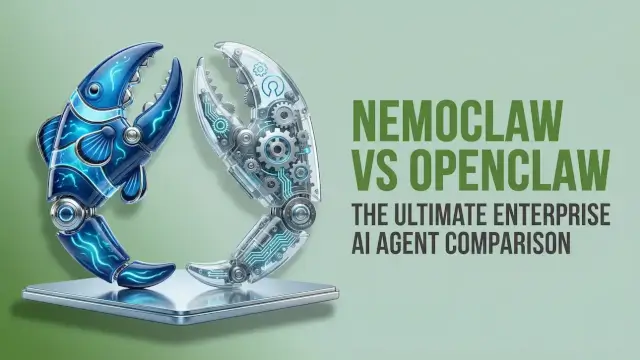
NemoClaw and OpenClaw operate at different layers. OpenClaw is an open-source personal AI assistant that can run on a user's machine and connect to channels, tools, files and network services. NemoClaw is an NVIDIA open-source reference stack for running supported AI agents more safely inside NVIDIA OpenShell sandboxes.
That distinction prevents a misleading feature checklist. OpenClaw is the assistant and gateway experience. NemoClaw is an opinionated installation, policy and lifecycle path around a sandboxed agent. In the documented default path, NemoClaw can install and launch OpenClaw, but it can also support other agents such as Hermes and LangChain Deep Agents Code.
The right question is not which name sounds more advanced. The right question is where the trust boundary should sit, which agent and inference provider you need, how much host access is acceptable, and whether your team can operate the resulting system.
For adjacent agent architecture, read our multi-agent protocols guide. For a broader model view, see our best AI models guide.
What You'll Learn
- How the OpenClaw assistant differs from the NemoClaw reference stack.
- How gateways, agents, providers and OpenShell sandboxes fit together.
- How to assess installation, migration, messaging and operational risk.
- How to choose a deployment path without claiming unsupported performance.
What OpenClaw Provides
OpenClaw is built around a gateway that receives requests, routes them to an agent and exposes selected capabilities. Depending on configuration, the assistant can execute shell commands, read and write files, access network services and send messages through connected channels. Those capabilities make the tool useful, but they also make configuration and trust boundaries part of the product design.
The official OpenClaw security guidance describes a personal-assistant security model. It supports one user or trust boundary per gateway and does not treat one shared gateway as a hostile multi-tenant boundary for mutually untrusted users. If several untrusted users can message one tool-enabled agent, they share that agent's delegated authority.
OpenClaw's normal controls include gateway authentication, device pairing, direct-message policy, channel and group allowlists, tool policy, sandbox settings and host isolation. A session identifier is a routing selector, not an authorization token. A person who can modify the gateway host state or configuration should be treated as a trusted operator.
This model is suitable for a controlled personal assistant or a separately isolated team cell. It should not be described as a universal enterprise isolation layer without checking the actual gateway, host, user and channel design.
What NemoClaw Adds Around an Agent
NemoClaw adds a maintained setup path around supported agents. NVIDIA describes it as an open-source reference stack that installs OpenShell, prepares agent-specific integration, applies policy and network choices, and provides sandbox lifecycle commands. The goal is to make the execution boundary explicit before an always-on assistant receives tools or messages.
The NemoClaw quickstart uses OpenClaw as the default agent choice. It asks the operator to choose an inference provider and model, choose optional web search or messaging, and accept a policy tier when the selected platform path requires it. The installer can then create a named sandbox and expose commands for status, connection, dashboard access and launch.
NemoClaw does not turn model output into a guarantee of safe behavior. A sandbox limits the blast radius of an agent, while identity, network policy, secrets, dependency review and application-level controls still determine what the system can do. The stack is a reference implementation, so teams must validate its current supported platforms and release behavior before production use.
For a related view of agentic development tools, read our agentic coding guide. The comparison below keeps the assistant layer separate from the runtime and policy layer.
Architecture and Trust Boundaries
A useful architecture has four parts. The user or channel submits an instruction. The gateway authenticates and routes it. The agent decides how to respond or which tool to request. The runtime applies the host, filesystem and network boundary. NemoClaw places the agent inside an OpenShell sandbox, while a standalone OpenClaw deployment requires the operator to configure the relevant isolation and host controls.
| Layer | OpenClaw role | NemoClaw role |
|---|---|---|
| Assistant | Provides the personal assistant, gateway and channel workflow. | Uses OpenClaw by default or another supported agent selected during onboarding. |
| Control plane | Gateway authentication, routing, tools, policies and device pairing. | Onboarding choices, sandbox lifecycle, agent integration and launch preflight. |
| Execution boundary | Depends on configured host execution and optional sandbox settings. | OpenShell sandbox with policy and network choices around the selected agent. |
| Inference | Uses the model and provider configured for the assistant. | Wizard supports hosted providers, compatible endpoints and selected local runtimes. |
Use this model when reviewing risk. A policy that blocks a network destination does not replace identity checks. A gateway allowlist does not make an unrestricted host safe. A container does not automatically protect a secret if the secret is passed to an untrusted process. Security comes from the combined boundary and from verifying what the running configuration actually permits.
Installation Prerequisites and Supported Environments
Start with readiness, not the installer command. NVIDIA's quickstart recommends checking the operating system, architecture, product and firmware identity, GPU and memory, NVIDIA driver, Container Toolkit, Docker, Node.js, disk space, existing services, relevant ports and administrator access. The platform classification affects which local runtimes and express paths can be offered.
The official setup documentation covers Linux and macOS paths and includes platform-specific guidance for DGX systems and Windows Subsystem for Linux when the environment is detected. On Linux, the installer can install Docker. On macOS, Docker Desktop or Colima must be running before installation. A Docker command blocked by a coding-agent execution sandbox should be approved narrowly rather than by changing socket permissions broadly.
The hosted installer follows the maintained last-known-good release by default. It can be run interactively, or environment variables can provide the agent, provider and sandbox name for a non-interactive path. Third-party software acceptance and administrator access must be handled deliberately. Credentials should be collected through a secure local mechanism rather than pasted into chat or a command argument.
NemoClaw's documentation includes special handling for platform-specific preview paths. For example, an N1x path is described as a Deferred managed-vLLM preview pending physical end-to-end validation. That is not evidence that every NVIDIA system or ordinary computer has the same local-runtime support.
Inference Providers and Model Choices
NemoClaw separates the agent choice from the inference provider. The quickstart documents options including NVIDIA Endpoints, OpenRouter, OpenAI, Anthropic, Google Gemini, local Ollama, OpenAI-compatible endpoints, Anthropic-compatible endpoints and configured model-router profiles. Provider selection determines which credential, endpoint and model configuration must be available.
| Provider path | Typical use | What to verify |
|---|---|---|
| Hosted provider | Use a remote model service without downloading a local model. | Credential scope, data handling, rate limits, model availability and billing. |
| OpenAI or Anthropic compatible endpoint | Connect an agent to a service that implements the relevant API shape. | Endpoint compatibility, model identifier, authentication and tool behavior. |
| Local Ollama | Run a supported local model where the agent and platform permit it. | Installed service, model memory needs, port exposure and update process. |
| Local or managed vLLM | Use a local inference runtime on an eligible supported platform. | Hardware readiness, download size, model support and preview status. |
| Google Gemini | Use Google's hosted model API with a Gemini credential. | API key handling, model support, request limits, data terms and cost. |
Do not attach a benchmark score to one provider from the architecture documentation. The sources used for this rewrite document integration paths and security behavior, not a controlled head-to-head accuracy or latency test. If model quality matters, create a task-specific evaluation set and compare the chosen models using the same prompts, tools, context and hardware.
For a broader discussion of multimodal model systems, see our multimodal AI guide. For another infrastructure boundary, read our edge inference guide.
OpenShell Sandbox and Policy Controls
The important NemoClaw question is not whether a sandbox exists in a diagram. It is what the sandbox allows at runtime. The onboarding flow asks for choices that can affect network access, optional web search, messaging bridges, provider credentials and agent behavior. Changing some choices later can require sandbox recreation.
Use a restrictive starting policy and add only the endpoints the assistant needs. If an application needs a messaging channel, identify the exact channel, token, user scope and outbound destinations before enabling it. If it needs web search, review that network path separately from the model provider path.
The quickstart exposes a status command for checking sandbox readiness. It also describes a launch command that runs preflight checks. On macOS, launch runs the complete preflight every time. On Linux, the documentation describes a fixed 24-hour launch-readiness lease, and says that configuration or live-runtime changes invalidate prior evidence before a new preflight.
That behavior is useful operational evidence, not a substitute for change management. Record which agent, provider, model, policy and channels were selected. Recheck the sandbox after upgrades, credential changes, policy edits and host changes. Do not assume that a successful installation means the current runtime still has the same boundary.
OpenClaw Security Model and Enterprise Limitations
OpenClaw's official security guidance is direct about its threat model. An assistant with shell access can execute commands, read or write files, access network services and send messages when channel access is granted. A person who messages the bot may try to manipulate it, socially engineer access or probe infrastructure details.
The documented security order is identity first, scope next and model last. In practice, decide who can talk to the bot through pairing or allowlists. Decide where the bot can act through group rules, mention gating, tool policy, sandboxing and device permissions. Then assume the model can be manipulated and design for a limited blast radius.
| Control | What it addresses | What it does not prove |
|---|---|---|
| Gateway authentication | Whether a caller can reach the gateway control plane. | That the caller is a separate hostile tenant inside the same trusted gateway. |
| DM pairing | Whether an unknown sender is approved before messages are processed. | That an approved user cannot manipulate the agent or misuse its tools. |
| Group and channel allowlists | Which rooms or senders can reach the assistant. | That the selected agent has a safe host or filesystem boundary. |
| Exec approvals | Guardrails for operator intent and selected commands. | Hostile multi-tenant isolation or complete semantic control over every interpreter path. |
| Separate host or OS user | A stronger trust boundary between untrusted users or organizations. | Correct configuration of the application, secrets, network and model policy. |
OpenClaw supports direct-message policies such as pairing, allowlist, open and disabled. The documented default pairing flow says codes expire after one hour and pending requests are capped at three per channel. The open policy is an explicit opt-in and should not be treated as a safe default for a mixed-trust room.
NemoClaw can reduce runtime exposure by placing a supported agent in an OpenShell sandbox, but it does not remove the need for OpenClaw identity controls or separate trust boundaries. For a security-oriented companion, read our AI cybersecurity guide and our agentic AI security risks guide.
Migration from OpenClaw to NemoClaw
Migration should be treated as a boundary change, not as a package replacement. Begin by inventorying the existing gateway, agent configuration, channels, credentials, plugins, workspace data, scheduled tasks and host permissions. Record which items are required and which were enabled during experimentation.
Create a separate test sandbox and select OpenClaw as the agent. Choose the provider and model deliberately, then decide whether web search and messaging belong in the first build. Import only the configuration and data that the test requires. Do not copy unknown plugins or host credentials into the new boundary simply because the old assistant used them.
Run a functional test for each important path. Check direct messages, group allowlists, tool calls, file access, network requests, model responses, errors, logs and restart behavior. Compare the actual behavior with the intended policy. A migration is not complete when the dashboard opens. It is complete when the allowed workflows work and the denied workflows fail in a reviewable way.
After the test, decide whether to keep the old gateway, retire it or run separate isolated cells. OpenClaw's documentation recommends separate gateways, and ideally separate OS users or hosts, when users are mutually untrusted. NemoClaw's sandbox can complement that separation but should not be used to justify sharing one gateway across unrelated trust domains.
For a related agent comparison, see our agent swarms architecture guide. It is useful when deciding whether one assistant or several isolated workers fit the workload.
Operations, Monitoring and Change Control
An always-on assistant needs an operational routine. Store the selected configuration in version control without committing secrets. Maintain a provider and model inventory. Record policy changes, sandbox recreation, plugin changes, channel additions and host updates. Define who can approve a change and who can review the resulting behavior.
Use the documented status and launch checks after installation. Review gateway logs and agent errors without copying sensitive prompts or credentials into general-purpose log stores. Monitor outbound destinations, tool use, resource consumption and failed authentication. Keep a tested rollback path for the agent configuration and the host runtime.
Run OpenClaw's security audit after configuration changes or before exposing a network surface. The documentation says the audit checks inbound access, tool blast radius, execution settings, network exposure, browser control, local disk hygiene, plugins, policy drift and model hygiene. A clean audit is evidence about the checked configuration at that time, not a permanent security certificate.
For teams comparing coding-agent operations, our Codex and Claude Code analysis provides another example of separating model capability from execution permissions. The same principle applies here.
Common Problems and Practical Fixes
Installation failures are often caused by an unready runtime rather than by the agent itself. Check Docker, administrator access, Node.js, disk space, ports and platform detection first. If the installer reports that a new group must be applied, follow the official instruction before retrying. Do not launch duplicate installers or model servers while the first process is still running.
If an agent cannot reach a provider, verify the provider name, credential variable, endpoint and model identifier. A valid API key for one provider is not automatically valid for another. If a local runtime is selected, check that the service is running on the expected interface and that the sandbox policy permits the required connection.
If messages fail, review the selected channel, token, allowlist, group policy and mention behavior. If a workflow changed after onboarding, rerun the documented onboarding path and accept sandbox recreation when required. If the launch command stops during preflight, treat the message as a configuration or authority signal rather than bypassing the check.
If the assistant can perform too much, reduce tool access, tighten the policy, close public DM or group settings, and separate the gateway from other users. If a secret may have been exposed, rotate it and review logs. A prompt change alone is not a security fix for an exposed runtime.
Which Should You Choose: NemoClaw or OpenClaw?
| Situation | Starting choice | Reasoning |
|---|---|---|
| Personal assistant on a controlled machine | OpenClaw with explicit pairing, allowlists and host controls. | Use the direct assistant workflow when the operator owns the trust boundary. |
| OpenClaw with a stronger runtime boundary | NemoClaw with OpenShell and a reviewed policy. | Add the reference stack when sandbox lifecycle and policy setup are useful. |
| Prototype on eligible NVIDIA hardware | NemoClaw after readiness and platform checks. | Evaluate supported local runtimes or hosted providers without assuming universal hardware support. |
| Mixed-trust users or organizations | Separate gateways, OS users or hosts first. | Do not use one shared gateway as the isolation boundary for hostile tenants. |
| Production deployment | Either path only after an evidence-based security and operations review. | Check identity, tools, filesystem, network, secrets, model behavior, cost and rollback. |
Choose OpenClaw when the assistant workflow is the main requirement and the operator can maintain its gateway and host boundary. Choose NemoClaw when you specifically need its supported agent onboarding, OpenShell sandbox, policy choices and lifecycle checks. Choose neither as a substitute for a threat model, change control and separate trust boundaries.
There is no verified basis in the sources used here for declaring a universal performance winner between NemoClaw and OpenClaw. NemoClaw changes the runtime and operating path around an agent. OpenClaw defines the assistant and gateway experience. Measure the complete system on your own tasks, providers, channels and hardware before making a deployment decision.
Frequently Asked Questions

SK Jabedul Haque
Building India's most trusted finance education platform — simplifying news, schemes and market trends so anyone can understand and invest confidently.
Read full bio

Never miss an update
Get our clearest explainers on schemes, markets and money — read what matters, without the noise.
Explore more articles