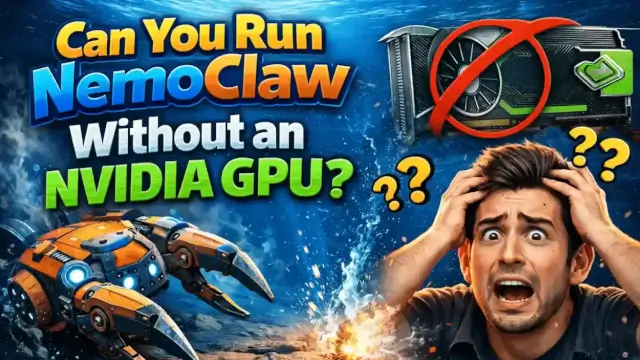
Can You Run NemoClaw Without an NVIDIA GPU?
What You'll Learn
- What NemoClaw does and why the GPU question depends on the provider
- How local NVIDIA inference differs from hosted or compatible endpoints
- What CPU only, AMD, macOS, and ordinary Linux users should verify
- How OpenShell policies, credentials, network rules, and readiness checks affect setup
What Is NVIDIA NemoClaw?
Can You Run NemoClaw Without an NVIDIA GPU? The direct answer is conditional. NemoClaw is an open source reference stack for running supported AI agents more safely inside NVIDIA OpenShell sandboxes. NVIDIA describes it as a layer for guided onboarding, managed inference, network policy, managed integrations, and lifecycle operations.
NemoClaw is not itself a GPU driver and it is not identical to a local model server. It installs or configures the OpenShell sandbox, applies an agent integration layer and a versioned blueprint, and helps connect an inference provider. The model may run locally on the host or remotely through a supported hosted route.
NVIDIA announced NemoClaw on March 16, 2026 for the OpenClaw agent platform. The announcement says it can use local open models on a dedicated system or route frontier models in the cloud through a privacy router. That distinction is the foundation of the hardware answer.
| Layer | Role | GPU question |
|---|---|---|
| Agent runtime | OpenClaw, Hermes, or Deep Agents Code | Depends on its supported setup |
| NemoClaw CLI | Onboarding, routing, lifecycle, and policy operations | Does not equal local model inference |
| OpenShell | Sandbox, credentials, and network controls | Needs supported host software |
| Inference provider | Local model, hosted endpoint, or compatible API | Determines where compute runs |
Can You Run NemoClaw Without an NVIDIA GPU?
Yes, a non-NVIDIA machine may be able to run a NemoClaw path that uses a supported hosted or compatible inference provider, provided the operating system, Docker, Node.js, administrator access, network policy, and agent requirements are satisfied. This is not the same as saying that every NemoClaw feature or local model route works without NVIDIA hardware.
The official docs require a readiness check rather than a blanket hardware promise. That check examines the operating system, architecture, product and firmware identity, GPU and memory, NVIDIA driver, Container Toolkit, Docker, Node.js, disk space, ports, administrator access, and existing services. If the machine is uncertain, NemoClaw's preflight should make the final platform decision.
A practical answer therefore has two parts. For hosted inference, the local computer primarily runs the agent sandbox and provider connection. For local inference, the host must satisfy the selected runtime and model requirements. Readers should not choose a local NVIDIA model merely because the NemoClaw command itself starts.
Local Inference Versus Hosted Inference
Local inference means the model weights and inference process run on hardware you control. It can reduce dependence on a remote provider and may support a stronger privacy posture, but it needs compatible compute, memory, drivers, containers, model storage, and a supported runtime.
Hosted inference means a provider runs the model elsewhere and NemoClaw routes requests through a configured endpoint. The local machine still needs to run the agent integration and sandbox, but it may not need an NVIDIA GPU for the model computation. Provider authentication, billing, network access, latency, data retention, and service limits still matter.
NVIDIA's announcement describes this local and cloud combination as a privacy router model. The AI agent guide explains why an agent runtime and a model provider should be evaluated separately. The Llama 4 Maverick guide covers the related difference between downloadable weights and the cost of real inference.
What NVIDIA Hardware Does NemoClaw Target?
NVIDIA's official announcement names dedicated NVIDIA GeForce RTX PCs and laptops, NVIDIA RTX PRO workstations, DGX Station, and DGX Spark as dedicated platforms for NemoClaw for OpenClaw. NVIDIA says these systems can provide local computing for autonomous agents that run around the clock.
That list describes NVIDIA's target local platforms. It does not mean an NVIDIA GPU is required for every hosted route, and it does not mean every RTX model has the same memory or runtime support. The official prerequisites and platform-specific instructions are more authoritative than a generic GPU label.
| Machine situation | Likely question | Safe interpretation |
|---|---|---|
| Dedicated RTX PC or laptop | Can local workloads fit the memory and provider rules | Check the current local-runtime eligibility |
| RTX PRO workstation | Is the system intended for sustained agent work | Verify driver, container, memory, and model support |
| DGX Station or DGX Spark | Does the platform asset apply | Use the matching official instructions after readiness detection |
| No NVIDIA GPU | Can a hosted route run on this host | Check the selected agent and provider path |
Supported Agents and the OpenShell Sandbox
The official NemoClaw documentation and GitHub repository list OpenClaw as the default supported agent, along with Hermes and LangChain Deep Agents Code. The selected agent matters because installation choices, provider support, local runtime options, messaging, and lifecycle commands can differ.
OpenShell is the isolation and policy layer beneath the stack. The documentation says NemoClaw installs OpenShell, uses it for sandboxing, and provides credential custody for managed inference and host-configured integration credentials. This is useful even when the model is hosted because the agent can still access files, tools, and network endpoints.
Do not treat the sandbox as a substitute for hardware. A sandbox controls execution and permissions. It does not make a CPU perform a GPU-only local model efficiently, and it does not turn an unsupported provider route into a supported one. Read the AI model comparison before assuming that a model name alone answers a deployment question.
CPU Only Machines and Local Models
A CPU-only host may be able to run the NemoClaw control path and a hosted inference route, but local model execution is a separate decision. Large models can require substantial memory and can be slow or impractical on a general CPU. A smaller local model or a remote endpoint may be a better fit, subject to the current provider documentation.
Do not infer support from the fact that the installer launches. A successful CLI installation proves only that the setup command ran. The official quickstart says to verify the provider, model, sandbox status, inference route, and agent response after onboarding.
For a CPU-only experiment, start with a read-only readiness check. Confirm Docker, Node.js, disk space, administrator access, ports, and the selected provider. The offline model guide gives useful context on storage, memory, and local inference tradeoffs without turning one device profile into a universal requirement.
AMD and Non NVIDIA Hardware
An AMD GPU or an integrated graphics system should not be described as automatically supported or automatically blocked without checking the current NemoClaw prerequisites. The official docs separate platform detection from provider selection and instruct the setup flow to examine the machine before showing runtime choices.
The safest conclusion is narrower. Hosted inference may be possible if the chosen agent and provider support the operating system and sandbox. Local inference depends on the runtime, drivers, model format, memory, and official support for that hardware. A compatible endpoint may be more practical than forcing a local NVIDIA-specific path on an AMD machine.
MacOS and ordinary Linux users should also distinguish operating-system support from local model support. The official guide includes hosted and compatible provider routes, but the exact options are filtered by the selected agent and detected platform. Use the free AI tools guide for a separate comparison of hosted access and plan limits.
Software Prerequisites and Readiness
Before provider selection, the NemoClaw documentation says the readiness process should inspect the distribution, architecture, product and firmware identity, GPU and memory, NVIDIA driver, Container Toolkit, Docker, Node.js, disk space, existing NemoClaw or model services, relevant ports, and administrator access.
Do not paste passwords or API keys into chat or into a blog tutorial. The official docs describe secure credential handling and approval before commands that install software, change the system, create a sandbox, or start a long-running process. A safe installation records what was checked and verifies results after the important commands.
| Check | Why it matters | What to record |
|---|---|---|
| Operating system and architecture | Determines supported installation path | Distribution, version, and CPU architecture |
| GPU, memory, and driver | Determines local inference options | Detected hardware and driver status |
| Docker, Node.js, and disk | Supports sandbox and CLI operations | Versions, free space, and permissions |
| Ports and existing services | Prevents conflicts and duplicate servers | Occupied ports and active runtimes |
Providers and Model Routing
NemoClaw documentation includes routes for NVIDIA Endpoints, OpenRouter, OpenAI, Anthropic, Google Gemini, model routing, existing local servers, Ollama, vLLM, llama.cpp, NVIDIA NIM, and compatible endpoints. Those are provider paths in the documentation. They are not a guarantee that every route appears or works on every machine.
A no-GPU user should start by asking where the model will run. If it will run in a hosted service, verify the provider key, endpoint, model availability, network policy, data retention terms, and rate limits. If it will run locally, verify the exact runtime, model, driver, memory, and platform support before downloading anything large.
The coding agent cost guide explains why repeated calls and context can change the real cost of an agent. Provider choice should consider retries, tool calls, monitoring, and human review, not only the price of one model response.
Security, Permissions, and Network Policy
NemoClaw's value is not limited to inference. NVIDIA describes OpenShell as an isolated sandbox with policy-based security, network, and privacy guardrails. The user guide includes network policy, credential custody, sandbox hardening, filesystem controls, process controls, and monitoring.
Use least privilege. A read-only workspace is safer than a production directory. A restricted network allowlist is safer than unrestricted egress. A draft action is safer than an automatic purchase, deletion, account change, or message send. Require approval before consequential actions and keep secrets out of prompts, logs, and source files.
The RAG guide is relevant when an agent reads external documents because retrieved content can contain malicious instructions. Sandboxing reduces blast radius, but it does not remove the need for source validation and human oversight.
Troubleshooting and Decision Checklist
If NemoClaw cannot start, first separate an installation problem from an inference problem. Check whether the sandbox exists, whether the selected agent is running, whether the provider route validates, whether the model is available, and whether network policy blocks the request. Do not repeat an installer blindly if the first result is unclear.
If local inference fails on a non-NVIDIA host, do not assume that a hosted route has also failed. Re-run the official readiness and provider checks, then choose a supported endpoint or a documented local runtime. If a port is occupied, identify the existing service before stopping anything. Preserve logs without exposing credentials.
Use the official NemoClaw quickstart, prerequisites, and GitHub repository for current version-specific instructions. The Llama 4 guide provides additional context on model downloads and deployment cost.
| Question | If yes | If no |
|---|---|---|
| Will the model run remotely | Check provider, credentials, network, and policy | Continue to local hardware and runtime checks |
| Does readiness recognize the platform | Follow the matching official path | Let official preflight decide or stop before install |
| Is the local runtime supported | Confirm model, memory, driver, and storage | Use a supported hosted or compatible route |
| Can the agent action be reversed | Log it and test in a restricted sandbox | Require human approval before execution |
Final Verdict: Can You Run NemoClaw Without an NVIDIA GPU?
You may be able to run NemoClaw without an NVIDIA GPU when the selected route uses hosted or compatible inference and the host passes the current software, sandbox, agent, and provider checks. You should not claim that this enables every local model path. NVIDIA positions local always-on compute around dedicated RTX, RTX PRO, DGX Station, and DGX Spark systems, while cloud routing moves model computation away from the local machine.
The practical rule is simple. First identify the agent. Then run readiness. Next decide where inference will run. Finally verify the provider, model, sandbox, network policy, credentials, and response. If any of those steps is uncertain, stop before a large download or system change and use the official version-specific documentation.
Frequently Asked Questions

SK Jabedul Haque
Building India's most trusted finance education platform — simplifying news, schemes and market trends so anyone can understand and invest confidently.
Read full bio

Never miss an update
Get our clearest explainers on schemes, markets and money — read what matters, without the noise.
Explore more articles