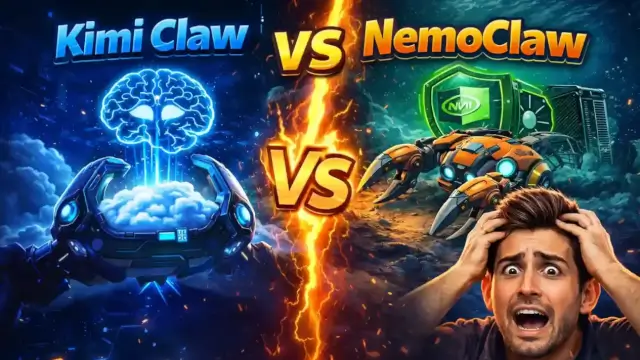
Kimi Claw vs NemoClaw
What You'll Learn
- ✓ What OpenClaw is and why it matters for AI agents in 2026
- ✓ Kimi Claw's full feature set, pricing tiers and Kimi K2.6 upgrade
- ✓ How NemoClaw's OpenShell sandbox secures enterprise deployments
- ✓ Which platform is right — personal productivity vs enterprise security
Why the OpenClaw Platform Matters in 2026
OpenClaw launched on January 25, 2026, built in roughly an hour by Austrian developer Peter Steinberger. Within weeks it had become one of the fastest-growing open-source repositories in GitHub history — an AI agent anyone could run locally to organise files, write code, and browse the web without routing data through a cloud. That kind of unchaperoned access was, for millions of individuals, exactly what they wanted. For enterprise IT teams, it was both the opportunity and the problem.
Two major players moved quickly. Moonshot AI launched Kimi Claw on February 15, 2026 — a cloud-native, one-click deployment of OpenClaw that runs in your browser tab 24/7. NVIDIA announced NemoClaw at its GTC 2026 conference on March 16, 2026 — a single-command enterprise security stack that wraps OpenClaw with policy-based guardrails, local model execution, and hardware-level sandboxing.
Understanding both requires understanding that they are not competitors — they solve fundamentally different problems on the same underlying platform.
Kimi Claw: Moonshot AI's Cloud Agent Platform
Kimi Claw is Moonshot AI's managed, cloud-hosted implementation of OpenClaw. The core promise: deploy a professional-grade AI agent in 30 seconds, no terminal commands, no Docker setup, no VPS configuration. The agent runs continuously in Moonshot's cloud — monitoring workflows, executing scheduled tasks, and triggering notifications even when your laptop is closed.
Kimi Claw is powered by Kimi K2.6, released April 20, 2026 — a 1-trillion-parameter Mixture-of-Experts model that ties GPT-5.5 on SWE-Bench Pro at 58.6% and leads on Humanity's Last Exam with tools at 54.0%. With 32 billion active parameters per request and a 256K token context window, K2.6 delivers frontier-level performance at roughly 80% lower cost per million tokens than comparable closed models.
Kimi Claw Key Features
- › ClawHub Marketplace — 5,000+ community-contributed pre-built skills for task automation and complex workflow chains
- › 40GB Cloud Storage — Persistent files, long-term memory, and document processing
- › Agent Swarm — Up to 300 parallel sub-agents with 4,000 coordinated steps and 12-hour autonomous sessions (Allegretto tier and above)
- › Pro-Grade Search — Real-time data retrieval including Yahoo Finance for live, time-sensitive queries
- › Claw Groups (Preview) — Multiple agents and humans operating as collaborators in a shared space, with agents from any device or model
- › BYOC (Bring Your Own Claw) — Connect existing OpenClaw instances to Kimi's interface for hybrid local+cloud workflows
- › Telegram/WhatsApp Integration — Group chat automation and notification delivery
Kimi Claw Pricing Tiers (2026)
| Plan | Price | Key Feature |
|---|---|---|
| Moderato | $19/month | K2.6 chat, Deep Research, Kimi Code |
| Allegretto | $39/month | Agent Swarm (up to 300 agents), Kimi Claw cloud deployment |
| Allegro | $99/month | More Kimi Code credits, larger Professional Data quota |
| Vivace | $199/month | Maximum agent credits, enterprise data limits |
API access is billed separately at approximately $0.55–$0.95 per million input tokens and $2.65–$4.00 per million output tokens depending on provider — making Kimi K2.6 one of the most cost-competitive frontier models available. Self-hosting on a $2/month VPS with local OpenClaw is technically possible, but Kimi Claw's convenience layer costs 20x more for a reason: zero infrastructure management.
Privacy and Security Concerns with Kimi Claw
Kimi Claw's biggest limitation is also its origin. Moonshot AI is a Beijing-based company backed by Alibaba (which holds a 36% stake), incorporated in Singapore, and running infrastructure on Alibaba Cloud. The Institute for AI Policy and Strategy (IAPS) published a detailed memo in February 2026 warning that an always-on AI agent with access to files, apps, and communications — hosted by a company subject to Chinese law — represents a qualitatively deeper data exposure risk than TikTok.
For individual users without compliance requirements, this is a calculated convenience tradeoff. For enterprise teams handling regulated data — healthcare, finance, government — Kimi Claw is essentially off the table. That is precisely the gap NemoClaw was built to fill.
NemoClaw: NVIDIA's Enterprise Security Stack for OpenClaw
NemoClaw is not a cloud service. It is a free, open-source software stack from NVIDIA that installs on top of OpenClaw in a single command, transforming any local deployment into an enterprise-grade agentic platform. Announced at NVIDIA GTC 2026 in San Jose on March 16, 2026, NemoClaw was built in direct collaboration with OpenClaw creator Peter Steinberger.
Jensen Huang's framing at GTC was deliberate: "Mac and Windows are the operating systems for the personal computer. OpenClaw is the operating system for personal AI. This is the moment the industry has been waiting for — the beginning of a new renaissance in software." NemoClaw is NVIDIA's answer to the question of what happens when that operating system needs to run inside a regulated enterprise.
NemoClaw Core Components
- › NVIDIA OpenShell — Open-source security runtime with kernel-level sandboxing. Rules defined in YAML files specify exactly which files agents can access, which network connections they can make, and which cloud services they can call. Security is structural — enforced outside the agent's own process, so even a compromised agent cannot bypass restrictions.
- › Nemotron Local Models — NVIDIA's open model family runs entirely on local hardware. Nemotron-3-Super scored highest among all open models on PinchBench (the primary OpenClaw benchmark). No data leaves the premises for local inference.
- › Privacy Router — Monitors agent behavior and controls communication with cloud-based frontier models. Agents can still access OpenAI, Anthropic, and other providers, but only within defined guardrails.
- › Hardware Agnostic Deployment — Runs on GeForce RTX PCs/laptops, RTX PRO workstations, DGX Station, DGX Spark, and community setups like Mac minis.
NemoClaw is also working with Cisco, CrowdStrike, Google, and Microsoft Security to bring OpenShell compatibility to their security tools, embedding agent guardrails into the broader enterprise security stack rather than treating them as a separate layer.
Kimi Claw vs NemoClaw: Head-to-Head Comparison
| Feature | Kimi Claw | NemoClaw |
|---|---|---|
| Launched | February 15, 2026 | March 16, 2026 (GTC) |
| Built By | Moonshot AI (Beijing/Alibaba-backed) | NVIDIA (GTC 2026, San Jose) |
| Deployment | Cloud-only (browser tab) | Local / On-premises / Hybrid |
| AI Model | Kimi K2.6 (1T MoE, SWE-Bench 58.6%) | Nemotron (local) + any cloud model |
| Security Layer | Cloud isolation only | OpenShell: kernel sandbox + YAML policies |
| Skills / Marketplace | 5,000+ ClawHub community skills | Any OpenClaw skills + NVIDIA blueprints |
| Multi-Agent | Up to 300 parallel sub-agents | Unlimited (hardware-bound) |
| Pricing | $19–$199/month | Free (open-source); hardware cost varies |
| Data Privacy | Data on Moonshot/Alibaba Cloud servers | Fully local; cloud only via privacy router |
| Best For | Individual productivity, no-setup users | Enterprise, regulated industries, compliance |
Who Should Use Kimi Claw?
Developers and productivity users who want a capable AI agent running 24/7 without managing any infrastructure should look at Kimi Claw. The $19/month Moderato tier gives access to K2.6, Deep Research, and Kimi Code - competitive with Claude Code and substantially cheaper on a per-token basis.
The Agent Swarm feature at the $39 Allegretto tier is particularly powerful for parallelizable tasks — content research, competitive analysis, multi-step data gathering. With 300 sub-agents running simultaneously over 13-hour autonomous sessions, what previously required a full development team can now run on a weekend without human supervision.
The catch: you are trusting a Beijing-based, Alibaba-backed company with everything your agent sees and does. For personal use without sensitive data, that is an acceptable tradeoff. For professional use in regulated environments, it is not.
Who Should Use NemoClaw?
NemoClaw is designed for organizations that cannot afford to route data through external cloud services. Healthcare teams handling HIPAA-protected records, financial institutions under SOC 2 or PCI-DSS requirements, and government contractors under FedRAMP obligations all have the same structural problem: agents need broad system access to be useful, but compliance requires that access to be controlled and audited.
OpenShell solves this at the infrastructure level — not by telling the agent what not to do, but by making it structurally impossible for the agent to step outside defined boundaries, even if the model itself is compromised. NVIDIA's partnership with Cisco, CrowdStrike, and Microsoft Security means NemoClaw integrations can slot into existing enterprise security toolchains rather than requiring a parallel governance layer.
The limitation: NemoClaw requires dedicated hardware. RTX PCs for local Nemotron inference, DGX Station for frontier-class local models. The software is free; the hardware bill is not. For most enterprises already running on-premises AI infrastructure, NemoClaw is a straightforward add. For teams without local compute, the ROI conversation becomes hardware procurement, not subscription cost.
The OpenClaw Ecosystem: Where Both Platforms Are Heading
Both Kimi Claw and NemoClaw are building toward the same destination: agents that operate continuously, coordinate with other agents, and learn new skills autonomously. Kimi Claw's Claw Groups preview — which lets agents from different devices, models, and providers collaborate in a shared operational space — is the consumer version of this vision. NemoClaw's self-evolving agent architecture, where claws acquire new skills within sandbox limits, is the enterprise version.
Moonshot's Kimi K3 is reportedly targeting 3–4 trillion parameters, which would represent a significant step beyond K2.6's current frontier parity. NVIDIA's DGX Station opened for orders the same day NemoClaw launched, signaling that the hardware layer is expected to see serious enterprise adoption. The OpenClaw ecosystem is not a niche — it is becoming foundational AI infrastructure for 2026 and beyond.
Verdict: Cloud Convenience vs Enterprise Control
Kimi Claw wins on convenience. One click, no setup, 300 parallel agents, 5,000+ skills, and Kimi K2.6 performance at a fraction of the cost of comparable closed models. For individuals, freelancers, and startups without compliance requirements, it is the fastest path to a genuinely capable 24/7 AI agent.
NemoClaw wins on control. Local execution, structural security, hardware-enforced policy guardrails, and integration with the enterprise security stack. For any organization where data sovereignty and auditability are non-negotiable, NemoClaw is the only credible choice on the OpenClaw platform today.
Both platforms are evolving rapidly. The choice between them is not technical — it is organizational. Know your data, know your compliance obligations, and the decision makes itself.
Last Updated: May 17, 2026 | Source: NVIDIA Newsroom, Dataconomy, Moonshot AI (Official)
Frequently Asked Questions

SK Jabedul Haque
Building India's most trusted finance education platform — simplifying news, schemes and market trends so anyone can understand and invest confidently.
Read full bio

Never miss an update
Get our clearest explainers on schemes, markets and money — read what matters, without the noise.
Explore more articles