Sarkari Karigar Pension Yojana 2025
What You'll Learn
- What the Ministry of Textiles artisan-support scheme covers and why “up to ₹8,000” is not an automatic fixed pension promise.
- The verified award, age, income and duplicate-assistance conditions for a master craftsperson.
- Which documents are listed by the official scheme page and how the offline application route works.
- How scrutiny, field inspection, annual documents and committee selection affect the final decision.
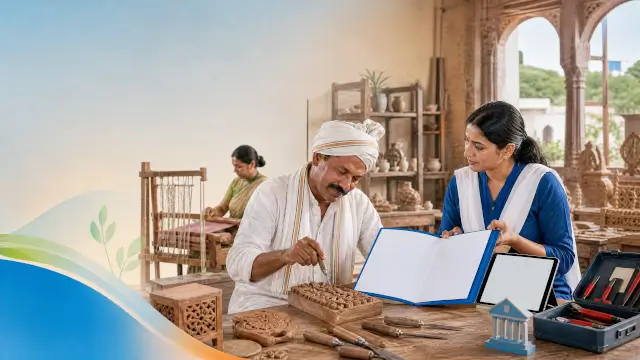
The phrase “Karigar Pension Scheme” is commonly used in search queries, but the official MyScheme page gives the programme a more specific name: National Handicrafts Development Programme: Direct Benefit to Artisans — Supports to Artisans in Indigent Circumstances. It is administered under the Ministry of Textiles and is intended to support eligible artisans during old age. The distinction matters because the benefit is not described as a universal payment for every craft worker.
The most important correction for readers is the amount. The official page says assistance of up to ₹8,000 per month may be granted as a monthly allowance, a lump-sum grant, or both. Therefore, an article or social-media post that guarantees ₹8,000 to every applicant is overstating the rule. The final support depends on the scheme conditions, documents, scrutiny and selection process.
What is the Karigar Pension Scheme under NHDP?
The programme sits within the National Handicrafts Development Programme, or NHDP. Its focus is the welfare of master craftspersons who have contributed to the handicrafts sector and who meet the scheme’s indigent-circumstances and eligibility conditions. The official Indian Handicrafts portal presents NHDP as a wider Ministry of Textiles programme supporting artisans, product quality, technology, branding, marketing and livelihood opportunities.
This is why the article should not present the programme as an ordinary old-age pension available through a generic online form. It is a targeted support route connected to recognized artisan achievement, financial need and official verification. Readers should use the current scheme page, prescribed form and notice from the relevant handicrafts office rather than relying on an unofficial “apply now” button or a copied social-media checklist.
The programme is different from general welfare documents such as a disability certificate or a state social-security benefit. For background on how government documentation can affect access to different schemes, see this disability certificate and UDID benefits guide. That comparison is useful, but a disability certificate does not by itself establish eligibility for artisan financial assistance.
How much assistance can an eligible artisan receive?
The official MyScheme description uses the words “up to ₹8,000 per month”. It also says that support may take the form of a monthly allowance or a lump-sum grant or both, with disbursement through PFMS/DBT in the scheme description. This wording creates three practical limits.
| Claim | Verified position | What a reader should understand |
|---|---|---|
| Maximum amount | Up to ₹8,000 per month | It is a ceiling in the official description, not an unconditional guarantee. |
| Form of support | Monthly allowance, lump-sum grant or both | The support form should not be reduced to only a fixed monthly pension. |
| Payment description | PFMS/DBT is mentioned by the scheme page | Payment follows official selection and processing; it is not automatic after form submission. |
| Continuation evidence | Income certificate and affidavit every financial year | Applicants must keep documents current for continued support. |
The amount also should not be confused with a state government top-up, another artisan benefit or a different pension scheme. If a notice gives a lower amount, a different payment form or a specific financial-year limit, that notice needs to be read alongside the scheme guidelines. Amounts and application windows can be notice-specific.
Eligibility conditions: award, age, income and other support
The official eligibility conditions are more specific than the legacy article suggested. The applicant should be a master craftsperson who has received a Shilp Guru Award, National Award, Merit Certificate, State Award or another bigger award. The page also states that the artisan should not be less than 60 years old on the date of application.
The income condition is stated as an annual income not exceeding ₹1,00,000 in the preceding financial year. This is not the same as a monthly income below ₹3,000. The older monthly figure has therefore been removed from this guide. Applicants should use the income certificate and the current official form rather than converting the annual ceiling into a different rule.
The page further says that the applicant should not receive similar financial assistance from another source. This means that an applicant should disclose overlapping assistance honestly. Receiving a different benefit does not automatically prove disqualification in every possible case, but similar assistance must be checked against the official rule before applying.
For artisans with disabilities, the official page notes that the minimum age may be relaxed subject to submission of a certificate issued by the appropriate authority. The relaxation is not an automatic waiver for every applicant. The certificate and the applicable official decision remain important.
| Condition | Officially stated rule | Common mistake to avoid |
|---|---|---|
| Professional recognition | Master craftsperson with a listed national, state, merit, Shilp Guru or bigger award | Assuming any informal craft experience is enough. |
| Age | Not less than 60 on the application date | Using the date of award instead of the application date. |
| Income | Annual income not exceeding ₹1,00,000 in the preceding financial year | Repeating the unsupported monthly ₹3,000 threshold. |
| Other support | No similar financial assistance from another source | Failing to disclose an overlapping benefit. |
| Disability relaxation | Possible age relaxation with the required authority certificate | Calling the relaxation automatic or unlimited. |
Documents required for the application
The official scheme page lists a focused document set. Applicants should check the latest prescribed form because the office may request supporting records or a specific format. A document list is not the same as approval, and a complete file still goes through inspection and selection.
- A recent photograph.
- A self-attested copy of the handicrafts award certificate issued by the Central or State Government.
- An income certificate for the preceding financial year.
- Proof of age.
- A disability certificate where the applicant is seeking the applicable relaxation.
- An affidavit in the prescribed format, attested by a First-Class Magistrate.
Keep the award certificate legible and make sure the name is consistent across the application, identity documents and bank records. Do not upload or send identity documents to an unofficial agent merely because a message promises faster approval. If an intermediary asks for an OTP or a payment to “unlock” the pension, stop and verify the office route first.
The document discipline is similar to other official-portal tasks: a scheme name alone is not enough. For example, readers checking a ration or welfare benefit should use the official process and avoid treating a general article as proof of eligibility. Our Annapurna Bhandar ration-card linking guide explains why a portal status and a final benefit decision are not always the same thing.
How to apply: the official offline route
The current MyScheme page describes the application process as offline. It says eligible master craftspersons are invited every year through publicity and should take a printout of the prescribed application format. The form must be completed, signed and submitted with the required documents to the relevant Handicrafts Service Centre or Regional Office.
- Check the current notice. Confirm that applications are open for the relevant financial year and that the applicant fits the award, age, income and similar-assistance conditions.
- Download the prescribed format. Use the application form linked from the official scheme page or the current notice from the competent handicrafts office.
- Prepare the documents. Attach the award certificate, income certificate, age proof, photograph, affidavit and disability certificate where applicable.
- Submit to the correct office. The official route refers to a Handicrafts Service Centre or Regional Office. Do not assume that a random website or private agent is an authorized submission point.
- Keep the acknowledgement reference. The scheme description says a unique number is assigned to identify the applicant and acknowledge receipt.
- Respond to verification requests. Field officers inspect applications, and the office may need clarification or additional supporting evidence.
The page states that completed applications are processed within 30 days, but processing is not the same as approval or payment. The Regional Director recommends cases, and a Core Committee under the Development Commissioner (Handicrafts) finalizes selection. This is a selection-based support scheme, not a guaranteed payment after submission.
What happens after submission?
After the application reaches the office, field-level inspection is part of the described process. The file is checked for completeness, award status, income evidence, age and other conditions. A missing income certificate or an expired supporting document can delay a decision or require a fresh application according to the applicable financial-support rules.
Applicants should maintain copies of the complete form, attachments and acknowledgement. If the office gives a reference number, keep it with the submission date and contact details of the receiving office. A phone call or message claiming “approved” is not enough unless it can be matched to the official reference and competent authority.
For readers comparing government schemes, this staged process is common. A NGO DARPAN registration guide also shows why registration, verification and access to a later benefit are separate steps. The same principle applies here: filing a form begins scrutiny; it does not establish entitlement by itself.
Annual continuation and income-certificate checks
The official scheme page says that, after selection, the master craftsperson must submit an income certificate and an affidavit duly countersigned by a First-Class Magistrate every financial year to seek continued financial support. This annual requirement is central to the programme because income and other-assistance conditions can change.
Do not treat the original selection as a lifetime approval. Keep the annual income record ready, notify the office if a relevant circumstance changes, and follow the current notice. If an applicant’s income exceeds the stated ceiling or similar support is received from another source, the continued eligibility position should be checked with the responsible office.
The same careful approach is useful for payment-status questions in other schemes. For example, the PM-Kisan status guide without OTP explains the difference between a public status check and an authenticated record. It is not the same scheme, but it illustrates why a status screen should not be confused with a final entitlement decision.
Common mistakes and fraud warnings
The first mistake is copying a fixed ₹8,000 promise into a poster or video. The official wording is “up to ₹8,000,” and it allows a monthly allowance, a lump-sum grant or both. The second mistake is using the old ₹3,000 monthly income claim. The current scheme page states the annual income ceiling as ₹1,00,000 for the preceding financial year.
The third mistake is sending an application through an unverified website. The official route described by MyScheme is offline, using a prescribed format and the relevant Handicrafts Service Centre or Regional Office. The fourth mistake is assuming that Aadhaar, a bank account or an artisan card alone creates eligibility. Identity and payment records may support verification, but the award, income, age, assistance and selection rules still apply.
Never share an OTP, debit-card PIN or internet-banking password with a person promising pension approval. Do not pay a “release fee” to a private number. If a notice differs from the scheme page, compare both documents and ask the competent handicrafts office for clarification. Readers can also review our official e-KYC safety guide for general advice on protecting credentials during government-portal processes.
Where to verify the latest scheme details
The most reliable starting point is the MyScheme page for the NHDP direct-benefit component. It includes the benefit, eligibility, application process, documents, FAQs and links to guidelines and the prescribed application form. The Indian Handicrafts official portal is useful for Ministry of Textiles programme context and scheme documents.
A current notice can be more specific than a general explainer. Check the financial year, submission deadline, office jurisdiction and any revised form before preparing a file. For a wider view of artisan and welfare policy, the UDID and disability-benefit guide and the beneficiary-list verification guide show how official records and scheme-specific rules should be read separately.
The practical answer is straightforward: verify the award and income conditions, use the official form, submit to the correct handicrafts office, keep the acknowledgement and renew the annual documents. A careful application is more useful than a viral headline promising a guaranteed pension.
Final checklist for applicants
| Before submission | What to confirm |
|---|---|
| Scheme identity | NHDP Direct Benefit to Artisans — Supports to Artisans in Indigent Circumstances. |
| Award record | Eligible master-craftsperson award certificate is available and readable. |
| Age | Applicant is at least 60 on the application date, unless the documented disability relaxation applies. |
| Income | Preceding financial-year annual income is not above ₹1,00,000 according to the official condition. |
| Other support | No similar financial assistance is being concealed or duplicated. |
| Form and office | Latest prescribed form and correct Handicrafts Service Centre/Regional Office are confirmed. |
| Future compliance | Annual income certificate and affidavit can be supplied for continued support. |
This guide is based on the official scheme description and related government/legislative material available at the time of review. Notices, forms, office instructions and application windows can change, so verify the latest official version before submitting documents.
Frequently Asked Questions

SK Jabedul Haque
Building India's most trusted finance education platform — simplifying news, schemes and market trends so anyone can understand and invest confidently.
Read full bio


Never miss an update
Get our clearest explainers on schemes, markets and money — read what matters, without the noise.
Explore more articles