Labour Card 2025
What You'll Learn
- The truth behind the "₹5 lakh benefit" claim — what is actually universal and what is state-specific
- How the ₹2 lakh PMSBY accident cover and the ₹3,000 monthly PM-SYM pension actually work
- Verified state-by-state benefits for Delhi, Punjab, Haryana, UP, Assam, Tamil Nadu, Odisha and West Bengal
- Step-by-step online registration, eligibility rules, status check and official helpline numbers
The BOCW Act, enacted in 1996, required every state to set up a welfare fund and a welfare board for building workers, financed through a labour cess computed on construction costs — commonly around 1% of the project cost — collected from builders and contractors. The corpus funds the pension, marriage, education and death benefits listed later in this guide. This is also why entitlements are state-specific: each board manages its own fund and its own rules, and there is no single national labour card entitlement beyond the central schemes attached to e-Shram.
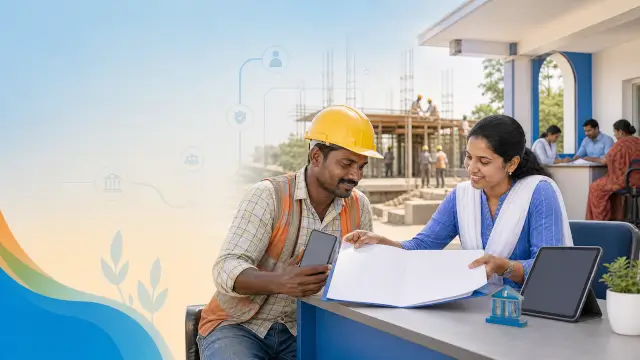
Labour card 2026 is shorthand for two different things that are frequently confused: the state-issued Building and Other Construction Workers (BOCW) welfare card, created under the BOCW Act of 1996 and managed by each state's welfare board, and the central e-Shram digital card, issued free by the Ministry of Labour and Employment to all unorganised workers. Both matter for a construction worker, and both carry different benefits. This guide separates the two, corrects the widely circulated claim of a universal ₹5 lakh benefit, and lists every benefit with figures verified against official portals — e-Shram, PIB, state BOCW boards and the PM-SYM website — as of August 10, 2026.
e-Shram vs Labour Card: What's the Difference
This is the single biggest source of confusion in Hindi-language searches, and the practical answer shapes every application decision. The e-Shram card is a central government digital card — a 12-digit Universal Account Number (UAN) — issued free to any unorganised worker aged 16 to 59 across more than 400 occupations. The labour card is a state welfare board card for construction workers under the BOCW Act, which also carries a registration fee capped at ₹50 under the Act. A construction worker can hold both, and the e-Shram UAN is increasingly the gateway that links a worker to central schemes like PMSBY and PM-SYM.
| Feature | e-Shram Card | State BOCW Labour Card |
|---|---|---|
| Issued by | Central: Ministry of Labour and Employment | State welfare board under BOCW Act, 1996 |
| Who is eligible | All unorganised workers, 16–59 years | Construction workers employed in building work, 18–60 years |
| Registration cost | Free | Nominal fee, capped at ₹50 under the Act |
| Card form | Digital card with 12-digit UAN | Physical/state labour card |
| Core benefits | Central schemes: PMSBY accident cover, PM-SYM pension, welfare scheme access | State benefits: pension, marriage, education, maternity, death assistance |
Neither card automatically enrols workers in every scheme — PM-SYM, for example, is a separate voluntary enrolment using the UAN. The state board benefits also differ sharply, which is why the state-wise table in this guide is the part to read carefully.
e-Shram Registrations Cross 31.85 Crore in 2026
The official e-Shram portal (eshram.gov.in) shows 31,85,74,768 e-Shram cards issued as of its last update on August 10, 2026 — roughly 31.9 crore unorganised workers registered, against an estimated unorganised workforce of about 40 crore. Registration is free, requires only an Aadhaar-linked mobile number and a bank account, and takes under ten minutes online. The portal also displays the national helpline: 14434 and 1800-889-6811.
The scale matters because several welfare schemes now use the e-Shram database as their enrolment base. The PIB release of December 2, 2024 (PRID 2079858) on benefits under the e-Shram card confirms the two flagship entitlements: enrolment in PM-SYM for a monthly pension of ₹3,000 after age 60, and the PMSBY accident cover of ₹2 lakh. The portal also lets workers correct their occupation category after registration, which matters because categories feed scheme targeting — a worker registered under a generic occupation may miss construction-specific communications. Workers registering on e-Shram should select the construction category explicitly rather than leaving the field generic. For the full application walkthrough, see our e-Shram Card 2026 guide.
Labour Card Benefits 2026: The Complete List
Benefits cluster in six categories once a worker holds a registered card and maintains continuous membership. Accident insurance via PMSBY is the central entitlement. Pension via PM-SYM (central) or the state board (state-specific) is the retirement entitlement. Health support includes medical reimbursement where hospitalisation spans five or more days — Delhi's board reimburses up to ₹10,000 — and Delhi announced cashless treatment up to ₹2 lakh per worker and ₹10 lakh per family in June 2026. Education assistance covers children from Class I through professional degrees. Marriage and maternity assistance covers family events, and death benefits cover accidental, natural and funeral expenses.
The "₹5 lakh benefit" claim circulating on social media is state-specific, not universal. The verified reality: Punjab's board pays ₹5 lakh on accidental death or 100% disability; Tamil Nadu raised its workplace financial assistance for construction workers (registered and unregistered) from ₹5 lakh to ₹8 lakh in April 2025; and Delhi's board gives a ₹3 lakh advance for building or buying a house. In every other context the headline benefit is the ₹2 lakh PMSBY cover, which is the number that applies to nearly every cardholder. Nothing in the central schemes promises a flat ₹5 lakh to everyone.
One further point that gets buried in Hindi-language videos: state board benefits are not automatic on registration. Most boards require continuous membership with regular contributions before claims are paid. Delhi's marriage assistance needs three years of continuous membership, education assistance under Rule 281 needs a minimum membership period, and the ₹3 lakh house advance needs one year of membership plus 15 years remaining before superannuation. A worker who registers but never contributes typically retains only the schemes that do not depend on the state board — the PMSBY cover and PM-SYM pension linked to e-Shram.
Accident Insurance: The ₹2 Lakh Cover on Your Card
Accident Insurance: The ₹2 Lakh Cover on Your Card
The accident cover linked to the card is PMSBY — the Pradhan Mantri Suraksha Bima Yojana. For a premium of ₹20 per year, auto-debited from a linked savings account, a worker gets ₹2,00,000 on accidental death or total permanent disability and ₹1,00,000 on partial permanent disability. Eligibility is broad: savings account holders aged 18 to 70, with Aadhaar-linked accounts preferred. The premium is among the cheapest insurance products in the world — ₹20 for a year of ₹2 lakh cover. For a construction worker, whose occupation carries well-documented accident risk, this single enrolment is the highest-value step after getting the card itself. Full scheme details are in our PMSBY 2026 guide, and PMSBY pairs naturally with PMJJBY for life cover — see PM Suraksha Bima and PM Jeevan Jyoti Bima 2026.
PM-SYM Pension: How the ₹3,000 Monthly Pension Works
PM-SYM — the Pradhan Mantri Shram Yogi Maandhan — is the pension scheme linked to the card, and it pays ₹3,000 per month after the worker turns 60. It is a voluntary contributory scheme for unorganised workers aged 18 to 40 with monthly income of ₹15,000 or below. The worker contributes 50% of the monthly premium and the central government contributes the matching 50% until the worker turns 60. The entry-age contribution runs from ₹55 a month at age 18 to ₹200 a month at age 40; the government matches every rupee. Enrolment happens online at maandhan.in or at CSC centres, using the e-Shram UAN. On the member's death, the spouse receives 50% of the pension as family pension.
Workers without smartphones or banking apps are not locked out: Common Service Centres (CSC) process PM-SYM enrolment across the country, and the FAQ published by CSC India spells out the full age-wise contribution chart along with the annual auto-debit discipline required to keep the policy alive. The golden rule is to enrol as young as possible — the contribution chart jumps from ₹55 at 18 to ₹100 at 29 and ₹200 at 40, and every year of delay both raises the premium and shortens the contribution period.
| Entry Age | Member's Monthly Contribution | Central Govt Contribution | Total Monthly Premium |
|---|---|---|---|
| 18 years | ₹55 | ₹55 | ₹110 |
| 29 years | ₹100 | ₹100 | ₹200 |
| 40 years | ₹200 | ₹200 | ₹400 |
The scheme had crossed 54 lakh beneficiaries by mid-2026, a number the Labour Ministry has cited publicly in its disclaimers about the importance of early enrolment — starting at 18 means paying ₹55 a month for 42 years, while starting at 40 means ₹200 a month for just 20 years. Workers comparing retirement options should also see our Atal Pension Yojana 2026 guide and the broader Pension Schemes in India 2026 roundup, which compares all retirement options side by side.
State-Wise BOCW Benefits 2026 at a Glance
State boards set their own benefit amounts under the BOCW Act, and the differences are large. Delhi and Haryana are the most generous on pensions and marriage assistance; Punjab leads on accident and natural death cover; Tamil Nadu leads on workplace financial assistance. The table below compiles figures from official state board portals and myScheme listings, all current as of August 2026.
| State | Pension (60+) | Death / Accident Cover | Marriage Assistance | Education & Other |
|---|---|---|---|---|
| Delhi | ₹3,000/month, +₹300 per extra year of membership | Accidental ₹2,00,000; natural ₹1,00,000; funeral ₹10,000 | Daughter/female member ₹51,000; son/male member ₹35,000 | Education ₹500–₹10,000/month; maternity ₹30,000 |
| Punjab | — | Accidental death/100% disability ₹5,00,000; natural death ₹3,00,000; cremation ₹20,000 | — | Stipend ₹3,000–₹70,000/year |
| Haryana | Disability pension ₹3,000/month | — | Daughter ₹51,000 (Kanyadan) + ₹50,000; son ₹21,000 | Education ₹8,000–₹20,000/year; self-marriage of women workers ₹50,000 |
| UP | ₹1,500/month | — | — | Health cover and education support via board |
| Assam | ₹2,000 + ₹100 per completed year (max ₹3,000) | — | Available via board | Maternity, death, skill training via board |
| Odisha | — | Accidental ₹2,00,000; natural ₹1,00,000 | — | — |
| West Bengal | ₹750/month; family pension ₹375 | Accidental ₹1,50,000; natural ₹50,000 | — | — |
| Tamil Nadu | — | Workplace financial assistance ₹8,00,000 (registered and unregistered) | — | — |
Delhi's board model is worth studying because it is the most complete. The official Delhi BOCW portal (bocw.delhi.gov.in) lists 17 schemes: a ₹3,000 monthly pension after 60 with a ₹300 increase for every completed year of membership beyond five years, family pension at 50% (minimum ₹1,500), a ₹3,000 monthly disability pension, ₹1,00,000 ex-gratia for permanent disability, ₹30,000 maternity benefit for up to two children, ₹10,000 medical assistance for hospitalisation of five or more days, ₹2,00,000 on accidental death and ₹1,00,000 on natural death, ₹10,000 funeral assistance, a ₹20,000 loan and a ₹5,000 five-yearly grant for work tools, a ₹3,00,000 house advance (with one year of membership and 15 years left to superannuation), education assistance from ₹500 to ₹10,000 a month, plus vocational training and a construction academy. Delhi has more than 2.70 lakh registered construction workers, and in February 2026 the state distributed ₹5,000 each to 5.7 lakh construction workers — ₹290 crore in total.
Beyond the eight states in the table, other boards run workable schemes at smaller scale: Karnataka pays ₹1,000 per month pension with ex-gratia payments up to ₹2,00,000; Meghalaya sanctions ₹15,000 on the death of a member; and Tripura's 2026 housing scheme extends loans of up to ₹6,00,000 for house construction. The pattern is consistent everywhere — pension, death cover, education and marriage — but always with state-specific numbers, which is why the only reliable source for a worker's actual entitlement is their own state board portal.
Education Assistance for Children of Workers
Education assistance is the benefit families underestimate. Delhi's Rule 281 pays monthly scholarships up to ₹10,000 for professional courses; Punjab's stipend scheme runs from ₹3,000 a year at primary level to ₹70,000 a year for degree courses; Haryana pays ₹8,000 to ₹20,000 a year. Eligibility generally requires the worker to be a registered, contributing member for one to three years, and benefits usually cover up to two children.
| Level | Delhi (Rule 281) | Punjab (Stipend) | Haryana |
|---|---|---|---|
| Class I–VIII | ₹500/month (₹6,000/year) | ₹3,000–₹4,000/year | ₹8,000–₹20,000/year |
| Class IX–X | ₹700/month (₹8,400/year) | ₹10,000–₹13,000/year | ₹8,000–₹20,000/year |
| Class XI–XII | ₹1,000/month (₹12,000/year) | Higher rates | ₹8,000–₹20,000/year |
| Graduation | ₹3,000/month (₹36,000/year) | Up to ₹70,000/year | ₹8,000–₹20,000/year |
| ITI / Diploma | ITI ₹4,000/month; Diploma ₹5,000/month | Higher rates | ₹8,000–₹20,000/year |
| Engineering / Medicine / MBA | ₹10,000/month (₹1,20,000/year) | Up to ₹70,000/year | ₹8,000–₹20,000/year |
The education and health benefits connect directly to the bigger safety-net discussion: for health cover beyond BOCW reimbursements, the Ayushman Bharat PM-JAY 2026 guide covers the ₹5 lakh family health cover available to eligible families on the SECC list, which overlaps heavily with construction worker households.
How to Apply for a Labour Card Online
Application has two independent tracks. For the e-Shram card, go to eshram.gov.in, select "Register on e-Shram", and complete the flow with your Aadhaar number, an Aadhaar-linked mobile number, and a bank account (with IFSC). You choose your occupation category — construction worker is a listed category — and the system generates the 12-digit UAN immediately. Registration is free and there are no charges at any step. For the state BOCW labour card, apply through your state's BOCW welfare board portal (bocw.delhi.gov.in for Delhi, state equivalents elsewhere), where the worker registers with proof of construction employment — often with the involvement of the employer or contractor, and in some states through dedicated registration camps, such as the camps Uttar Pradesh ran from January 2026 to enrol workers and warn that continuous membership of two to three years is required to unlock welfare benefits.
The e-Shram track, step by step: open eshram.gov.in on a phone or PC; select Register on e-Shram; enter the Aadhaar number and verify the OTP; fill the form with name, date of birth, address, occupation category (construction) and bank account with IFSC; submit, and the 12-digit UAN is generated instantly with a downloadable digital card. State boards follow a similar flow on their portals but add document verification, sometimes with the employer or contractor co-signing the employment proof.
Two practical warnings from the verification process. First, never pay an agent for an e-Shram card — it is free by law, and the official helpline 14434 exists precisely for reporting fraudulent charges. Second, migrate construction workers arriving from other states should also register on the Shram Shakti portal, which covers migrant worker registration and portability of benefits; our Shram Shakti Portal registration guide has the details.
Eligibility, Status Check and Helpline Numbers
Eligibility by scheme: e-Shram accepts unorganised workers aged 16 to 59 — including construction workers, gig workers, domestic workers and street vendors; state BOCW cards are for construction workers aged 18 to 60 engaged in building and other construction work, employed for at least a specified period (Delhi requires one year of work as a building worker for pension eligibility); PM-SYM accepts unorganised workers aged 18 to 40 with monthly income of ₹15,000 or below, who are not covered by EPFO/ESIC or other statutory pension schemes.
Status checks: the e-Shram card status is checked by logging into eshram.gov.in with the UAN and mobile OTP, or via the helpline 14434 / 1800-889-6811. State BOCW card status is checked on the respective state portal — Delhi workers use the same bocw.delhi.gov.in portal with the registered mobile number. Workers already covered by EPFO, ESIC or another statutory pension scheme do not qualify for PM-SYM — the scheme targets the uncovered unorganised workforce, which is why the e-Shram database is its natural base. Gig workers, domestic workers, street vendors and agricultural labourers beyond construction enjoy the same e-Shram and PMSBY entitlements; state BOCW boards are the construction-only layer.
Documents to keep ready for either registration: Aadhaar, bank passbook or account number with IFSC, a mobile number, and for state boards a photograph and address proof; for PM-SYM enrolment, the e-Shram UAN is the key reference.
The Bottom Line
Labour card 2026 reality in one paragraph: the e-Shram card is free, covers 31.85 crore registrations and unlocks a ₹2 lakh accident cover for ₹20 a year; PM-SYM adds a ₹3,000 monthly pension after 60 for a ₹55-to-₹200 monthly contribution; state boards add pension, marriage, education, maternity and death benefits that vary widely — Delhi ₹3,000 pension, Punjab ₹5 lakh accidental cover, Tamil Nadu ₹8 lakh workplace assistance. The "₹5 lakh" figure circulating online is a state-specific number, not a universal entitlement — this article's earlier version repeated several unverified state figures that have now been replaced with the verified numbers above.
For a construction worker in 2026, the correct sequence is: register on e-Shram today (free, ten minutes), enrol in PMSBY at ₹20 a year for the ₹2 lakh cover, enrol in PM-SYM if between 18 and 40, and then complete the state BOCW registration to unlock the state board benefits — because state boards, not the central card, hold most of the marriage, education and death assistance. The earlier the PM-SYM enrolment, the cheaper it is, and every step is verifiable on the official portals cited in this guide.
Frequently Asked Questions

SK Jabedul Haque
Building India's most trusted finance education platform — simplifying news, schemes and market trends so anyone can understand and invest confidently.
Read full bio

Never miss an update
Get our clearest explainers on schemes, markets and money — read what matters, without the noise.
Explore more articles