Annapurna Bhandar District Wise List 2026: Check Your Name & Status
What You'll Learn
- How to check your name in the Annapurna Bhandar district-wise list under the new state government
- Why the scheme changed from Lakshmir Bhandar to Annapurna Bhandar, and how the change in government affected it
- The current status of August 2026 payments and why some accounts have not been credited yet
- How to file an objection or a re-application if your name is missing or was wrongly deleted
The Annapurna Bhandar district wise list 2026 is being published and updated on a rolling basis across all 23 West Bengal districts, more than a year after the scheme replaced Lakshmir Bhandar. Since West Bengal Chief Minister Suvendu Adhikari formally launched Annapurna Yojana from Nabanna on June 1, 2026, the state has moved past 1.2 crore verified women beneficiaries, each receiving a flat ₹3,000 per month in place of the earlier ₹1,000-₹1,200 under Lakshmir Bhandar. For the eligibility rules and full application walkthrough, see our complete application guide 2026.
This guide has been updated for August 2026 to reflect the change in state government, the latest district-wise verification status, and the payment delays several beneficiaries are currently facing. Every figure, date and process step below is sourced from official government notifications, Economic Times, The Hindu, Livemint, News18 and Times of India. For the original launch announcement, read the Economic Times report on the June 3 launch. To understand the 11-page application form, read our 11-page form controversy explainer, and for migration from Lakshmir Bhandar see our Lakshmir-to-Annapurna migration process guide.
What Is the Annapurna Bhandar District-Wise List and Why It Matters in 2026
The Annapurna Bhandar district-wise list is the official register of women approved to receive ₹3,000 per month, organised by West Bengal's 23 districts and subdivided into blocks, gram panchayats, municipalities and KMC wards. It follows a four-tier public disclosure model set out in the Women and Child Development and Social Welfare Department notification of May 19, 2026.
Why does the district-wise list matter in August 2026? Three reasons stand out.
First, the list is still being cleaned up. Roughly 58 lakh names were removed from the earlier Lakshmir Bhandar rolls under the ASDD categories (Absent, Shifted, Dead, Duplicate), with close to 6 lakh more flagged separately during the SIR-2026 voter roll revision, according to India Today's May 27, 2026 report. For the full data on the ineligible-name detection, see our ineligible Lakshmir Bhandar names analysis.
Second, the verification and grievance window closes August 25, 2026. The state's own scheme documentation confirms the beneficiary list is refreshed every seven days, with the verification and correction window running from May 27 to August 25, 2026 - giving affected women a limited period to fix their status.
Third, the total beneficiary count has crossed 1.2 crore. Times of India reported on June 30, 2026 that Annapurna Yojana crossed the one-crore mark, and Economic Times reported on July 1, 2026 that the state was transferring ₹3,000 monthly to nearly 1.1 crore women, with the number rising in every weekly batch since.
New Government, New Scheme: How the Suvendu Adhikari Administration Runs the List
One fact has changed the entire administrative picture behind the Annapurna Bhandar district-wise list: West Bengal now has a different state government than when Lakshmir Bhandar was created. Following the 2026 West Bengal Assembly election, Suvendu Adhikari was sworn in as Chief Minister on May 9, 2026, succeeding Mamata Banerjee. He personally inaugurated Annapurna Yojana from Nabanna on June 1, 2026, and formally launched the scheme's public rollout on June 3, 2026, when the state credited its first batch of 28,25,769 women.
This matters for the district-wise list because it explains why the verification exercise has been so aggressive. Livemint reported that Annapurna Yojana replaces the previous TMC government's Lakshmir Bhandar scheme, under which women from Scheduled Caste and Scheduled Tribe households received ₹1,200 per month and women from other categories received ₹1,000. The new government's stated position is that the earlier database needed a full citizenship and residency check before any new instalment could go out - which is why the district-wise list you see today is smaller and more tightly verified than the old Lakshmir Bhandar rolls, even as the total beneficiary count keeps climbing toward the state's full target.
The change of government also changed who signs off on your application. Under Lakshmir Bhandar, block and district officers largely rubber-stamped an existing list. Under Annapurna Bhandar, the District Magistrate of each district - or the KMC Commissioner for Kolkata - personally acts as the sanctioning authority for every application, whether it is a migrated case or a fresh one. This is a deliberate design choice by the new administration: by centralising sanction power at the DM or Commissioner level, the state can more easily track which applications are pending, which are rejected, and why - data that feeds directly into the district-wise list you see on the portal today.
How to Check Your Name in the Annapurna Bhandar District-Wise List
There are four official ways to check whether your name is on the Annapurna Bhandar district-wise beneficiary list. Pick the one that matches your situation.
Method 1 - Online portal (recommended for most beneficiaries): Go to annapurnabhandarwb.com and open the "Beneficiary Status" or "Track Application" section. Enter your Aadhaar number and registered mobile number to see one of three statuses: Approved, Pending Verification / Under Enquiry, or Not Found / Migrated Out. The West Bengal Social Security Portal can also be used for the same status check.
Method 2 - District NIC portal (for local KYC windows): Several districts have opened dedicated verification windows, such as North 24 Parganas' ayn24p.in portal. Check your district's official NIC website for a similar window before assuming your name is permanently excluded.
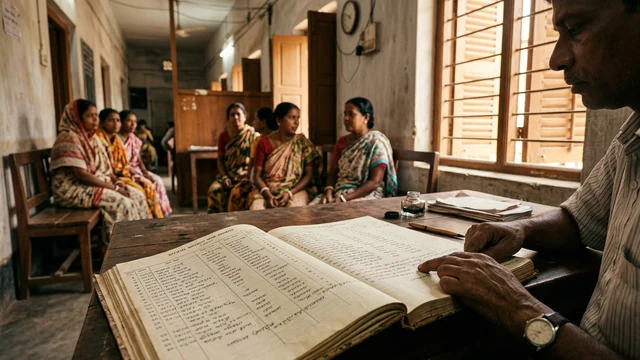
Method 3 - BDO or municipality office (offline): Field teams made up of gram panchayat officials, gram rojgar sahayaks, nirman sahayaks and booth-level officers (BLOs) have been conducting door-to-door verification since the scheme launched. You can walk into your BDO office with your Aadhaar card and old Lakshmir Bhandar reference number to ask about your status directly.
Method 4 - KMC ward office (for Kolkata residents): Since the KMC Commissioner - not the District Magistrate - is the sanctioning authority for Kolkata's beneficiaries, residents of the Kolkata Municipal Corporation area should visit their ward office or check the KMC's Annapurna Bhandar microsite instead of the district portal.
Migration From Lakshmir Bhandar: The Verification Drive That Reshaped the List
To understand today's district-wise list, you have to understand the database it replaced. Lakshmir Bhandar had roughly 2.2 crore active beneficiaries across West Bengal, of which approximately 7.84 lakh were in Kolkata alone. This was the largest women-centric direct benefit transfer (DBT) database in India, and also the one the new government targeted for the most thorough cleansing before releasing any Annapurna Bhandar instalment.
The migration order issued on May 19, 2026 by the Women and Child Development and Social Welfare Department stated that all existing Lakshmir Bhandar beneficiaries would be migrated to Annapurna Yojana except those dead, shifted, deleted or flagged as absentee electors during SIR-2026, those deleted after the second voter list was published, those deleted after adjudication, or those falling in the ASDD (Absent, Shifted, Dead, Duplicate) category found during voter slip distribution. If you fall into any of these categories, you will not appear on the new list until you prove otherwise through a fresh application or an objection.
Kolkata District: 7.84 Lakh-Plus Beneficiaries and KMC's Separate Sanction Track
Kolkata remains the most-watched entry in the Annapurna Bhandar district-wise list. The city alone accounts for more than 7.84 lakh of the migrated women, and because Kolkata falls under the Kolkata Municipal Corporation rather than a zilla parishad, the sanctioning authority is the KMC Commissioner, not the District Magistrate. This is not a cosmetic difference - it changes which office processes your application, which portal you use, and where you file an objection.
For Kolkata residents, the practical workflow is: register on annapurnabhandarwb.com then upload Aadhaar and bank passbook then wait for the KMC ward-level enquiry then receive a sanction letter from the Commissioner's office (to check Aadhaar-DBT seeding status, see our Aadhaar DBT status guide) then ₹3,000 credited to your Aadhaar-linked account. Kolkata's high migrant population, with many beneficiaries having shifted between boroughs or out of the city, means the Not Found / Migrated Out status has been more common here than in most other districts.
Because Kolkata's Aadhaar-bank seeding rate is among the highest in the state, the city is usually one of the first areas to see each month's DBT batch clear - which is why, if you live in Kolkata and still have not been paid days into August, the more likely explanation is a document or account-level issue rather than a district-wide processing delay. Check your exact rejection reason on the portal before assuming your name has been dropped from the list entirely.
North 24 Parganas, South 24 Parganas and Hooghly: The Three Largest District Pools
Outside Kolkata, the three highest-volume districts in the Annapurna Bhandar district-wise list remain North 24 Parganas, South 24 Parganas and Hooghly. Each has an estimated 14-20 lakh migrated beneficiaries, and each has run a slightly different verification model, so a one-size-fits-all approach to checking your name will not work everywhere.
| District | Approx. Beneficiaries | Sanctioning Authority | Verification Channel |
|---|---|---|---|
| North 24 Parganas | 18-20 lakh | District Magistrate, Barasat | BDO + BLO door-to-door verification |
| South 24 Parganas | 15-17 lakh | District Magistrate, Alipore | Block-level camps + online portal |
| Hooghly | 14-16 lakh | District Magistrate, Chinsurah | Panchayat-level display boards |
| Howrah | 12-14 lakh | District Magistrate, Howrah | BLO + municipality camps |
Figures above are reconstructed from district-level WCD estimates and news reports as of August 2026; the state has not published a single official district-wise breakdown for these districts. If your district has not yet published a similar order, ask your BDO when door-to-door verification for your gram panchayat will begin.
Howrah, Nadia and Murshidabad: Urban-Fringe Districts With High Migration
Howrah, Nadia and Murshidabad form the second tier of the district-wise list, with roughly 8-14 lakh migrated beneficiaries each. A large share of their Lakshmir Bhandar beneficiaries have shifted between blocks or out of the district entirely for work, which makes the ASDD flag disproportionately common here.
The state's dedicated online portal for "authentication of beneficiaries, correction of records and rationalisation of the database" is the most useful tool for women in these three districts who have moved within their district. A woman who shifted from Ranaghat to Kalyani in Nadia district, for example, can update her address through the portal without losing her migrated status. If your enquiry has been pending for more than 30 days, the district WCD office can escalate it.
North Bengal and the SIR-2026 Legal Challenge
Malda, Uttar Dinajpur, Dakshin Dinajpur, Jalpaiguri, Alipurduar and Cooch Behar - the six North Bengal districts - remain the most under-covered in the Annapurna Bhandar district-wise list so far (for SIR-2026 deletion impact in North Bengal, see our SIR deletion analysis). North Bengal has a lower Aadhaar-bank seeding rate, which continues to slow DBT clearance for approved names.
There is also an active legal dimension worth watching. The Hindu reported that the Calcutta High Court has stayed the discontinuation of PDS benefits to a woman affected by an SIR-related deletion, noting that over 90 lakh names were deleted during the SIR process in West Bengal before the 2026 Assembly election, and that the Supreme Court has reiterated safeguards around such deletions. This case does not directly cover Annapurna Bhandar, but it signals that courts are actively scrutinising SIR-linked exclusions from welfare schemes - a trend worth watching if your name was removed on SIR grounds.
If you are a North Bengal beneficiary, confirm your bank account is Aadhaar-mapped and active, check the malda.gov.in or jalpaiguri.gov.in notice boards where physical lists are still being displayed, and file an objection immediately if a family member is marked "shifted" but is in fact still residing in the district.
North Bengal's lower seeding rate is not simply a technology gap. A larger share of the working-age population from these districts migrates seasonally to other states for construction, agricultural or domestic work, which means the address on record often does not match where the BLO actually finds - or fails to find - the beneficiary during door-to-door verification. If you or a family member falls into this pattern, the safest step is to proactively update your address on the portal before the verification team visits, rather than waiting to be flagged as "absent" and having to appeal afterward.
August 2026 Payment Status: Why Some Accounts Have Not Received the ₹3,000 Yet
The most common question in early August 2026 is not about the district-wise list itself but about the monthly payment. Livemint reported on August 1, 2026 that the August instalment was expected to be credited into verified bank accounts in the first week of the month, in a phased manner rather than all at once. A follow-up Livemint report confirmed that although payments are generally credited during the first week, many accounts had still not received the funds days into the month.
According to Goodreturns' August 3, 2026 report, the most common reasons a beneficiary's ₹3,000 has not arrived are: a joint bank account instead of a single-holder personal account, a blurry or cropped document uploaded during scanning, a mismatch between the spelling on Aadhaar and the application form, applying through an unofficial website instead of the government portal, an unresolved "invalid bank account" status, a bank account that is not Aadhaar-seeded or DBT-enabled, or a name removed during the ongoing verification drive.
If your payment is delayed, first check your status on annapurnabhandarwb.com or the West Bengal Social Security Portal for the specific rejection reason shown against your name, then act on that reason directly rather than simply waiting for the next cycle.
It also helps to understand how the phased crediting actually works. Rather than pushing all 1.2 crore-plus payments on a single day, the state's Directorate of Social Welfare releases funds in weekly batches, district by district, tied to how quickly each district's Aadhaar-bank seeding rate clears the finance department's checks. This is the same batching model used for the June 3 launch, when the first tranche of 28,25,769 women were paid on day one and the rest followed over subsequent weeks. If your district has a lower seeding rate - as North Bengal districts currently do - expect your batch to clear later in the month than a high-seeding district like Kolkata or Howrah.
How to File an Objection or Re-Application if Your Name Is Missing
If your name is missing from the Annapurna Bhandar district-wise list - or if you know of an ineligible name wrongly included - there is a structured, time-bound process to fix it, running through the August 25, 2026 grievance deadline.
For missing names (you believe you are eligible but do not appear on the list): Submit a fresh application on annapurnabhandarwb.com under "New Application." Attach your Aadhaar card, bank passbook first page, a passport-size photograph, and a self-declaration that you are an Indian citizen aged 25-60, not a government employee or income-tax payer. Your application is routed to the District Magistrate, or the KMC Commissioner if you live in Kolkata.
For wrongly deleted names (you were on Lakshmir Bhandar but your name has been purged): Visit your BDO office in person with your old Lakshmir Bhandar reference number, Aadhaar card, and a copy of the current electoral roll showing your name is still active. The BDO can recommend re-inclusion, after which the DM must approve or reject it within the grievance window.
For ineligible names appearing in your area: File a written objection with the gram panchayat pradhan or municipality chairman, attaching documentary evidence such as a death certificate or address proof showing the person has shifted. The objection must be disposed of within 30 days; if the pradhan does not respond, escalate to the Sub-Divisional Officer (SDO) of your subdivision. For the full grievance escalation process, see our CM grievance cell online complaint guide.
Keep in mind that the August 25, 2026 deadline applies to the current verification cycle, not to your right to apply altogether. Fresh applications continue to be accepted on a rolling basis even after the window closes, but cases filed before the deadline are processed with priority against the current district-wise list, while later applications are folded into the next update cycle. If your situation is time-sensitive, filing before August 25 gives you the fastest path to a resolved status.
Conclusion: A Living List Under a New Administration
The Annapurna Bhandar district-wise list 2026 is not a static document - it is being refreshed every seven days under a state government that changed hands in May 2026, and it is still absorbing the effects of the ASDD cleanup, the SIR-2026 voter roll revision, and an active Calcutta High Court case on SIR-linked welfare exclusions. More than 1.2 crore women are now receiving ₹3,000 a month, but the August 2026 instalment has shown that Aadhaar-bank seeding, correct documentation and single-holder bank accounts remain the biggest hurdles to getting paid on time.
For most of West Bengal's eligible women, the practical workflow is unchanged: confirm your name on the portal, ensure your Aadhaar-bank mapping is correct, and check your local gram panchayat or municipality notice board. For those still excluded, the objection and re-application process - running through August 25, 2026 - remains the only path back onto the list, and for the 7.84 lakh-plus Kolkata beneficiaries, the KMC Commissioner's office remains the only place where the sanction letter is signed.
Frequently Asked Questions

SK Jabedul Haque
Building India's most trusted finance education platform — simplifying news, schemes and market trends so anyone can understand and invest confidently.
Read full bio

Never miss an update
Get our clearest explainers on schemes, markets and money — read what matters, without the noise.
Explore more articles