Fed Holds Rates Through 2026
What You'll Learn
- What the June 9 Reuters economist poll actually said about the 2026 Fed path
- Why inflation, oil, tariffs, jobs, and AI investment changed the case for rate cuts
- How the later June 17 FOMC decision and projections should be read as later context
- Why market-implied pricing, official projections, and analyst views are different evidence
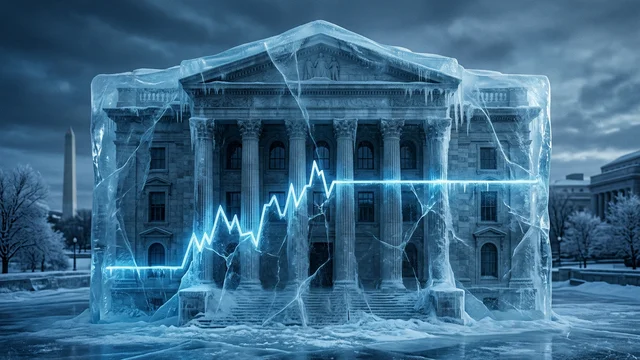
The headline says the Fed holds rates through 2026, but the defensible claim is narrower. Reuters reported on June 9 that a strong majority of economists expected the Federal Reserve to keep its key interest rate unchanged for the rest of the year. The report also said interest-rate futures priced at least one hike by year-end. These were separate signals. The economist poll described a survey view, while futures reflected market pricing that could change with new data.
The article was published around June 12, before the Federal Open Market Committee meeting scheduled for June 16 and 17. Later Federal Reserve materials are included as a clearly labeled update layer. They do not change what was known on June 12. They show how the original expectation compared with the eventual decision and projections.
Why the June 12 Poll Changed the Fed Debate
Reuters described a shift away from the rate-cut view that had dominated earlier forecasts. The June 4 to 9 survey found a strong majority expecting the policy rate to remain in its then-current 3.50% to 3.75% range through the rest of 2026. No economist in the poll expected a cut at the June 16 and 17 meeting. The finding did not mean every forecaster expected a hike. It meant that the hold case had become the modal survey view.
The background was a combination of persistent price pressure and steady activity. Reuters said inflation had risen to roughly double the Federal Reserve’s 2% target and that there was little prospect of a quick retreat after more than five years of persistent price pressure. It also connected the change to a strong May jobs report and to concerns that energy costs linked to the Middle East conflict could pass through to broader inflation.
That combination creates a difficult policy tradeoff. A central bank can wait for more evidence when growth and employment are holding up, but it also risks allowing an energy shock to influence wages, expectations, and service prices. A rate cut would reduce borrowing costs, yet it could also make it harder to convince households and businesses that inflation will return to 2%.
What the Reuters Poll Actually Said
The Reuters poll is best read as a distribution of economist views, not as an official forecast issued by the Federal Reserve. Of 102 economists surveyed, 72 expected the key rate to remain in the 3.50% to 3.75% range through the rest of 2026. That is nearly 70% of respondents. The survey was conducted from June 4 to June 9, so its information set predates the June 16 and 17 decision.
| Evidence | Reported result | How to interpret it |
|---|---|---|
| Reuters economist poll | 72 of 102 economists expected the 3.50% to 3.75% range through 2026 | Survey consensus, not an FOMC commitment |
| Interest-rate futures | At least one hike priced by the end of 2026 | Market-implied probability, not a guaranteed outcome |
| June meeting expectation | No economist in the poll expected a cut | Pre-meeting survey view for June 16 and 17 |
| Inflation backdrop | Roughly double the Federal Reserve’s 2% target | Reuters description of the pressure behind the hold view |
The difference between a survey and market pricing matters. A survey asks people what they think will happen. A futures market embeds a price for several possible outcomes and includes risk premia, positioning, and liquidity conditions. Neither measure is a policy decision. Both can move before the next meeting.
Reuters also reported that only a handful of economists saw the next move as a hike and that most forecasters had pushed rate-cut expectations into 2027 or removed them. This is not the same as saying cuts are impossible. It says the timing had moved beyond the horizon used by the original article’s title.
Readers comparing this policy article with the gold-price source reconciliation should apply the same rule. A market quote, a survey, and a forecast must retain their date, instrument, and source type.
Why Goldman Moved Rate Cuts to 2027
Goldman Sachs Research and a separate Reuters report both described a move in the bank’s expected cutting cycle. Goldman moved its expected cuts from December 2026 and March 2027 to June and December 2027. The stated reason was stronger economic activity and job growth after a stronger-than-expected payrolls report.
Goldman’s own June 9 analysis reported a May unemployment rate of 4.3% and projected 4.4% for the year. The firm said that rise would not be enough to create urgency for lower rates. It also said April core PCE inflation was 3.3% and expected core PCE to remain at 3% or more through 2026 under its assumptions.
The Goldman view was not a call for a hike as the base case. It said a hike remained unlikely, although it had become somewhat more plausible because stronger activity reduced the perceived cost of tightening. That distinction is important. A delayed cut, a prolonged hold, and a hike are three different policy paths.
What Inflation Has to Do With the Hold
Inflation is not a single number for policy analysis. Headline PCE includes food and energy. Core PCE excludes those components and is used to study underlying price pressure. Consumer prices, producer prices, wages, rents, and inflation expectations can tell different stories at the same time.
The June Reuters poll described inflation at roughly twice the Federal Reserve’s 2% target. Goldman’s analysis placed April core PCE at 3.3% and said the effects of tariffs, higher oil prices connected to the Middle East conflict, other war-related pressures, and AI demand could keep core PCE at 3% or more through 2026. These are source-specific statements with different reference points. They should not be combined into one undated inflation reading.
| Inflation measure or view | Figure | Source status |
|---|---|---|
| Federal Reserve longer-run goal | 2% | Official policy objective |
| Reuters poll backdrop | Roughly double the 2% target | Reuters description of the June survey environment |
| April core PCE | 3.3% | Goldman Sachs Research reported value |
| Goldman 2026 core PCE view | 3% or more through 2026 | Attributed forecast under stated assumptions |
An energy shock can push prices higher without automatically requiring a rate hike. The policy question is whether the shock fades or spreads. If higher oil costs lift inflation expectations, wage demands, and service prices, the central bank may need to keep policy restrictive for longer. If the shock stays concentrated and demand weakens, the response can be different.
The March FOMC minutes described the same problem in earlier form. They recorded higher near-term inflation expectations after the Middle East conflict and a higher market-implied policy path. They also noted that longer-run inflation expectations remained closer to the Federal Reserve’s objective. That distinction between near-term and longer-run expectations helps explain why officials can hold rates while still watching for a later hike.
Why Jobs Data Reduced Pressure to Cut
Monetary policy reacts to both sides of the Federal Reserve’s mandate. A labor market that is slowing sharply can strengthen the case for lower rates, especially if inflation is falling. A labor market that remains steady gives policymakers more time to wait when inflation is above target.
Reuters said the May jobs report helped put the case for rate cuts to rest in the June poll. Goldman’s analysis said job growth had picked up impressively and that stronger employment data lowered the urgency to reduce the funds rate. The message was not that employment was free of risk. It was that the available evidence did not require immediate easing.
Later Federal Reserve materials reported May unemployment at 4.3%. CNBC’s later coverage reported May payroll growth of 172,000 and core CPI of 2.9%. Those figures are later context and were not available as the June 9 poll’s final meeting outcome. They support the broader point that policymakers were balancing steady labor conditions against above-target inflation rather than responding to a sudden employment collapse.
A jobs report also has a timing problem. Payroll data are revised, and one month can be affected by strikes, weather, seasonal patterns, or sector concentration. A careful rate article therefore treats a strong report as one input into the policy reaction function, not as proof that rates must rise.
What Rate Futures Were Signaling
Rate futures can be useful because they update continuously as investors trade contracts linked to short-term interest rates. They are not a direct statement from the Federal Reserve. Their prices can include a probability-weighted path, term premia, hedging demand, and liquidity effects.
Reuters reported that futures had gone further than the economist poll by pricing at least one rate hike by the end of 2026. A separate Reuters report on Goldman’s view cited a 75.5% CME FedWatch probability for a hike by year-end. That percentage is tied to the time of that report and should not be reused as a current probability after the market has changed.
The useful question is not whether futures are right. It is what information is moving them. A stronger jobs report can delay cuts. Higher oil prices can lift near-term inflation. A change in the Federal Reserve’s language can alter the path even before the next vote. The same instrument can also move because investors are reducing hedges rather than changing their central forecast.
The current Finance article path is protected and must not be treated as a separate source. The source behind the policy figures remains Reuters, Goldman Sachs Research, or the Federal Reserve material named in the body.
What the June 17 Fed Decision Later Confirmed
The June 17 FOMC statement provides a later check on the June 12 outlook. The Federal Reserve said the Committee approved the statement by a 12-0 vote and maintained the target range at 3.50% to 3.75%. It said economic activity was expanding at a solid pace, job gains had kept pace with the workforce, unemployment had changed little, and inflation remained above the 2% goal.
This later decision confirmed the hold part of the Reuters poll. It did not validate every market-impact claim in the original body, and it did not turn a survey into a promise about all of 2026. The later statement also said supply shocks, including energy-related price increases, were part of the inflation problem.
CNBC reported that the statement was shorter and removed language viewed as a bias toward future cuts. The article also reported that the June projections raised the median year-end funds-rate projection to 3.8%. These later details show how communication can matter alongside the rate itself.
| Later June 17 item | Reported figure or action | Why it matters |
|---|---|---|
| FOMC vote | 12-0 | Unanimous decision to maintain the range |
| Target range | 3.50% to 3.75% | Confirmed the pre-meeting range |
| Year-end median funds-rate projection | 3.8% | Later projection, not the June 12 poll result |
| Statement language | Cut-bias wording removed | Communication shifted toward a less easing-oriented stance |
The date label is essential. A report published before the June meeting can explain the expectations going into the decision. It cannot claim that the decision or projections were already known. Later information can be added as an update section without rewriting history.
How the Dot Plot Changed the Read
The Federal Reserve’s June Summary of Economic Projections listed a median 2026 PCE inflation projection of 3.6%, core PCE inflation of 3.3%, GDP growth of 2.2%, unemployment of 4.3%, and a year-end federal funds rate of 3.8%. The 2027 and 2028 median funds-rate projections were 3.6% and 3.4%, while the longer-run median was 3.1%.
These numbers are projections made by individual participants under their own assumptions about appropriate policy. They are not a binding path and they are not the same as a market forecast. The projections also reflect an information set from the June 16 and 17 meeting, which is later than the June 12 publication frame.
CNBC reported that the rate grid was based on 18 of 19 possible responses because Chair Kevin Warsh did not submit a dot. It reported that eight participants expected no change, one expected a cut, and nine expected at least one hike. Reuters separately reported that nine officials anticipated a hike by the end of 2026. The difference between a median projection and a count of individual projections is material. One cannot be substituted for the other.
The projection tables also showed why a higher year-end rate does not mean an immediate hike. The median is one summary measure across participants. The range was wider, and the projection depends on how each participant views inflation, growth, employment, and the appropriate response to supply shocks.
What Higher for Longer Means for Markets
A prolonged hold changes the discount rate used across assets, but it does not dictate a single market direction. Higher short-term rates can make cash and short-duration instruments more attractive. Higher yields can also reduce the present value assigned to distant earnings. At the same time, stronger earnings or productivity expectations can support equity prices even when the policy rate is not falling.
Treasury yields can rise because investors expect a higher policy path, because inflation compensation increases, or because the term premium changes. The March minutes said Treasury yields had moved higher and that term premiums reflected uncertainty linked to the conflict. The June minutes later described a higher market-implied policy path and higher short-term Treasury yields after stronger economic data.
Gold can respond to rates and the dollar because it does not pay a coupon, but it can also respond to risk demand, physical flows, and positioning. The related June gold analysis separates spot data from futures and explains why a rate narrative should not be treated as a complete price model.
Digital assets need the same distinction. A higher discount rate can affect risk appetite, but a claim about Bitcoin ETF flows or token prices requires a dated source. The earlier baseline’s malformed `$2$2.7 billion` figure and its linked market-rotation conclusion are not carried forward because the audit did not find supporting evidence.
Why Global Markets Need Separate Evidence
The baseline connected the United States policy outlook to European central banks, Canada, Switzerland, Indonesia, Asian sovereign borrowers, Wall Street banks, and stablecoin products. Some of these relationships are reasonable subjects for analysis, but the original wording bundled them with unsupported figures and did not provide enough dates or sources.
The March FOMC minutes did say that market participants expected the European Central Bank, Bank of Canada, and Swiss National Bank to hike modestly in response to higher energy-driven inflation. That is a dated description of market expectations in March. It is not proof that every central bank followed the same path in June.
| Market channel | What can be inferred | What requires separate evidence |
|---|---|---|
| Policy differential | A higher expected US path can affect exchange rates and bond yields | The size and direction of any currency move |
| Asian sovereign debt | Higher global yields can raise refinancing sensitivity | A specific issuer’s pricing, spread, or default risk |
| Digital asset services | Financial firms may build products for strategic reasons | Adoption, revenue, transaction volume, or user growth |
| Stablecoin settlement | Payment infrastructure can be discussed separately from policy | A causal effect on rates or global capital flows |
The Morpho funding analysis and the LG blockchain pilot analysis illustrate the same separation between a company or project claim and a measured market outcome. A rate article should avoid turning a broad theme into a quantified conclusion without a source.
What Could Change the Rate Path
The hold-through-2026 view was conditional even when it looked like a consensus. A faster decline in inflation could reopen the case for cuts. A second-round energy shock, broader service inflation, or rising inflation expectations could make a hike more plausible. A material labor-market weakening could change the balance even if inflation remained above target.
Goldman Sachs Research expects inflation to move closer to 2% in 2027 if there are no further supply shocks. The Federal Reserve’s June projections place median PCE inflation at 3.6% in 2026, 2.3% in 2027, and 2% in 2028. The path therefore depends on whether the shock fades, persists, or spreads into expectations and wages.
Policy communication is another variable. The June 17 statement removed the language that markets had read as an easing bias. A future statement could restore stronger guidance, remove it again, or change the description of inflation and employment. Markets can reprice before the Committee changes the target range.
Readers should also separate a probability from a decision. The 75.5% CME FedWatch figure cited by Reuters was a market-implied reading at a particular time. The 3.8% FOMC median was a participant projection. The 3.50% to 3.75% range was the actual policy decision. These measures answer different questions.
How to Read the 2026 Fed Outlook
The most defensible reading of the June 12 story is that economists had moved from expecting several cuts to expecting a prolonged hold, while rate futures were pricing a meaningful chance of a hike. Reuters linked that change to war-related inflation and a stronger May jobs report. Goldman Sachs Research independently moved its expected cuts to 2027 and said a hike had become somewhat more plausible without becoming its base case.
Later Federal Reserve materials confirmed the target range remained at 3.50% to 3.75% on June 17. They also showed a 3.8% median year-end policy projection, 3.6% median PCE inflation, and 3.3% median core PCE inflation for 2026. Those later figures sharpen the discussion but should remain labeled as later context rather than backdated evidence.
The practical lesson is to identify the evidence type before drawing a conclusion. A Reuters poll measures economist opinion. Futures pricing measures market-implied probabilities. A Goldman note expresses an analyst view. A Federal Reserve statement records the official decision. A projection table records participants’ conditional assessments. None of these is a guaranteed forecast of asset returns.
The Coinbase AI-agent review and the AlphaPepe source review provide related examples of why product claims, market pricing, and future outcomes should not be collapsed into one statement.
A higher-for-longer policy path can affect borrowing costs, valuations, currencies, bonds, gold, and digital assets, but the direction and size of each response require separate evidence. The article therefore keeps the June 12 poll, the later official decision, and each attributed forecast in their own lanes. That approach is more useful than presenting a single rate narrative as a certainty.
Frequently Asked Questions

SK Jabedul Haque
Building India's most trusted finance education platform — simplifying news, schemes and market trends so anyone can understand and invest confidently.
Read full bio

Never miss an update
Get our clearest explainers on schemes, markets and money — read what matters, without the noise.
Explore more articles