
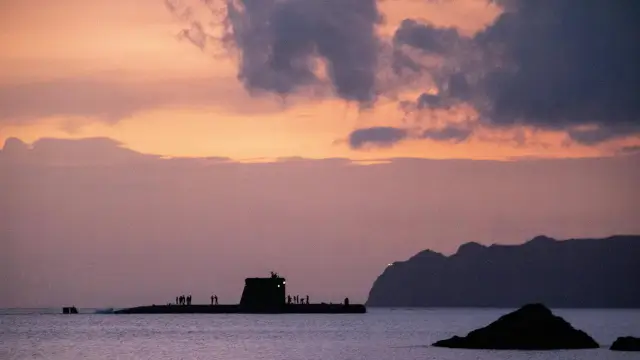
INS Aridhaman, India's 3rd indigenous nuclear-powered ballistic missile submarine (SSBN), is powered by a high-efficiency 83 MW BARC reactor. Commissioned in April 2026, it features a significantly lower acoustic signature and carries up to 8 K-4 SLBMs, moving India closer to true continuous at-sea nuclear deterrence.
What You Will Learn
- Technical specifications of the 83 MW BARC Compact Light Water Reactor.
- How the ATV Project achieves 100% indigenous manufacturing.
- India vs. China: A 2026 comparison of underwater nuclear capabilities.
- The strategic importance of the K-4 SLBM and second-strike capability.
Engineering Milestone: The 83 MW BARC Reactor
When Rajnath Singh commissioned INS Aridhaman on April 3, 2026, it wasn't just another submarine launch; it was the culmination of decades of indigenous nuclear research. At its heart lies the 83 MW Compact Light Water Reactor (CLWR) designed by the Bhabha Atomic Research Centre (BARC). This reactor is not only more powerful than its predecessor in INS Arihant but also significantly quieter, making the submarine nearly impossible for enemy sonars to detect in the deep waters of the Indo-Pacific.
The lower acoustic signature of INS Aridhaman is achieved through a new 7-blade propeller design and advanced dampening systems around the reactor core, ensuring elite-level stealth.
100% Indigenous: The Make in India Story
The Advanced Technology Vessel (ATV) project, started in the 1980s, is one of India's most classified and successful defense programs. Unlike other nations that often import reactor technology, India has built the Arihant-class submarines entirely on home soil. Over 200 Indian MSMEs contributed to the construction of INS Aridhaman at the Ship Building Centre in Visakhapatnam, proving that India has reached global maturity in complex defense engineering. This aligns with other government schemes in 2026 aimed at boosting indigenous manufacturing.
India vs. China: The Underwater Power Balance 2026
In the Indo-Pacific, the nuclear race is defined by "second-strike capability." The regional stability is further analyzed in our report on the Iran war impact on India. While China operates around 12 nuclear submarines, including 6 SSBNs, India's strategy focuses on quality and survivability. With 3 SSBNs now operational, India is approaching the threshold of Continuous At-Sea Deterrence (CASD). A fourth submarine, expected by 2028, will ensure that India always has at least one nuclear-armed vessel on patrol 24/7/365.
Key Takeaways
- INS Aridhaman is India's 3rd SSBN, commissioned on April 3, 2026.
- It is powered by an indigenous 83 MW BARC reactor with lower noise levels.
- The submarine can carry up to 8 K-4 SLBMs with a strike range of 3,500 km.
- 100% indigenous manufacturing achieved through the ATV Project and SBC Vizag.
- India is now just one submarine away from achieving continuous at-sea deterrence.
Last Updated: May 08, 2026 | Source: Indian Navy, BARC & DRDO Annual Reports (Official Website)