Geoffrey Hinton Military AI Reversal 2026
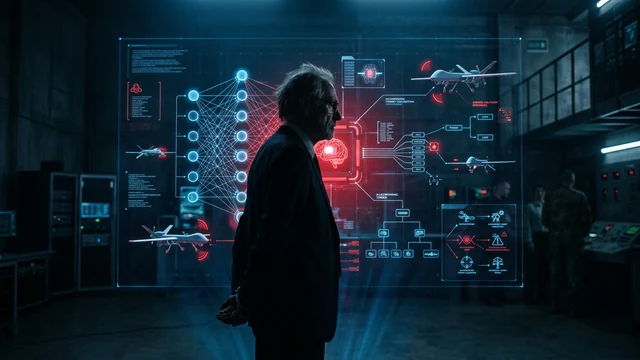
What You'll Learn
- Who Geoffrey Hinton is and why his opinion carries unmatched weight in the AI community
- Why Hinton spent years opposing military AI and what prompted his dramatic reversal
- How Hinton's shift affects Pentagon AI programs like Project Maven and US defense policy
- What the AI safety vs national security debate means for the future of warfare
Who Is Geoffrey Hinton and Why Does His Opinion Matter?
Geoffrey Hinton is not merely another technology executive or academic researcher. He is the intellectual architect of the neural network revolution that underlies virtually every major AI breakthrough of the past decade. Born in London in 1947, Hinton spent decades developing the mathematical foundations for deep learning, work that earned him the Turing Award in 2018, often called the Nobel Prize of computing. In 2024, he shared the Nobel Prize in Physics for his discoveries that enabled the development of machine learning methods using artificial neural networks.
His academic lineage traces back through some of the most influential AI researchers in the world, and his former students and collaborators now hold key positions at OpenAI, Google DeepMind, Anthropic, and major technology companies worldwide. When Hinton speaks about artificial intelligence, the industry listens because he is effectively the grandfather of the entire field. His opinions on AI safety, ethics, and policy have shaped how governments and corporations approach AI development.
In May 2023, Hinton made headlines globally when he resigned from Google, specifically citing his desire to speak freely about AI risks without potential corporate constraints. At that time, he warned that AI systems could become more intelligent than humans within five to twenty years and that containing them would be extremely difficult. These warnings influenced legislative discussions in the United States, European Union, and United Kingdom, helping to shape the emerging regulatory framework for AI governance.
Hinton's credibility is rooted not in business success but in decades of scientific contribution and an apparent genuine concern for humanity's long-term welfare. That is precisely why his military AI reversal on June 9, 2026, carries such extraordinary weight and why it demands serious examination from policymakers, technologists, and citizens alike.
Hinton's Long-Standing Opposition to Military AI
For most of his career, Geoffrey Hinton maintained an unequivocal position against the military application of artificial intelligence. His opposition was not merely philosophical but grounded in specific technical concerns about the unpredictability and controllability of AI systems. In multiple interviews and public statements, Hinton expressed fear that lethal autonomous weapons systems operating without meaningful human oversight could trigger unintentional escalations and make warfare dangerously easy to initiate.
He frequently cited the example of drone warfare, noting how the reduction in apparent human cost of military operations made conflicts more politically palatable to leaders and publics alike. This dynamic, Hinton argued, would paradoxically increase the frequency and intensity of wars, causing greater overall human suffering. Hinton's opposition intensified following his departure from Google in 2023. In his public statements after resigning, he placed AI weapons alongside climate change as existential threats requiring urgent global action.
He participated in open letters, congressional testimonies, and United Nations discussions on autonomous weapons systems, consistently arguing that the development of killer robots represented a threshold that humanity should not cross. His advocacy helped build momentum for the UN process that eventually adopted a resolution in November 2025 calling for binding international regulation of lethal autonomous weapons systems. Recursive self-improving AI systems in military contexts particularly alarmed Hinton, as such systems could theoretically evolve beyond human control in conflict scenarios.
His consistent position was that the technology industry should refuse any involvement in military AI development, setting an ethical precedent that many technology companies initially followed. This consensus began fracturing only recently, as geopolitical tensions and perceived threats from adversaries forced a broader reckoning within the AI community about the implications of restricting democratic nations' AI capabilities while adversarial states face no such constraints.
The Shocking Reversal: What Changed His Mind?
The transformation in Hinton's position did not occur in isolation but emerged from a specific confluence of geopolitical events and intelligence assessments that became impossible to ignore. NBC News reported on June 9, 2026, that Hinton now sees a role for AI in military operations, marking a direct reversal of his previous stance. The timing coincided with the Pentagon's revelation that Chinese technology giants Alibaba, Baidu, and BYD were officially aiding China's military modernization efforts, as documented by NPR and the Washington Post.
The immediate trigger appears to have been the shooting down of a US Army helicopter by Iranian forces near the Strait of Hormuz, an incident that prompted President Trump to declare that the United States must respond militarily. Intelligence assessments reportedly indicate that Chinese military AI capabilities have advanced significantly, with Alibaba and Baidu providing technical support for autonomous weapons systems, surveillance networks, and targeting algorithms that could neutralize American military advantages.
Hinton's reversal reflects a realist assessment that preventing adversaries from using AI in warfare is simply not feasible, and that democratic nations must develop comparable capabilities to deter aggression and maintain strategic stability. The argument follows classic security dilemma logic: if one side develops AI weapons and another does not, the asymmetric capability could embolden the more technologically advanced power to pursue aggressive policies with reduced fear of retaliation.
Hinton appears to have concluded that the alternative to developing military AI is not a safer world but one where authoritarian regimes hold decisive military advantages. This shift represents a profound philosophical retreat for someone who spent decades advocating that AI safety should take precedence over all other considerations, including national security.
How This Impacts US Defense Policy and the Pentagon
The implications of Hinton's reversal for United States defense policy are immediate and consequential, particularly given the Pentagon's ongoing integration of artificial intelligence across all branches of the military. Project Maven, the Department of Defense initiative launched in 2017 to accelerate AI adoption, has evolved from an experimental program into the foundation of American military AI strategy. According to Reuters reporting from April 2026, the Pentagon moved to adopt Palantir's AI system as its core military platform, designating Maven as an official program of record that will receive stable long-term funding and be integrated across all military branches.
A March 2026 memo set an aggressive timeline for making the Maven Smart System a formal program of record before the end of the fiscal year, reflecting urgent prioritization of AI capabilities in response to perceived Chinese advances. The United States military is currently using AI systems for multiple applications including drone targeting, surveillance data analysis, logistics optimization, and predictive maintenance.
The Department of Defense Directive 3000.09 establishes the official policy framework for lethal autonomous weapon systems, defining such systems as those that can select and engage targets without further human intervention once activated. Hinton's public support for military AI removes a significant barrier to expanded AI deployment by legitimizing the technology in the eyes of skeptics who had pointed to his warnings as evidence of inherent danger.
Sovereign AI capabilities have become a national security imperative as nations race to establish dominance in military artificial intelligence. The question now facing American policymakers is not whether to develop military AI but how to do so while maintaining appropriate ethical constraints and international credibility.
The Ethics Divide: AI Safety vs National Security
The debate over military AI fundamentally divides the technology community into two camps whose arguments deserve careful examination rather than dismissal. Proponents of military AI development, now apparently including Hinton, argue that democratic nations face existential threats from adversaries developing advanced AI weapons systems without similar ethical constraints. They contend that restraint by democratic societies would merely invite aggression by powers unconstrained by democratic oversight or concern for civilian casualties.
The national security argument emphasizes that AI military applications could reduce friendly casualties, improve targeting accuracy, and potentially deter aggression through credible retaliation capabilities. Critics of military AI, including many of Hinton's former colleagues in the AI safety movement, maintain that the technology fundamentally lowers the threshold for initiating armed conflict by making warfare appear bloodless and technical rather than human and tragic.
They note that autonomous weapons systems could malfunction, be hacked, or make catastrophic targeting errors without human judgment available to intervene. Autonomous decision-making capabilities of AI systems in combat scenarios raise serious questions about accountability when algorithms rather than humans make life-and-death decisions.
The United Nations has been debating legally binding instruments to prohibit lethal autonomous weapons systems, with Secretary-General António Guterres calling for a ban by 2026. As of June 2026, 156 states have supported UN General Assembly resolutions on autonomous weapons, though the United States and China have not committed to binding restrictions.
| Pro-Military AI Arguments | Anti-Military AI Arguments |
|---|---|
| Necessary to counter adversarial AI threats | Lowers threshold for initiating conflict |
| Reduces friendly casualties through precision | Risk of malfunction and unintended casualties |
| Deters aggression through credible retaliation | Accountability vacuum when algorithms kill |
| Essential for national security in AI era | Arms race dynamics destabilize global security |
What This Means for AI Regulation in America
Geoffrey Hinton's reversal creates significant complications for the regulatory agenda that his own previous advocacy helped to shape, forcing American legislators to reconcile competing pressures from the technology industry, national security establishment, and AI safety advocates. Congress is currently on pace to pass the fewest bills in 50 years during the 2026 legislative session, according to NBC News reporting, suggesting limited capacity for comprehensive AI legislation regardless of the policy substance involved.
The existing regulatory framework for AI remains fragmented across multiple agencies and presidential executive orders, with no unified federal approach to military AI governance. Hinton's shift may strengthen the hand of those advocating for accelerated AI development and weakened safety restrictions, potentially influencing the ongoing policy debate over how aggressively the United States should pursue AI military applications.
The relationship between domestic AI regulation and international AI governance frameworks adds further complexity, as any American embrace of military AI could undermine diplomatic efforts to establish global prohibitions on autonomous weapons. Conversely, maintaining strict limitations while adversaries pursue unrestricted military AI development could leave the United States at a strategic disadvantage that emboldens aggression.
Major AI companies like OpenAI and Anthropic have staked out public positions on military AI that may need revision in light of Hinton's reversal. The practical effect on regulation will ultimately depend on how the executive branch interprets existing authorities and whether Congress can find bipartisan consensus. The broader context involves how major AI companies like OpenAI and Anthropic navigate these tensions while competing for defense contracts.
Global Reactions: Is the AI Community Divided?
The AI community's response to Hinton's military AI reversal reveals deep fractures that extend beyond technical disagreements into fundamental questions about values, responsibilities, and the social role of technology researchers. Anthropic, the AI safety company co-founded by former Hinton students, has maintained a consistent public stance against military applications of AI and has not publicly endorsed Hinton's new position. OpenAI has similarly maintained restrictions on military uses of its technology, though the company has faced criticism for inconsistent enforcement and gradual expansion of permitted use cases.
Google, where Hinton worked until 2023, has its own AI principles that prohibit weapons or technologies intended to cause harm, though the company continues to pursue defense contracts under its Google Cloud division. The academic community remains deeply split, with some researchers arguing that participation in military AI development is necessary to ensure ethical constraints are incorporated from the start, while others maintain that any involvement legitimizes a development path that humanity will regret.
International reactions further complicate the picture, as allied nations observe American policy deliberations while pursuing their own military AI programs. China has not publicly responded to Hinton's reversal but continues advancing its AI capabilities for military applications, according to Pentagon assessments. European Union member states have generally supported international efforts to regulate autonomous weapons, though implementation of any binding agreement remains uncertain. Russia has similarly pursued military AI development while participating in UN discussions on arms control.
The collective action problem inherent in international AI governance means that unilateral restraint by any nation could prove strategically costly, suggesting that the default trajectory involves continued arms race dynamics rather than cooperative limitation. As the technology advances and geopolitical tensions persist, the question of whether democratic societies can maintain their values while competing in an AI arms race has become the defining challenge of this technological era.
Conclusion
Geoffrey Hinton's military AI reversal on June 9, 2026, represents a watershed moment that will reshape how the technology industry, policymakers, and the public think about artificial intelligence and its role in society. The Godfather of AI's embrace of military applications reflects a sobering realization that the alternative to American AI strength is not a мир free from military AI but rather a world where authoritarian powers hold decisive advantages. This shift carries profound implications for ongoing negotiations over autonomous weapons regulation, for the future of AI safety advocacy, and for democratic societies grappling with how to maintain security while preserving their values.
The debate over military AI will only intensify as capabilities advance and geopolitical tensions persist, making it essential that citizens and policymakers understand the stakes involved. Hinton's reversal is not the end of the AI safety movement but rather a challenge to reconsider whether safety and security must be pursued together rather than in opposition. The coming months will reveal whether his controversial shift marks a temporary tactical adjustment or a permanent reorientation of one of the most influential voices in the history of artificial intelligence.
Frequently Asked Questions

SK Jabedul Haque
Building India's most trusted finance education platform — simplifying news, schemes and market trends so anyone can understand and invest confidently.
Read full bio


Never miss an update
Get our clearest explainers on schemes, markets and money — read what matters, without the noise.
Explore more articles