PM Kisan Registration 2026
What You Will Learn
- Who may qualify for PM-KISAN and which exclusions can stop a payment
- Which identity, land, bank, and contact details are needed for registration
- How to use the official portal for registration, eKYC, status, and beneficiary-list checks
- How to handle a pending, rejected, or missing payment without using an unofficial website
What PM-KISAN registration means
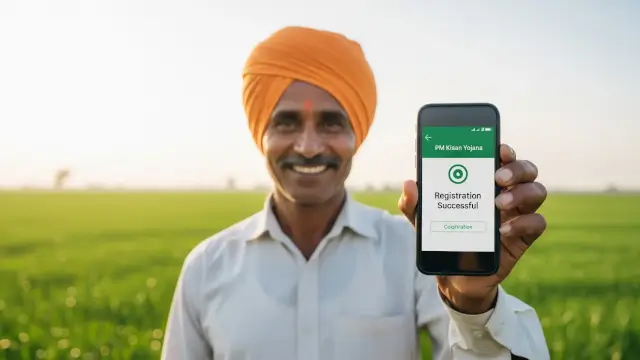
PM-KISAN registration is the process through which an eligible landholding farmer family submits details for consideration under the Pradhan Mantri Kisan Samman Nidhi scheme. The official portal says the scheme provides Rs 6,000 per year in three equal instalments of Rs 2,000, subject to the scheme rules and verification.
Registration is not the same as approval. A submitted form can be checked by the relevant state or Union Territory authorities, and land records, identity information, bank details, and exclusion declarations may be reviewed before payment. The official PM-KISAN portal is the correct starting point for a new application and status check.
The portal currently states that eKYC is mandatory for registered farmers. It also says biometric-based eKYC is available through CSC VLE logins, the PM-KISAN mobile application, and state-authorized user logins. Keep the application number and registered mobile details available after submission.
Who can apply for PM-KISAN
The official scheme definition covers landholding farmer families that have cultivable land in their names according to the land records of the concerned state or Union Territory. The family definition includes husband, wife, and minor children. The official Revised FAQ says the scheme was extended to farmer families irrespective of the size of their landholding from June 1, 2019.
A tenant farmer or a person cultivating land that remains in another person's name generally cannot claim the benefit under the landholding rule. Succession after the death of a landowner is treated separately, but the successor still needs to satisfy the other conditions and provide the required details through the applicable process.
Before registering, compare your land record, Aadhaar details, bank account, and family information. A mismatch can delay verification. Do not submit a self-declaration that you cannot support with records, because the official FAQ says an incorrect declaration can lead to recovery and other action under law.
Registration checklist at a glance
| Check | What to confirm | Why it matters |
| Land record | Cultivable land is recorded in the eligible family name | Land ownership is used for beneficiary identification |
| Identity | Aadhaar and other required identity details match the applicant | Identity verification supports the registration record |
| Bank account | Account number and IFSC code are accurate | Benefits are transferred to the beneficiary bank account |
| eKYC | eKYC is completed through an official route | The current portal marks eKYC as mandatory for registered farmers |
This checklist does not guarantee approval. It helps identify common gaps before a form is submitted or a pending application is followed up.
Details and documents needed
The official Revised FAQ lists the core information used for enrolment. This includes the farmer's name, age, gender, category where applicable, Aadhaar number, bank account number, and IFSC code. The FAQ describes the mobile number as advisable when available because it can help communicate information about the transfer.
| Information | Practical preparation | Review before submission |
| Name and personal details | Keep the spelling consistent with official records | Check name, age, gender, and category fields |
| Aadhaar or accepted identity record | Use the document and route accepted by the portal or authority | Check authentication and spelling |
| Bank account | Keep the account number and IFSC code ready | Confirm the account is active and belongs to the eligible applicant |
| Land information | Use the state land record details where requested | Check ownership and cultivable status |
Do not email or share Aadhaar, bank, OTP, or identity documents with a person who promises instant approval. Enter personal information only on the official PM-KISAN domain or through an authorised government channel.
How to register on the official portal
Open pmkisan.gov.in and locate New Farmer Registration. Use the portal's own registration flow rather than a search advertisement or a third-party form. The official FAQ says the online form contains mandatory fields and a self-declaration about eligibility.
Enter the requested identity, location, land, bank, and contact details carefully. Review the spelling of the name, Aadhaar information, bank account number, IFSC code, and mobile number before submission. Save the acknowledgement, temporary ID, or registration number shown by the portal.
The official FAQ describes an automated forwarding process to the State Nodal Officer for verification after a new registration is submitted. The registration record may therefore remain pending while officials check the data. A pending status is not proof of approval or rejection.
After submission, return to the official portal rather than creating repeated applications. Duplicate records can make a family-level verification problem harder to resolve. If the form cannot be submitted, record the exact message and use the official grievance or help route.
How to complete Aadhaar eKYC
The current PM-KISAN home page clearly states that eKYC is mandatory for registered farmers. Use the option displayed on the official portal or an authorised method listed there. Depending on the available route, the process may use Aadhaar authentication, a registered mobile OTP, biometric verification, the official mobile application, or an authorised service point.
Do not treat an OTP request from an unknown caller as an official eKYC step. Government staff or a service provider should not need your banking PIN. If an authentication attempt fails, compare the name and identity details with the official record and try the correct authorised route.
| eKYC route | Use case | Safety check |
| Official portal flow | Online identity confirmation for the registered record | Check the exact pmkisan.gov.in domain before entering details |
| CSC VLE biometric route | Assisted verification through an authorised service point | Ask for the acknowledgement and do not disclose a banking PIN |
| PM-KISAN mobile application | Official mobile route mentioned on the portal | Install only from the recognised app channel |
| State-authorized user login | Verification handled by an authorised state user | Keep the reference and date of completion |
The portal also says that biometric-based eKYC is available for CSC VLE logins, the PM-KISAN mobile application, and state-authorized user logins. Availability can depend on the route and the applicant record. Keep the date of completion and any confirmation message for later follow-up. The camp verification guide also explains why a location or service claim should be checked against an official notice.
How to check registration and payment status
Use the official Know Your Status page for the registration record. The page asks for a registration number and says an OTP will be sent to the registered mobile number. It displays payment status, bank name, UTR number, payment mode, account credited, credited date, and financial-year-wise eKYC information.
| Portal result | Meaning to investigate | Next careful step |
| Registration pending | Verification or approval is not complete | Keep the temporary or registration number and check later |
| eKYC incomplete | The mandatory identity step is not recorded as complete | Use the official eKYC route and check the status again |
| Payment not credited | Bank, approval, exclusion, or transfer data may need review | Read payment details and contact the authorised grievance channel |
| Record not found | The entered number or mobile details may not match the record | Recheck the official number and avoid making a duplicate form |
The current beneficiary-list page shows state, district, sub-district, block, and village filters. Use the official beneficiary list only as a public record check. A name in a list does not remove the need to review the individual payment and eKYC details.
Benefit amount and instalment information
The official PM-KISAN scheme information states that the annual benefit is Rs 6,000 per eligible family, paid in three equal instalments of Rs 2,000 every four months. The payment goes directly to the beneficiary bank account after the record is verified and included for transfer.
The portal currently says the 23rd instalment was released on June 20, 2026 from Tarakeswar, Hooghly, West Bengal. This is a current portal announcement reviewed on August 21, 2026, not a promise that every registration will receive payment on the same date. Payment depends on eligibility, approval, eKYC, bank details, and other checks.
The home page also displays 9,44,65,646 farmers benefited for the April to July 2026-27 period. That is a portal-wide period figure and should not be read as an individual payment confirmation. For an individual record, use Know Your Status and the bank account information shown there.
Do not rely on a social media post that predicts a future instalment date. Check the official PM-KISAN portal or an official government release for any new announcement. For a dated market-information workflow, the source-and-date guide shows the same principle without replacing the official PM-KISAN source.
Exclusions and land-record checks
The official scheme page lists several exclusion categories. These include institutional landholders, present or former constitutional post holders, ministers and legislators, serving or retired government officers and employees except the stated Multi Tasking Staff or Class IV or Group D categories, pensioners receiving Rs 10,000 or more monthly except the stated staff categories, income-tax payers, and practicing professionals such as doctors, engineers, lawyers, chartered accountants, and architects.
The official guidance records February 1, 2019 as the eligibility cut-off date, with an exception for succession after the death of a landowner. The portal currently flags suspected cases where land ownership was acquired after that date or where more than one family member receives benefits. It says benefits in such cases may be temporarily withheld until physical verification.
Land records should be clear and updated. A person may cultivate a plot but still fail the general landholding rule if the record remains in another person's name. If ownership changed through inheritance, ask the local revenue authority how the record must be updated before relying on the PM-KISAN registration process. scheme verification guide offers another example of separating eligibility evidence from a general benefit claim.
How to handle pending or rejected registration
First identify whether the issue is registration, eKYC, land ownership, bank details, exclusion review, or payment transfer. These are different stages. Write down the exact portal message, the date checked, the registration or temporary number, and the details that need correction.
Do not create multiple applications to solve a status problem. Check the official status page, correct only the information that the authorised process permits, and contact the responsible state or district channel when land records or verification are involved. If a bank account or IFSC code is wrong, ask the bank and the authorised scheme channel how the record can be corrected.
The PM-KISAN portal also provides an official grievance page. It says a temporary ID should be used when a registration is new or pending approval at any level. Keep the acknowledgement and any response because a grievance reference can help distinguish a technical problem from an eligibility decision.
Grievance safety and official-source rules
Use only pmkisan.gov.in and government-authorised channels for PM-KISAN registration and status work. The official portal is maintained by the Department of Agriculture and Farmers Welfare, Ministry of Agriculture and Farmers Welfare, Government of India, with site hosting by the National Informatics Centre.
Never share an OTP, ATM PIN, internet banking password, or card security code with a caller. A registration helper should not ask you to pay a private fee for guaranteed approval. Confirm the domain spelling before entering Aadhaar or bank information, and close pages that imitate the portal.
For official scheme definitions, read the Revised PM-KISAN FAQ. For a broader digital-service comparison, the RAG guide shows why a source and a dated record matter when information is retrieved from a system.
Conclusion: register carefully and verify every stage
PM Kisan Registration 2026 should be completed through the official PM-KISAN portal with accurate land, identity, bank, and contact information. Complete eKYC through an authorised route, save the registration record, check Know Your Status, and use the beneficiary list only as a public cross-check. The official portal's current instalment announcement does not replace individual eligibility and payment verification.
Frequently Asked Questions

SK Jabedul Haque
Building India's most trusted finance education platform — simplifying news, schemes and market trends so anyone can understand and invest confidently.
Read full bio


Never miss an update
Get our clearest explainers on schemes, markets and money — read what matters, without the noise.
Explore more articles