Karmashree Scheme 2026
What You'll Learn
- Who can seek work under the Karmashree scheme in West Bengal
- How Job Cards, work-demand forms, and the 14-day demand limit fit together
- Why the 50-day objective is not an automatic cash payment
- How Gram Panchayats, BDOs, districts, and the official portal support the process
What Is Karmashree Scheme 2026?
Karmashree Scheme 2026 is a West Bengal employment-generation programme for rural unskilled workers. The official South 24 Parganas district page says the scheme was first announced in the State Budget for 2024 to 2025 and combines several schemes under the labour department.
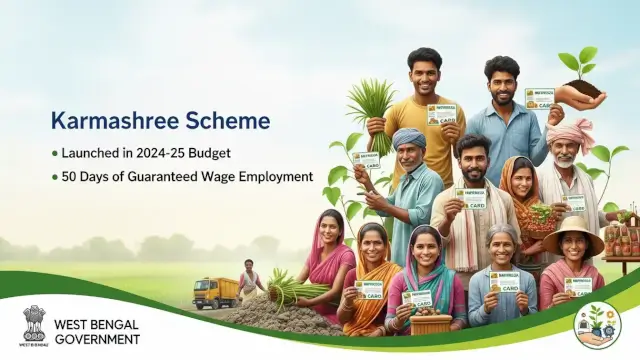
The stated objective is to provide at least 50 days of wage employment to each Job Card holder household in a financial year through works implemented by different departments of the State Government. It is a work-demand and wage-employment route, not a monthly allowance scheme.
The scheme is implemented throughout West Bengal. The exact availability of work depends on registration, demand, departmental works, local administration, and feasibility. A reader should not interpret the 50-day objective as an automatic transfer or as a promise of work without submitting a valid demand.
| Scheme point | Official description | What it means |
|---|---|---|
| Target Group | Rural unskilled workers connected with MGNREGS Job Cards | Job Card status matters |
| Main objective | At least 50 days of wage employment per Job Card holder household in a financial year | It is an employment objective, not a flat cash grant |
| Area | Entire area of West Bengal | Local implementation is through Panchayat and Block offices |
| Work type | Departmental works | Availability depends on approved work and feasibility |
Who Is Eligible for Karmashree?
The official district page says rural unskilled workers registered under Mahatma Gandhi NREGS through Job Cards are eligible to get employment under Karmashree. It also says a willing unskilled worker who does not have a Job Card should be issued one following the prescribed procedure so they can seek employment.
The page's citizen-service table also states that a job seeker should be an Indian citizen and should have completed 18 years of age at the time of application. The Job Card and local verification route remain central to the process.
Eligibility should be checked through the local Gram Panchayat or Block Development Office. Do not confuse the scheme with Banglar Yuba Sathi, which is a separate 2026 financial-assistance programme for educated unemployed youth. The Jubo Sathi guide covers that different scheme.
| Eligibility factor | Official position | Verification route |
|---|---|---|
| Worker profile | Rural unskilled worker | Local administration and Job Card records |
| Registration | Registered under MGNREGS through a Job Card | Check Job Card details with Gram Panchayat or Block office |
| Age | District page says 18 years completed at application | Use the prescribed local process |
| Citizenship | Citizen of India in the scheme table | Follow the local document requirements |
How Does the 50 Day Employment Objective Work?
Karmashree's 50-day figure refers to wage employment for each Job Card holder household in a financial year. The official page says the work is provided through various works implemented by different State Government departments.
The figure should be read together with the demand process. A household must have the relevant Job Card and workers must demand employment through the prescribed route. Work is then allocated according to the available departmental work and local feasibility.
This is why a reader should not treat Karmashree as a fixed monthly payment. The Banglar Yuba Sathi article explains a different monthly support programme. Karmashree is about wage employment generated through demand and departmental works.
How to Get or Check a Job Card?
The official district page says a worker who wants employment but does not possess a Job Card should be issued one following the prescribed procedure. The local Gram Panchayat is the first practical contact for a rural worker seeking to understand the Job Card route.
Keep the Job Card details consistent with the worker's identity and household records. If there is a correction, duplication, or missing entry, ask the local office for the prescribed correction process. Do not rely on an unofficial agent who promises a guaranteed work allocation.
The official Karmashree portal is hosted under the Department of Panchayats and Rural Development, Government of West Bengal. The Karmashree portal should be checked for current notices and system availability.
How to Demand Work Under Karmashree?
The official district page says an unskilled worker seeking employment should apply before the Gram Panchayat or Block Development Office using the specified Work Demand Form. When the form is received, a proper receipt should be provided.
The form should state the employment demand and use the worker's Job Card and Aadhaar details as required by the prescribed register. Retain the receipt because it is evidence that the demand was submitted through the local route.
The demand is not an online cash application. A person who sees a private website promising instant Karmashree money should verify the claim with the Gram Panchayat, Block Development Office, or official district information page. The NemoClaw guide has an unrelated technical example of why current official prerequisites matter.
What Is the 14 Day Work Demand Limit?
The official page says a worker can demand a maximum of 14 days of work at a stretch. On the basis of the demand, the worker may be engaged for a maximum period of 14 days at a stretch in a departmental work.
After that period, a Job Card holder can submit further demands for future employment. The page says future work is provided according to feasibility. Therefore, 14 days is a demand and engagement limit at a stretch, while 50 days is the household employment objective in the financial year.
| Number or time rule | Official meaning | Common mistake |
|---|---|---|
| 50 days | At least 50 days of wage employment objective per Job Card holder household in a financial year | Calling it a guaranteed cash payment |
| 14 days | Maximum work demand or engagement at a stretch according to the district page | Assuming no later demand can be submitted |
| Financial year | The period used for the annual employment objective | Mixing it with a monthly allowance cycle |
| Future demand | Later demands may be submitted by a Job Card holder | Assuming work is automatic without feasibility |
How Is Work Allocated and Recorded?
The Gram Panchayat or Block Development Office maintains a Demand and Allocation Register according to the official page. The register contains Gram Panchayat wise lists of workers demanding jobs and their Job Card and Aadhaar details.
On the basis of a demand, the worker can be engaged in departmental work for the stated period. The local office, departmental officers, and agencies must coordinate to connect unskilled workers with available works. Keep the demand receipt and ask how the work entry will be recorded in the Job Card or prescribed register.
A worker should not hand over original identity documents to an unverified person. If a document is required for inspection, ask for the official office and receipt procedure. The source verification guide is useful for assessing forwarded claims, while local officers remain the authority for scheme records.
Which Authorities Monitor the Scheme?
The official district page says Block Development Officers play a pivotal role at the ground level in coordination with other department officers. The District Nodal Officer for MGNREGS coordinates district department officers and BDOs to support the supply of unskilled workers for departmental works.
The District Magistrate remains overall in charge of implementation in the district. One Additional District Magistrate functions as the nodal ADM for the scheme. Panchayats and the Rural Development Department function as the nodal department for implementation.
This structure explains why a worker should start with the Gram Panchayat or Block office for a work demand, and escalate through the prescribed district route if a record or allocation problem remains unresolved.
What Services Does Karmashree Offer?
The district page's citizen-services list includes providing Job Cards, generating employment at the grassroots level of rural society, empowering rural women, and providing at least 50 days of wage employment. These descriptions express the programme's public-service objective.
The actual work will depend on departmental projects and local feasibility. A reader should ask which work is currently sanctioned in the relevant Gram Panchayat or block, how a demand is recorded, and how the worker will receive the wage under the applicable process.
Karmashree should also be kept separate from Karma Sathi Prakalpa, a different self-employment and enterprise-support route, and from Yuva Sathi, a separate youth assistance scheme. The student guide is included only as a general example of checking official access terms, not as a scheme source. The Aadhaar DBT guide covers a separate verification topic and is not an application source.
What Documents and Details Are Needed?
The Karmashree district page focuses on the Job Card, Work Demand Form, Job Card details, and Aadhaar details in the Demand and Allocation Register. The exact document list can depend on the prescribed local procedure for issuing or correcting a Job Card and submitting a demand.
Keep identity and household records ready, along with the Job Card if already issued. Ask the Gram Panchayat or Block Development Office which copies, photographs, declarations, and bank or Aadhaar details are required for the current transaction. Avoid publishing sensitive numbers online.
| Record or item | Why it matters | Safe handling |
|---|---|---|
| Job Card | Connects the worker and household to MGNREGS registration | Check name, household, and worker entries |
| Work Demand Form | Records the request for employment | Submit through the local office and retain the receipt |
| Aadhaar details | Included in the Demand and Allocation Register details | Share only through the official process |
| Household information | Relevant to the household employment objective | Correct inconsistencies through the prescribed office |
How to Check Current Status and Avoid Scams?
Start with the official Karmashree portal, the West Bengal government scheme information, or the district administration page. The current portal may load notices or statistics differently from a static district description, so use the latest official notice for operational changes.
For an employment demand, check the receipt, Demand and Allocation Register entry, Job Card record, local work availability, and wage record through the responsible office. A phone number or social media post is not proof that a worker has been allocated work.
Do not pay for a free Job Card or submit Aadhaar, bank details, OTPs, or passwords to an unverified agent. The dated guide method used elsewhere on this site also applies here: put an update date on changing information and trace claims to an official source.
Similar names create confusion. Karmashree is a rural wage-employment programme connected with MGNREGS Job Cards and departmental works. Karma Sathi Prakalpa is a different enterprise or self-employment support route. Banglar Yuva Sathi is a separate West Bengal youth assistance programme with its own age, education, unemployment, and payment conditions.
Before applying, compare the department, beneficiary group, benefit type, Job Card requirement, age rule, application route, and official notification. A reader searching Karmashree online may accidentally open a page for Karma Sathi or Yuva Sathi and submit the wrong information.
The Yuva Sathi comparison guide covers the separate monthly-assistance scheme. The AI agent guide is unrelated and is linked only for internal reading context.
Final Verdict: Karmashree Scheme 2026
Karmashree is a West Bengal rural employment route for eligible unskilled workers connected with MGNREGS Job Cards. The official objective is at least 50 days of wage employment for each Job Card holder household in a financial year through departmental works. The worker must demand employment through the Gram Panchayat or Block Development Office, keep the receipt, and follow local verification.
The 14-day rule concerns work demand or engagement at a stretch, while later demands may be submitted according to feasibility. The scheme is not a monthly allowance and should not be confused with Karma Sathi or Banglar Yuva Sathi. Check the current official portal and district administration for notices, work availability, records, and any changed procedure.
Frequently Asked Questions

SK Jabedul Haque
Building India's most trusted finance education platform — simplifying news, schemes and market trends so anyone can understand and invest confidently.
Read full bio


Never miss an update
Get our clearest explainers on schemes, markets and money — read what matters, without the noise.
Explore more articles