Yogyashree Scheme 2026
What You'll Learn
- What Yogyashree provides and why it should be read as pre-examination training
- How to interpret category, residence, academic and document conditions in a current notice
- How to locate the correct district application route and preserve submission evidence
- How to verify selection lists, centre instructions and claims about financial support
What Is Yogyashree Scheme 2026?
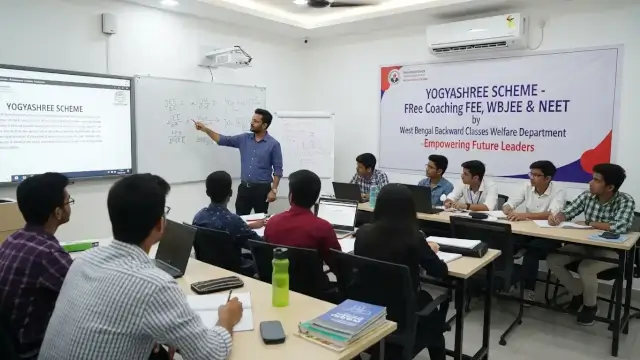
Yogyashree Scheme 2026 is a West Bengal government pre-examination training programme for students who are preparing for competitive entrance examinations. Official district material reviewed for this article describes free training under the Yogyashree name for JEE, WBJEE and NEET. The purpose is practical: students who need structured preparation can be connected with a government-supported coaching arrangement instead of being told to rely only on private tuition.
The programme is not the same as admission to an engineering or medical institution. A student must still satisfy the current notice, submit the requested records, complete any screening or verification process, attend the assigned centre and take the relevant entrance examination. A selected place in coaching can support preparation, but it does not change the rules of the examination or create a guaranteed college seat.
The safest starting point is the official WBCDev Yogyashree selection page. The page is titled YOGYASHREE 2026 LIST OF SELECTED CANDIDATES and is organised through district-wise links. That structure is important because the notice, closing date, form route and centre information can differ between districts.
Students comparing state support programmes should not merge Yogyashree with the objectives of the West Bengal Kanyashree Prakalpa. Kanyashree addresses a different policy need, while Yogyashree is focused on pre-examination preparation.
What training and support does the scheme provide?
The consistent benefit supported by the official source set is free pre-examination training for the examination targets named in a particular notice. The available district material identifies JEE, WBJEE and NEET. It does not establish that every centre provides the same teachers, study material, test schedule, travel support, accommodation or cash assistance. Those details belong to the current advertisement and the joining communication.
| Programme element | What the source supports |
|---|---|
| JEE preparation | Pre-examination training may be offered for students preparing for the engineering entrance route named in the notice |
| WBJEE preparation | A district notice may include preparation for the West Bengal Joint Entrance Examination |
| NEET preparation | A district notice may include preparation for the national medical entrance examination |
| Training cost | Official district material describes the relevant Yogyashree training as free of cost |
| Centre facilities | Teachers, tests, material, timing and any additional support must be confirmed from the current notice |
The word free should be read carefully. It refers to the training arrangement described in the official notice. It does not mean that a student will have no travel, stationery, device, examination or personal study expense. It also does not mean that every private service using the Yogyashree name is authorised. Never pay an intermediary merely because a form or message uses the scheme name.
The Sabooj Sathi Scheme guide is useful for understanding why one state programme should not be used to infer the benefit structure of another. Each programme has its own department, notice and operating conditions.
Who may be eligible for the current batch?
Eligibility is notice-specific. Official district notices reviewed for the Yogyashree coverage identify SC, ST, General, OBC and Minority students for particular training batches. That does not create a permanent entitlement for every student in every district. The applicant must read the complete notice for the relevant examination target and application window.
| Eligibility area | Question to verify in the notice |
|---|---|
| Category | Does the advertisement include the applicant's category and ask for supporting proof? |
| Residence | Does the student meet the West Bengal or district residence condition stated by the issuing office? |
| Academic stage | Does the student's present class, school status or higher-secondary stage match the batch description? |
| Academic record | Does the latest marksheet meet the academic condition printed in the advertisement? |
| Family condition | Does any income or economic condition apply, and what document proves it? |
| Examination target | Is the student applying for JEE, WBJEE, NEET or another target named in that notice? |
Many online summaries copy a marks threshold, age rule or income ceiling from one district and present it as a universal Yogyashree rule. That is not a safe approach. The official pages establish the programme and show district notices, but a single fixed threshold for every current batch was not established in the source set used for this rewrite. If a condition is not in the notice for the student's district, treat the online claim as unverified.
Applicants can review the Banglar Yuva Sathi registration guide for a separate example of why a state application should be checked against its own official route. It is not an eligibility source for Yogyashree.
Which documents should applicants prepare?
Prepare a document folder before the application window opens, but submit only what the current advertisement requests. Keep originals available for inspection and provide copies only when the notice permits them. A student should never hand over an original certificate without an acknowledgement, a written requirement or a clearly identified government office.
| Record | Why it may be requested |
|---|---|
| Application form | Records the examination target, contact details and applicant declaration |
| Residence proof | Supports the state or district residence condition in the advertisement |
| Category certificate | Supports SC, ST or OBC status when category evidence is requested |
| Community proof | Supports a Minority category claim where the notice asks for it |
| Recent marksheet | Allows the office to check the academic condition for that training batch |
| School or enrolment proof | Confirms the student's current academic stage and institution |
| Identity record and photographs | Supports identity matching and the applicant record |
| Income proof | Supports an income condition when the current notice includes one |
Names, dates of birth and category details should be consistent across the application and supporting records. If a residence or income certificate is required, check the issuing authority, date and validity wording. The pension schemes guide offers general document-reading context, but the Yogyashree advertisement remains the controlling source.
How do you find the current application notice?
Start with the district administration website, the Backward Classes Welfare office, the school notice board and the WBCDev page. Search with the examination year and the phrase used in the advertisement. A repost or search result can help locate a notice, but it should not be the final authority for the closing date or form instructions.
- Identify the district connected to the applicant's residence or to the route named in the notice.
- Open the district website and search its notices for Yogyashree pre-examination training.
- Read the examination target, category list, document list, office address and closing date.
- Use only the form, QR route or office named by the issuing authority.
- Save the notice and note the submission method before sending any record.
District examples show why this check matters. The official Howrah material carries a notice for free Yogyashree pre-examination training for JEE, NEET and WBJEE. The Uttar Dinajpur material describes a Yogyashree advertisement for SC, ST, General, OBC and Minority students and mentions an optional department-provided QR-code route. These examples support district variation, not a universal online process.
The DBT and document-verification guide can help with record keeping, but it is not an official Yogyashree form.
Is the application online or offline?
There is no single answer for every Yogyashree batch. A district may ask for a physical submission at a named office, or it may publish a QR code or online form with the advertisement. The correct route is the one printed in the current notice. Do not assume that a form found on a coaching website, messaging group or social-media page is authorised.
For an offline submission, take an acknowledgement showing the applicant name, date and receiving office. For an online or QR-based submission, save the confirmation screen, reference number and submitted document list. If a page asks for a payment that is not described in the official notice, stop and verify it with the designated office.
The application route can also change when an agency or training centre is selected. A previous batch's form may remain online even after its deadline. Check the notice date and the examination year before sending personal documents. The Aadhaar and NPCI status guide is relevant only for general document and bank-record checks, not as proof that a Yogyashree applicant must complete a DBT step.
How does selection and the merit list work?
Submitting an application does not by itself establish selection. The district may check documents, conduct a screening test, prepare a merit list and issue joining instructions. The official WBCDev selection page reviewed for this article is explicitly titled as the 2026 list of selected candidates and provides district-wise merit-list links.
The page is arranged through district rows, including links running from Alipurduar through Uttar Dinajpur. The page structure helps a student find the relevant district, but it does not prove that every district has the same number of seats, centre, timetable or selection test. Those conditions must be read in the notice and the joining communication.
| Selection stage | What the applicant should do |
|---|---|
| Notice review | Confirm examination target, category, documents, office and deadline |
| Application | Submit through the official route and save the receipt or digital confirmation |
| Screening | Attend a written test or document verification when named by the notice |
| Merit list | Use the official district or WBCDev page and the permitted identifier |
| Joining | Report to the assigned centre with the requested original records |
When checking a merit list, compare the district, examination target and applicant identifier. A name on a different district list does not prove selection for the student's own application. If a PDF or page is difficult to read, confirm the link through the department or district office rather than relying on a cropped screenshot.
What should applicants know about screening and attendance?
A screening test or verification stage is a normal possibility in a pre-examination training programme, but the exact format is controlled by the current advertisement. Do not copy a test duration, syllabus, cut-off or question pattern from an old post unless the new notice repeats it.
Preparation can remain practical. Revise the school-level concepts relevant to the selected entrance examination, practise timed questions, keep the application evidence available and plan travel to the notified venue. If the centre has an attendance condition, ask how absence is recorded and whom to contact when a genuine problem occurs.
Free training still requires consistent work from the student. Coaching cannot replace independent revision, official examination registration or the examination authority's rules. The student should also check whether the coaching schedule fits school, travel and family responsibilities before accepting the place.
Where can applicants verify coaching-centre details?
Take centre information from the current district notice, joining letter or official selection communication. The WBCDev page can help locate district-wise selection links, while the district administration page provides the local notice and submission instructions. A centre named in an old article may not be the centre for the current batch.
Before travelling, confirm the centre name, address, reporting date, contact office and documents to carry. If an agency or training partner is named, check that the name appears in the official communication. Do not share personal records with a centre that cannot show the department or district notice connecting it to the programme.
For a separate state-benefit comparison, the Lakshmir Bhandar guide explains why benefit delivery and eligibility should be verified from the scheme's own department. It should not be used to infer Yogyashree centre rules.
What claims about stipends and benefits need caution?
Readers should be cautious with fixed monthly stipend claims, guaranteed selection claims and statements that every student receives the same materials or travel support. The official source set used for this rewrite confirms free pre-examination training and the district-wise notice structure. It does not establish one universal cash benefit or identical support package for every Yogyashree batch.
If a current advertisement specifies a stipend, allowance, material grant or attendance condition, preserve that notice and read the payment or eligibility clause in full. Check who receives the support, when it is released, what records are needed and whether attendance or selection status affects it. A figure repeated by a private page is not enough evidence.
This distinction protects applicants from two errors. A student should not reject a legitimate free-training opportunity because an old summary omitted a local benefit. A student should also not pay a fee or plan household finances on the basis of an amount that the current district notice does not confirm.
How should a student prepare after selection?
After selection, save the merit-list page or PDF, joining communication and centre contact details in more than one place. Read every instruction about reporting, attendance, identity records and academic documents. Ask the designated office about any unclear condition before the first class rather than relying on an unofficial message.
Create a study plan that combines the coaching schedule with independent practice. Keep a record of topics completed, questions attempted and areas that need help. Students preparing for JEE, WBJEE and NEET have different examination patterns, so the preparation plan should follow the target examination's official information rather than a generic coaching claim.
Continue to verify the entrance examination itself through the relevant examination authority. Yogyashree coaching does not replace the candidate's responsibility to complete the examination application, pay any official examination fee that applies, carry the required identity record and follow the examination body's timetable.
What is the safest checklist before applying?
Use a short verification routine before submitting the form. First, match the examination year and district. Next, check the category, residence, academic and document conditions in the notice. Then confirm the form route, closing date, office or QR process. Finally, save proof of submission and wait for the official selection communication.
Do not treat a social-media poster, private coaching advertisement or forwarded message as a replacement for the department notice. When two pages disagree, prefer the official district page or the Backward Classes Welfare source and record the page title and date you relied on. This makes it easier to explain the application if a document or selection question arises later.
In short, Yogyashree Scheme 2026 should be approached as a district-notice-led free training opportunity for eligible and selected students. The reliable path is to verify the examination target, read the local conditions, apply through the named route and confirm the merit list from an official page. Training support is useful, but it is not a promise of admission, marks or employment.
Frequently Asked Questions

SK Jabedul Haque
Building India's most trusted finance education platform — simplifying news, schemes and market trends so anyone can understand and invest confidently.
Read full bio


Never miss an update
Get our clearest explainers on schemes, markets and money — read what matters, without the noise.
Explore more articles