WB Welfare June 2026: Annapurna, Free Bus & Ayushman
What You'll Learn
- What the official West Bengal State Portal confirms about Annapurna Yojana, including the stated benefit, age range and application route.
- Why free-bus and Ayushman Bharat statements should be separated from the official Annapurna details.
- Which documents and status checks are shown by the official Annapurna portal.
- How to avoid fake links, unverified promises and outdated instructions when checking a welfare benefit.
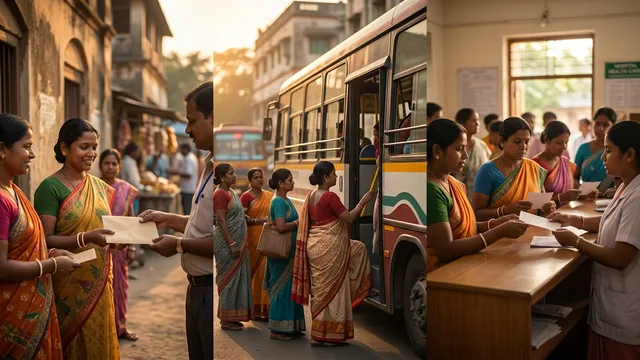
West Bengal’s June 2026 welfare story was published as one combined political and policy narrative. It grouped a new Annapurna cash-support programme, free travel for women on government buses, and the proposed or announced implementation of Ayushman Bharat. That framing is easy to read but not sufficient for a reliable public-service guide. Each measure has a different department, evidence trail, eligibility question and operational risk.
The most important editorial correction is to distinguish what is confirmed on an official page from what was reported as an announcement. The West Bengal State Portal’s Annapurna Yojana page provides a specific benefit, eligibility conditions, documents and application route. By contrast, the available evidence for free bus travel and Ayushman Bharat is a dated secondary report about a June rollout. That report is useful context, but it is not a substitute for a current transport notification, health-department notice, beneficiary lookup or card-status result.
What changed in West Bengal’s June 2026 welfare agenda?
The June narrative covered three separate policy tracks. Annapurna Yojana is a cash-assistance programme for eligible female residents. The free-bus measure concerns travel on government-run buses and therefore depends on transport-system instructions, route coverage and enforcement at the point of boarding. Ayushman Bharat concerns healthcare eligibility and enrollment under the national programme, so its practical availability depends on official beneficiary systems, empanelled facilities and current state-level implementation.
These tracks should not be treated as one combined application. A person may need to use the Annapurna family-level data process for one benefit, check a transport instruction for another, and use the national health-programme channels for healthcare eligibility. A single social-media post or a blog headline cannot prove that all three are open, universal or operating under identical conditions.
The earlier article treated all three as completed and fully operational from June 1, 2026. The safer updated interpretation is narrower. A government source confirms the Annapurna page and portal details. A secondary report describes the June 1 announcement and intended rollout of the other measures. Readers should verify any current operational change before travelling, submitting documents or relying on a health benefit.
Annapurna Yojana: the official benefit and eligibility
The State Portal describes Annapurna Yojana as a welfare scheme intended to support the empowerment and socio-economic upliftment of women. It states that eligible female residents of West Bengal between the ages of 25 and 60 can receive Rs. 3,000 per month. The page also lists conditions: the intended beneficiary must not hold permanent government employment, must not be an illegal immigrant, and must not be an income-tax payer.
Those are the conditions displayed by the government page used for this update. They should be read as an eligibility description, not as an automatic approval promise. A form submission can still require local verification, family-level data collection, identity matching, bank or record checks, and a decision by the responsible authority. Readers should also check whether a later official notice modifies the page, because welfare rules and implementation instructions can change.
The scheme’s stated payment is a monthly amount, but the public page does not turn every applicant into a confirmed beneficiary. A reader should not pay an agent, share an OTP, upload documents to an unverified website or assume that a viral registration link is genuine. The official page is the safer starting point, just as our credit-score guide explains why identity and financial information should be handled carefully.
What the official Annapurna page actually confirms
The official page gives four practical categories of information: the scheme’s purpose, the stated beneficiary conditions, the monthly benefit and the application process. It names the Family Level Data Collection form and says it can be submitted in person at Block Development Officer offices, Sub-Divisional Officer offices or ward offices within the Kolkata Municipal Corporation area. It also lists an online route at socialregistry.wb.gov.in.
The same page lists EPIC or Voter ID, Aadhaar and an active mobile number as mandatory documents. This is a short public list, not permission to upload additional documents wherever a third-party page asks for them. If a local office requests extra evidence, the applicant should ask which official instruction authorizes it and keep copies of anything submitted.
The State Portal page says it was last updated on June 26, 2026 and attributes the information to the Department of Information and Cultural Affairs, Government of West Bengal. That date matters: the page is stronger evidence than an undated social post, but it is still sensible to confirm the live status before taking action. The government page should be bookmarked directly rather than reached through a shortened link.
Free bus travel for women: announcement versus operation
India Today reported on May 11, 2026 that West Bengal planned a June 1 rollout of free travel for women on government buses. The report described the measure as part of a wider welfare announcement. It is useful evidence of the public announcement, but it does not by itself answer every operational question a passenger has.
For example, a reader still needs to know which transport undertakings and routes participate, whether ordinary state-run buses and special services are treated identically, whether any identification is required, how conductors are instructed to record the concession, and what happens when a bus crosses an administrative or service boundary. The original post presented universal free travel as settled without showing a current transport order. This update does not invent those missing details.
Before relying on the concession, check a current notice from the West Bengal transport authority or the relevant state-run bus operator. Confirm the route, service type and any identification requirement at the official source. Do not hand over an Aadhaar copy or pay a fee to obtain a supposed women’s travel card unless a government notice explicitly requires it.
The policy’s possible social effects can be discussed without claiming that every promised outcome has already occurred. Lower travel costs may help some women reach work, education, healthcare and markets, but the result depends on route frequency, safety, crowding, accessibility and actual implementation. Transport planning has an administrative side similar to the service questions discussed in our smart-cities guide.
Ayushman Bharat in West Bengal: what readers should verify
The same India Today report said West Bengal would implement Ayushman Bharat from June 1 and described the change as a major healthcare-policy shift. That is a dated report of an announced rollout. It does not prove that every resident became eligible, that every hospital was immediately empanelled, or that an application card could be issued through a random website.
The national programme has its own official ecosystem, but the PM-JAY public pages were not fully accessible in the evidence check used for this article. The official PM-JAY website should therefore be used directly when available, along with verified helpline and beneficiary-check channels. A health benefit must never be inferred only from a political announcement or a blog’s claim that one state scheme has replaced another.
The old article said Ayushman Bharat replaced Swasthya Sathi. That is too categorical for the evidence available here. A report can describe a new implementation while a state’s existing programme, transition arrangement or hospital process continues in parallel. Readers should look for an official notice explaining the relationship between programmes, eligibility, treatment access, card issuance and grievance handling.
Health decisions require extra caution. If a hospital or intermediary says that coverage is active, ask for the official beneficiary record and the name of the empanelled facility. Do not delay urgent treatment while waiting for an online article to resolve eligibility. For general background on digital systems in health services, readers can consult our healthcare-technology explainer, but that educational article is not a substitute for an insurance eligibility check.
How to apply for Annapurna Yojana safely
Start at the official West Bengal scheme page and read the displayed conditions. If you appear to qualify, use the Family Level Data Collection form route described there: the relevant BDO or SDO office, a KMC ward office where applicable, or the online social registry address linked by the government page. Type the domain yourself or follow the direct link from the State Portal rather than using a forwarded registration message.
Keep the listed EPIC or Voter ID, Aadhaar and active mobile number available, but submit them only through the official route. The Annapurna portal at socialsecurity.wb.gov.in visibly provides applicant-status tracking and form downloads in English, Bengali and Hindi. Its visible page also identifies the Government of West Bengal and NIC and carries a legal accuracy disclaimer. An office-login screen is not the same thing as a public application confirmation.
After submission, record the date, office or online reference and any receipt. Use the official status facility if one is available. If a person asks for a registration fee, OTP, bank password, debit-card PIN or remote-access installation, stop and verify the request with the responsible government office. Welfare applications should not require a private agent to control the applicant’s phone.
Confirmed, reported and still unverified claims
| Claim | Evidence status | Safe reader interpretation |
|---|---|---|
| Annapurna Yojana pays Rs. 3,000 per month | Confirmed on the West Bengal State Portal | It is the stated benefit for eligible beneficiaries. Approval still depends on verification. |
| Eligible female residents are 25 to 60 | Confirmed as displayed on the State Portal | Use the current official page and check for later amendments. |
| EPIC, Aadhaar and active mobile are listed documents | Confirmed on the State Portal | Submit them only through an official application or office route. |
| Free bus travel for women from June 1 | Reported by India Today as a government announcement | Confirm participating services and current operating instructions before travel. |
| Ayushman Bharat replaced Swasthya Sathi | Not established by the evidence checked | Do not assume replacement, universal eligibility or immediate card access. |
| Every applicant is automatically approved | Not established | Application, verification and status are separate from an eligibility claim. |
Administrative questions behind the welfare rollout
Cash assistance requires accurate household records, identity matching, payment routing and a process for correcting rejected or duplicated records. Transport concessions require instructions that reach depots, conductors and passengers consistently. A health-programme implementation requires beneficiary identification, hospital onboarding, claims handling and a grievance route. These systems can move at different speeds even when a political announcement gives them the same start date.
The distinction matters for public expectations. A beneficiary may hear that a scheme has launched but still see a pending status, a local office waiting for instructions, a route without the concession or a hospital unable to confirm coverage. That situation does not automatically prove fraud, but it does mean the reader should seek a dated official answer rather than rely on an influencer’s screenshot.
Government websites can also contain disclaimers, incomplete pages or office-only portals. Those limitations do not make every official statement false, but they affect how much can be concluded from a page. The right response is to preserve the exact claim, identify what it does not answer and look for the responsible department’s next notice. The same source-discipline principle applies when interpreting economic policy and public spending, as explained in our national-debt scenarios guide.
Fake-link and privacy protection checklist
Use the State Portal domain for Annapurna details, the linked social registry for the stated online route and the official Annapurna portal for status and form information. Check the spelling of every domain. A page that promises instant approval, asks for a fee, requests a one-time password or guarantees payment to everyone is a warning sign.
Never share an Aadhaar OTP, bank PIN, internet-banking password or card security code with a caller claiming to be a scheme agent. Avoid installing an APK sent through a message. Keep screenshots of official notices with their dates and URLs, but do not treat a screenshot as proof that a third-party application page is genuine.
If a document is rejected, ask the office for the written reason and the correction route. If an alleged benefit does not appear, check the official status rather than applying repeatedly through different agents. For people managing household finances, a clear record of applications and receipts is safer than informal promises. Our bookkeeping guide provides general record-keeping context, not scheme eligibility advice.
Final assessment of WB Welfare June 2026
The strongest verified part of the June welfare story is Annapurna Yojana as described on the West Bengal State Portal. The page states Rs. 3,000 per month, an age range of 25 to 60 for female residents, specific exclusion conditions, three listed documents and a route through BDO, SDO, KMC ward offices or the social registry. The official Annapurna portal adds status tracking and multilingual form downloads.
Free bus travel for women and Ayushman Bharat remain separate evidence questions. A dated India Today report records the government’s announced June 1 rollout, but it does not supply every live transport or health-operational detail. The previous article’s wording that Ayushman Bharat had replaced Swasthya Sathi, and its implication that all three measures were universally and fully active, has therefore been removed.
For readers, the practical rule is simple: use the official page for the official claim, verify local implementation before acting, protect personal data and treat unverified promises as unverified. This article is a source-led explainer of available public information, not an approval notice and not a substitute for a current department decision.
Frequently Asked Questions

SK Jabedul Haque
Building India's most trusted finance education platform — simplifying news, schemes and market trends so anyone can understand and invest confidently.
Read full bio

Never miss an update
Get our clearest explainers on schemes, markets and money — read what matters, without the noise.
Explore more articles