Top 10 Sarkari Yojana 2025
What You'll Learn
- Which major central scheme fits a farmer, artisan, household, business owner or pension saver
- What the official portals currently say about eligibility and benefits
- Why an application link is not the same as approval or guaranteed payment
- How to compare documents, dates, state rules and fraud risks before applying
What Makes a Government Scheme Useful in 2026?
Top 10 government schemes in India 2026 is a search phrase, not a government-issued ranking. There is no single scheme that is best for every household. A farmer may need income support or crop insurance, while an artisan may need training and credit. A street vendor, a girl-child savings account holder, a first-time home applicant and an informal worker face different rules.
This guide uses a practical test. Each entry serves a distinct need, has a government or government-backed source, and offers a clear official route for checking eligibility or applying. The order is for reading convenience. It does not mean the first scheme is better than the tenth, and the benefit figures are not promises to every applicant.
Some entries are Central Sector schemes. Others work through State or Union Territory administrations, banks, post offices, local bodies, LPG distributors, insurers or authorised portals. Read the eligibility section before collecting documents. A copied list from a social-media post can contain an old interest rate, a closed window or a benefit that applies only to a particular category.
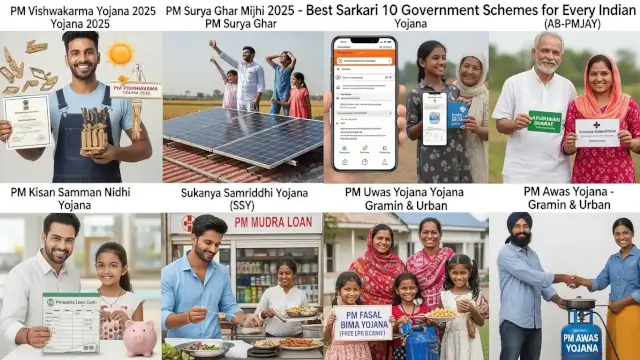
Top 10 Government Schemes at a Glance
| Scheme | Main need | Best first check |
|---|---|---|
| PM-KISAN | Income support for eligible landholding farmer families | PM-KISAN eligibility, eKYC and status |
| PM Vishwakarma | Training, tools and credit for traditional artisans | Trade, age and family eligibility |
| PM Surya Ghar | Residential rooftop solar support | Roof, electricity connection and portal subsidy rules |
| Ayushman Bharat PM-JAY | Public health cover for eligible families | Eligibility and empanelled facility search |
| Sukanya Samriddhi Account | Long-term small savings for a girl child | Age, KYC and current India Post rate |
| PM MUDRA Yojana | Credit for eligible micro enterprises | Business activity and lender appraisal |
| PMAY-U 2.0 | Affordable urban housing or rental support | Urban jurisdiction, income and house ownership |
| PM Ujjwala Yojana | Deposit-free LPG connection for eligible women | Household LPG record and deprivation declaration |
| PM Fasal Bima Yojana | Crop insurance and loss reporting | Season, notified crop and state notification |
| Atal Pension Yojana | Government-guaranteed minimum pension after 60 | Age, tax status and savings account |
PM SVANidhi is also a major option for eligible street vendors. It is covered later with the vendor-credit discussion because its application route and eligibility differ from the ten entries above. This keeps the main list focused on a spread of household needs while still pointing readers to a current government-backed credit route.
1. PM-KISAN Samman Nidhi
PM-KISAN is a Central Sector scheme funded by the Government of India. The official portal says eligible landholding farmer families can receive ₹6,000 per year in three equal instalments, subject to exclusions and identification by State or Union Territory administration. The money is transferred directly to beneficiary bank accounts under the scheme rules.
The portal currently says eKYC is mandatory for registered PM-KISAN farmers. It also records the 23rd instalment as released on 20 June 2026 and asks farmers to use Know Your Status or the mobile app when eligibility or payment needs checking. A name in a list is not a guarantee that a particular instalment has been credited.
Start at the official PM-KISAN portal for New Farmer Registration, Know Your Status, eKYC information and the public beneficiary list. For a focused explanation of payment messages, read the site's PM-KISAN instalment and beneficiary-status guide. Farmers dealing with a land-record identity issue can also read the site's UP Farmer Registry guide, but Farmer ID and PM-KISAN registration are not the same record.
2. PM Vishwakarma
PM Vishwakarma supports artisans and craftspeople who work with their hands and tools in one of the scheme's 18 traditional trades. The official portal includes carpenters, boat makers, blacksmiths, goldsmiths, potters, cobblers, masons, tailors, barbers, washermen and other listed trades.
The official eligibility conditions include being at least 18 years old, working in the concerned trade at registration, operating in the unorganised sector on a self-employed basis and meeting the scheme's family and credit-history conditions. Registration and benefits are restricted to one member of a family, and government employees and their family members are excluded.
Use the official PM Vishwakarma portal or an authorised route shown there. Do not pay a private person for a guaranteed certificate, toolkit or loan.
2. PM Surya Ghar Muft Bijli Yojana
PM Surya Ghar supports residential rooftop solar. A PIB Cabinet release says the scheme targets rooftop systems for one crore households and up to 300 units of electricity per month for households under the scheme's design. The same release describes Central Financial Assistance of ₹30,000 for a 1 kW system, ₹60,000 for 2 kW and ₹78,000 for 3 kW or higher at the stated benchmark prices.
These figures are not a promise that every roof receives the maximum amount. The applicable capacity, benchmark, vendor, electricity-distribution company process, installation and inspection determine the final subsidy. The PIB release says households apply through the National Portal and choose a suitable vendor. The official PM Surya Ghar portal is the starting point, while the PIB scheme release explains the original design.
Before applying, check whether the property is residential, whether the electricity connection and consumer details are correct, and whether the selected vendor and installation route appear on the official portal. Do not assume that “free electricity” means an unlimited zero bill. Generation, consumption, net-metering rules and local distribution conditions still matter.
4. Ayushman Bharat PM-JAY
Ayushman Bharat PM-JAY is a public health scheme administered through the National Health Authority and participating state systems. Its eligibility is not based on a generic “everyone gets a card” rule. A person must check the current beneficiary database, state implementation and empanelled hospital information through the official route.
The National Health Authority PM-JAY portal is the official starting point for Ayushman Bharat PM-JAY and related digital-health services. Because the public health system can have state-specific workflows, use the live eligibility and hospital tools rather than trusting a fixed hospital count or an old social-media claim.
Keep the beneficiary's identity details consistent and ask the hospital or authorised help desk about the documents needed for verification. A card or eligibility result does not mean that every treatment, facility or expense is covered without conditions. Check the package, hospital and state rule before planned treatment.
For a related public-service record topic, the site's UDID and government-benefit guide explains why a certificate, eligibility record and benefit approval should not be treated as one thing.
5. Sukanya Samriddhi Account
Sukanya Samriddhi Account is a Post Office small-savings scheme designed for a girl child. The official India Post page currently lists an 8.2% per annum rate, calculated yearly and compounded annually. Interest rates for small-savings products can change, so the live India Post page is the authority on the rate available when an account is opened or reviewed.
India Post lists proof of date of birth or a birth certificate as mandatory for a Sukanya account and asks for the relevant KYC and identity documents. The account is not a government cash grant. It is a long-term savings product with its own deposit, withdrawal, maturity and tax rules.
Use the official India Post savings page and a permitted post-office or bank channel. Compare the current rules with the family's goal before depositing money. Do not call a fixed future maturity value a guaranteed return without checking the account terms and contribution pattern.
6. Pradhan Mantri MUDRA Yojana
PM MUDRA Yojana supports eligible micro-enterprise and small-business credit through banks, microfinance institutions and non-banking finance companies. The official MUDRA page lists four categories: Shishu up to ₹50,000, Kishor above ₹50,000 up to ₹5 lakh, Tarun above ₹5 lakh up to ₹10 lakh and Tarun Plus above ₹10 lakh up to ₹20 lakh.
MUDRA is a refinancing institution. It does not directly lend to every individual. The official page says borrowers can approach a nearby eligible lender or file through the Udyamimitra route, and it warns that MUDRA has no agents or middlemen for obtaining loans.
| Business question | What to prepare | What is not guaranteed |
|---|---|---|
| What will the loan fund? | Business activity, working-capital or equipment requirement | Approval merely because the business is small |
| Which category fits? | Funding need and stage of the micro unit | A category chosen online without lender appraisal |
| Where should I apply? | Eligible bank, MFI, NBFC or the official online route | A loan through an agent asking an advance fee |
| What will it cost? | Lender's current interest, charges, repayment and documentation rules | A universal interest rate across all lenders |
Read the official MUDRA offerings page before applying. A lender may ask for business, identity, bank and repayment information. This is credit, not a grant, and repayment remains the borrower's responsibility.
7. PMAY-U 2.0
Pradhan Mantri Awas Yojana Urban 2.0 provides central assistance for eligible urban families to construct, purchase or rent affordable housing. The official applicant page describes four verticals: Beneficiary Led Construction, Affordable Housing in Partnership, Affordable Rental Housing and Interest Subsidy Scheme.
The PMAY-U 2.0 page says eligible urban EWS, LIG and MIG families must not own a pucca house anywhere in India. It lists annual income bands of up to ₹3 lakh for EWS, ₹3 lakh to ₹6 lakh for LIG and ₹6 lakh to ₹9 lakh for MIG. The page says the mission runs from 2024 to 2029, subject to its operational guidelines.
Start at the official PMAY-U 2.0 applicant page. Urban jurisdiction, prior housing benefits, family composition, income and the selected vertical affect the result. Do not use old PMAY-Urban CLSS figures or a rural PMAY-G link as if the programmes were identical.
8. Pradhan Mantri Ujjwala Yojana
PM Ujjwala is designed to provide a deposit-free LPG connection to eligible women from poor households. The official PMUY portal says the applicant must be a woman aged 18 or above, there must be no other LPG connection from any oil-marketing company in the same household and the adult woman must meet the prescribed poor-household or deprivation-declaration condition.
The portal lists KYC, Aadhaar, address or migrant self-declaration where relevant, ration or family-composition evidence, adult family Aadhaar copies and bank details among the documents. It currently lists cash assistance of ₹2,050 for a 14.2 kg cylinder connection or ₹1,300 for a 5 kg connection, along with a first LPG refill and stove provided free with the deposit-free connection under the stated scheme terms.
Use the official PMUY portal to locate an LPG distributor or begin an online application through the listed oil-company routes. Check the current household LPG record before applying. A distributor should not ask for an unofficial payment for a government benefit.
9. Pradhan Mantri Fasal Bima Yojana
PM Fasal Bima Yojana provides a government-backed crop-insurance route for notified crops and areas. The official portal gives farmers a Farmer Corner to apply, an insurance-premium calculator, application-status tools and a channel for crop-loss reporting and grievances.
Crop insurance is seasonal. Premium, notified crop, cut-off date, insurer, state notification and loss-reporting process can vary. That is why the old fixed percentages often repeated in generic listicles are not enough to decide whether a farmer is covered. Check the current season notification and policy details before paying a premium or reporting a loss.
Use the official PMFBY portal and its Krishi Rakshak helpline 14447. Keep the policy or application reference, crop and plot details, and the date of any loss report. A claim is not automatic merely because a crop was damaged.
10. Atal Pension Yojana
Atal Pension Yojana is a voluntary pension scheme for Indian citizens. The official PFRDA FAQ says a new subscriber must be between 18 and 40 years, hold a savings bank or post-office savings account and not be an income-tax payer on the date of a new application. The tax-payer exclusion for new accounts applies from 1 October 2022.
Depending on the chosen pension amount and contribution pattern, APY lists a government-guaranteed minimum monthly pension of ₹1,000, ₹2,000, ₹3,000, ₹4,000 or ₹5,000 after age 60. Contributions continue until the relevant age under the scheme terms. The official FAQ says enrolment is handled through the bank or post office holding the savings account and also describes digital enrolment options.
Read the PFRDA APY FAQ before opening an account. This is a long-term pension commitment, not a short-term return product. Check contribution frequency, nominee details, auto-debit rules and exit conditions before signing up.
PM SVANidhi for Eligible Street Vendors
PM SVANidhi is a Ministry of Housing and Urban Affairs micro-credit facility for street vendors. JanSamarth lists a collateral-free working-capital loan up to ₹10,000 for a one-year tenure, a 7% interest subsidy on timely or early repayment, digital-transaction cashback up to ₹100 per month and higher loan eligibility of ₹20,000 and ₹50,000 after timely repayment of earlier tranches.
Eligible applicants can include vendors with a Certificate of Vending or identity card, surveyed vendors without the issued document, vendors with a Letter of Recommendation and vendors from surrounding areas who vend within the relevant urban-body limits. Use the JanSamarth PM SVANidhi page to check eligibility and the current application path. Loan sanction still depends on the scheme and lending process.
Street vendors should keep their survey, certificate, identity or recommendation evidence and ask for a receipt. Never pay a middleman for a guaranteed first or second tranche.
How to Choose the Right Scheme
Start with the need, not the headline benefit. A farmer should first separate PM-KISAN income support from crop insurance and Farmer Registry work. A business owner should separate a MUDRA loan from a grant. A family looking for housing should first decide whether the jurisdiction is urban or rural. A parent considering Sukanya should read the current small-savings terms rather than compare it with an unrelated pension product.
| Your situation | Shortlist | First verification |
|---|---|---|
| Landholding farmer | PM-KISAN, PMFBY and a relevant Farmer Registry route | Land, eKYC, notified crop and bank records |
| Traditional artisan | PM Vishwakarma | Trade, age, family and prior-credit conditions |
| Urban household without a pucca house | PMAY-U 2.0 | Income band, city jurisdiction and prior housing benefit |
| Woman seeking an LPG connection | PMUY | Household LPG record and deprivation declaration |
| Micro-business owner | MUDRA or PM SVANidhi where applicable | Business or vending proof, lender route and repayment terms |
| Young eligible saver | Sukanya for a girl child or APY for pension planning | Age, account, current rate or tax status |
The site's Govt Schemes archive can help you compare related explainers, and the Yuva Sathi camp guide shows why local implementation details matter. The official department, bank, post office, insurer or local body controls the live rule.
Documents and Fraud Checks Before Applying
Prepare only the documents shown by the current official form. Depending on the scheme, this may include Aadhaar or another identity document, mobile number, bank details, land or crop information, income evidence, family composition, birth certificate, trade proof, vending certificate or an official recommendation. More documents do not automatically improve eligibility.
- Check the domain, spelling and security connection before entering personal details.
- Do not share an OTP, bank PIN, password or full document with a caller.
- Ask for a receipt at a bank, post office, CSC, LPG distributor or other assisted point.
- Do not pay an agent for a guaranteed approval, toolkit, housing sanction or instalment.
- Save the application or grievance reference and use the official status route.
Government websites can use different portals for registration, status, payment and grievance. That is normal. What is not normal is a private page claiming that one form makes every scheme available or that a fixed amount is guaranteed for everyone.
Check Current Rules Before You Submit
Scheme information changes in small but important ways. Interest rates can be revised. Subsidy caps can depend on system size or benchmark price. Housing verticals can have different income and jurisdiction rules. Crop insurance depends on season and notification. Loan sanction depends on the lender. Pension contributions depend on age and the selected pension amount.
Use the official source linked in the relevant section on the day you apply. Confirm the form, last date if one exists, required documents, grievance route and whether the benefit is a grant, subsidy, insurance cover, loan, savings account or pension contribution. Save a PDF or screenshot of the acknowledgement without exposing sensitive numbers.
Government scheme guides are useful when they explain the difference between these categories. They become risky when they copy an old figure and present it as a universal promise. This article removes that shortcut and keeps the official verification step visible.
The Bottom Line on Government Schemes in India 2026
The ten schemes in this guide cover different needs, from farmer income and crop risk to artisan credit, solar power, healthcare, housing, LPG, savings and pension. “Top” means useful for a broad audience, not guaranteed approval or the highest return. The right scheme is the one whose eligibility, purpose and application route match your situation.
Use primary portals, read the current conditions and keep a record of your submission. If the benefit is a loan, check repayment. If it is insurance, check the notified crop or package. If it is a savings or pension product, check contribution and maturity rules. If it is a subsidy or transfer, check the eligibility and verification record.
Frequently Asked Questions

SK Jabedul Haque
Building India's most trusted finance education platform — simplifying news, schemes and market trends so anyone can understand and invest confidently.
Read full bio

Never miss an update
Get our clearest explainers on schemes, markets and money — read what matters, without the noise.
Explore more articles