PM POSHAN Scheme 2026
What You'll Learn
- Who PM POSHAN covers and how school-level delivery is organised.
- The official primary and upper primary calorie, protein, food-grain, pulse, vegetable, and oil norms.
- How local menus, fortified rice, School Nutrition Gardens, material costs, and foodgrain allocation fit together.
- How to verify meal quality, social audit, school records, and the limits of unsupported registration or benefit claims.
What PM POSHAN Scheme 2026 Covers
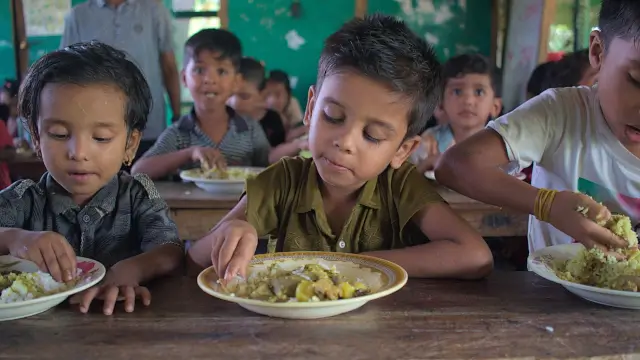
PM POSHAN is a centrally sponsored school meal scheme implemented by the Ministry of Education in partnership with State Governments and Union Territory Administrations. The official nutrition standards release dated July 27, 2026 says the overall responsibility for providing hot and nutritious meals lies with the States and UTs for children studying in Bal Vatika and classes I to VIII in Government and Government-aided schools.
Bal Vatika refers to the pre-primary stage before Class I in the scheme's school context. The eligible group therefore includes children before Class I as well as children in primary and upper primary classes. The practical delivery unit is the school, not a separate household application portal.
The meal is described by the Ministry as one hot cooked meal for eligible children on all school working days. This wording matters. It does not mean that every school serves the same menu, that every child receives the same portion regardless of class, or that a State's implementation details can be inferred from a national headline.
PM POSHAN also sits within a wider administrative chain. The Centre supports defined inputs and scheme components. States and UTs organise implementation, choose local menus within the standards, and remain responsible for the service delivered to children. The school, local authorities, School Management Committee, cooks, and community mechanisms each have a role in making the rules visible at ground level.
| Scheme element | Official position | What it means in practice |
|---|---|---|
| Eligible setting | Government and Government-aided schools | Delivery is organised through schools |
| Age and class coverage | Bal Vatika and classes I to VIII | Coverage is tied to an eligible school and class |
| Meal format | One hot cooked meal | Provided on school working days for eligible children |
| Implementing responsibility | States and UT Administrations | Local execution and service quality require local verification |
| Menu approach | Local menus within national norms | Ingredients can reflect local food habits and availability |
How Eligibility Works at School Level
For a parent, the first question is whether the child attends an eligible Government or Government-aided school and falls within the covered classes. The official sources do not describe PM POSHAN as a national cash benefit that a family claims by entering a bank account or Aadhaar number on a single central form.
A school may have local procedures for recording enrolment, attendance, meal preparation, and stock use. Those procedures can vary by State or UT. A parent seeking a practical answer should ask the school head or designated meal coordinator how the local register identifies eligible children, which days meals are served, and where the menu and inspection information are displayed.
The Department of Food and Public Distribution describes PM POSHAN as covering students of pre-school or Bal Vatika, primary, and upper primary classes in schools aided by the Government and schools run by local bodies. The operational description should still be read with the Ministry of Education's current standards and the State's implementation instructions.
Do not convert the scheme's class coverage into an unsupported national beneficiary count. The April 10, 2025 PIB release reported 11.20 crore students and 10.36 lakh Government and Government-aided schools for that reporting point. Those figures are useful historical context, but they are not automatically the current 2026 total.
The same discipline applies to school registration. A school may need to be recognised, mapped, and included in State records before it can receive scheme inputs. That is an administrative process for institutions. It is different from a household applying online for a personal monthly payment.
Nutrition Norms and Food Quantities
The July 2026 PIB release provides the clearest current nutrition table. Primary children receive a prescribed minimum of 450 calories and 12 grams of protein per child per day. Upper primary children receive 700 calories and 20 grams of protein per child per day.
The food quantities are also class-specific. The prescribed foodgrain quantity is 100 grams per primary child per day and 150 grams per upper primary child per day. Pulses are set at 20 grams and 30 grams. Vegetables are set at 50 grams and 75 grams. Oil and fat are set at 5 grams and 7.5 grams. Salt and condiments are provided as per need.
These are national norms, not a promise that each plate will display a fixed national menu. The Ministry says States and UTs are encouraged to decide menus suitable to local conditions while remaining within the nutrition and food norms. Local procurement can include items such as millets, vegetables, and condiments.
| Norm per child per day | Primary classes | Upper primary classes |
|---|---|---|
| Calories | 450 minimum | 700 minimum |
| Protein | 12 grams | 20 grams |
| Food grains | 100 grams | 150 grams |
| Pulses | 20 grams | 30 grams |
| Vegetables | 50 grams | 75 grams |
| Oil and fat | 5 grams | 7.5 grams |
The quantities describe the prescribed food norm, not a nutrition diagnosis for an individual child. A family should not use a school meal table to infer that a child has or does not have anaemia, an allergy, or a deficiency. Health questions require a qualified medical assessment. The scheme's official material describes nutritional support, but it does not turn a menu standard into a personal health guarantee.
PM POSHAN Budget and Cost Sharing
The PM POSHAN budget has several components, and a single headline number can hide how the scheme works. The official PM POSHAN budgetary page returned a 2026-27 allocation of Rs 12,750 crore in the search result used for this article. Because that page could not be fully extracted during this session, the number is presented as an official budget-page figure rather than expanded with unverified comparisons.
Cost sharing also depends on the component. The Ministry's public explanations distinguish foodgrain support, material cost, cooking inputs, transportation, and other implementation responsibilities. A State or UT may also contribute more than its minimum mandatory share from its own resources, including for meals with additional nutrition.
Older cost figures must be dated. The April 2025 PIB release said material cost was enhanced by 9.50% with effect from May 1, 2025. It reported Rs 6.78 per student per day for Bal Vatika and primary and Rs 10.17 for upper primary after the enhancement. Those are reported 2025 rates, not a substitute for a later notification.
| Budget or cost item | Verified dated figure | Reading rule |
|---|---|---|
| PM POSHAN allocation | Rs 12,750 crore for 2026-27 | Official budget-page result, not a household payment |
| Material cost enhancement | 9.50% from May 1, 2025 | Dated PIB notification context |
| Bal Vatika and primary material cost | Rs 6.78 per student per day | Reported enhanced 2025 rate |
| Upper primary material cost | Rs 10.17 per student per day | Reported enhanced 2025 rate |
| Additional central cost | Approximately Rs 954 crore in FY 2025-26 | Reported cost of the dated enhancement |
Material Cost and Foodgrain Funding
Material cost covers ingredients needed to cook the meal. The April 2025 PIB release lists pulses, vegetables, oil, spices and condiments, and fuel as material-cost inputs. It also says the material-cost rates are minimum mandatory rates and that States and UTs may contribute more than their prescribed share.
The Centre's foodgrain role is separate from the school menu decision. The Department of Food and Public Distribution says it makes consolidated foodgrain allocation to the Department of School Education and Literacy for State-level sub-allocation under PM POSHAN. The DFPD page identifies rates of Rs 3, Rs 2, and Rs 1 per kilogram against rice, wheat, and coarse grain respectively for that allocation description.
The April 2025 PIB release reported approximately 26 lakh metric tonnes of foodgrains through the Food Corporation of India and stated that the Government of India bears 100% of foodgrain cost including an approximately Rs 9,000 crore annual subsidy, along with 100% transportation cost from the FCI depot to schools. These figures belong to the dated government release and should not be presented as a new household entitlement.
For a school, the practical questions are whether the allocated foodgrain reaches the intended store, whether stock records match use, and whether the meal served matches the approved local menu and nutrition standards. For a parent, the useful route is to ask the school or local authority for the current menu and the relevant grievance channel rather than rely on a social-media post promising a new registration payment.
Fortified Rice and Micronutrients
Rice fortification is a separate input policy that can operate through PM POSHAN and other welfare schemes. The DFPD explains fortification as the deliberate addition of micronutrients to improve the nutritional quality of food. Its page identifies iron, folic acid, and vitamin B12 in the fortified-rice explanation.
The policy should be described accurately. Fortified rice is intended to add specified micronutrients to rice. It does not mean that every nutrition problem is solved by one ingredient, that anaemia outcomes are guaranteed for every child, or that local implementation never needs inspection.
DFPD records a 2024 Cabinet decision continuing the supply of fortified rice under PMGKAY and other welfare schemes up to December 2028 as a Central Sector Initiative funded 100% by the Government of India. It also describes an ongoing NITI Aayog and ICMR-NIN evaluation in six districts, with an end-line expected by December 2026. An ongoing evaluation is not the same as a completed nationwide impact finding.
The Ministry's July 2026 release separately reports a positive result from a 2025-26 independent third-party evaluation of PM POSHAN on child nutrition and learning outcomes. That statement is attributed to PIB. It should not be merged with the separate ongoing fortification evaluation or expanded into a claim that every school has identical results.
Menu Planning and Local Foods
There is no single national daily menu that every school must serve in identical form. The Ministry says States and UTs are encouraged to decide menus suitable to local conditions within the prescribed nutrition and food norms. This approach allows local food habits, cultural preferences, availability, and dietary practices to inform the menu.
Local choice does not remove the national standards. A menu still has to be assessed against the prescribed nutrition and food norms. The school also has to follow the State's procurement, hygiene, cooking, and recordkeeping directions. Parents who want to know what is served should check the school notice, menu register, or designated local information source for the current period.
The 2024 PIB release describes a Vocal for Local feature that encourages procurement of locally grown food items such as millets, vegetables, and condiments from Farmers' Producers Organizations and federations of women's Self-Help Groups. The objective includes local employment and improved nutrition, but the exact procurement route can vary by State or UT.
Local menus are therefore a reason to ask for the current school record, not a reason to circulate a universal menu image. A menu posted for one district may not be the approved menu in another district even when both follow the same national nutrition framework.
School Nutrition Gardens and the Flexi Component
School Nutrition Gardens are one of the scheme's community-linked features. The 2026 PIB nutrition standards release says States and UTs have a flexi component of 5% of total recurring budget for setting up School Nutrition Gardens and for supplementary nutrition interventions in identified districts.
The 2024 PIB release describes School Nutrition Gardens as a way for children to gain first-hand experience with nature and gardening. It also names special focus for aspirational, tribal, and districts with identified high cases of malnutrition. These features do not turn every school garden into a guaranteed source of all meal ingredients. Their existence, crops, and use should be checked at the school level.
A school interested in a garden should follow its State or UT instructions on land, water, safety, supervision, procurement, and use of produce. The flexi component provides a policy space. It does not mean that a parent can claim a personal garden grant through the PM POSHAN name.
The distinction between a school intervention and a personal benefit is useful across government-scheme reporting. Readers looking for direct transfer processes should use the relevant scheme's official channel. A separate explanation of bank and NPCI mapping is available in the site's DBT linking guide.
Quality Safety and Social Audit
Quality and safety are not optional extras in the official PM POSHAN description. The December 2024 PIB release says the Government has issued detailed quality, safety, and hygiene guidelines. It refers to Agmark-quality and branded items, training for Cook-cum-Helpers, and tasting of meals by 2 to 3 School Management Committee members including at least one teacher before the meal is served.
The same release describes mandatory social audit in all districts. Social audit is a community monitoring process covering issues such as equity, equality, and expenditure management. It gives communities a route to examine delivery, but it does not replace the administrative responsibility of the State or UT.
A useful local check should be specific. Ask whether the daily menu is displayed, whether the meal was served on the relevant school day, whether the food was tasted before serving, whether the store record is maintained, and where a complaint can be submitted. Record the date and school rather than making a broad claim about the national scheme from one incident.
Food safety concerns should be reported promptly through the school and district mechanism. If a child is unwell, seek medical care. An article about scheme rules cannot assess a suspected foodborne illness or determine responsibility in a particular school.
How School Level Delivery Works
PM POSHAN delivery connects central standards with local execution. The Centre establishes the scheme framework and supports defined inputs. The Department of Food and Public Distribution handles consolidated foodgrain allocation for the welfare-scheme channel it describes. The Department of School Education and Literacy makes the State-level sub-allocation under the scheme context. States, UTs, schools, and local bodies then handle the operational chain.
| Delivery stage | Officially described responsibility | Evidence to check locally |
|---|---|---|
| Standards | National nutrition and food norms | Current menu and class-level norm |
| Allocation | Consolidated foodgrain allocation and State sub-allocation | Stock receipt and distribution records |
| Preparation | School-level hot cooked meal service | Cooking, tasting, hygiene, and attendance records |
| Monitoring | School Management Committee and social-audit mechanisms | Inspection, complaint, and social-audit information |
| Local adaptation | State or UT menu decisions within norms | Approved local menu and procurement source |
This chain explains why a national article cannot answer every school-specific question. A family may need the State education department, district office, school head, or School Management Committee for a current menu, missing meal, stock issue, or complaint path.
It also explains why a school should preserve dated records. A clear record can connect the meal served to the approved menu, the foodgrain received, the ingredients purchased, and the checks completed before serving. This is more useful than an undated statement that the scheme is working or failing everywhere.
What Parents and Schools Should Verify
Parents should begin with eligibility and service facts. Confirm that the school falls within the Government or Government-aided category described by the scheme, ask whether the child is in Bal Vatika or a covered class, and ask where the local menu is displayed. Then check whether the meal was served on the relevant school working day and whether the school has a visible route for raising a concern.
Schools should verify the class-level nutrition norm before planning the menu. Primary and upper primary requirements are not identical. The school should also confirm that the ingredients, fuel arrangements, cooks, storage, tasting, and records follow State and UT directions. A locally suitable menu is valid only when it remains within the prescribed norms.
Readers should distinguish a dated official figure from a current local fact. The April 2025 coverage count, the 2025 material-cost rates, and the 2026-27 budget-page allocation answer different questions. None proves the number of children eating a meal in one named school today.
For comparison with other public programmes, the site's PM Fasal Bima Yojana guide, PM Mudra Yojana guide, and PM Kisan status guide cover schemes with different eligibility and delivery structures. They should not be treated as PM POSHAN registration instructions.
What PM POSHAN Does Not Guarantee
PM POSHAN provides a national framework for school meals, but it does not guarantee that every local implementation detail is identical. It does not create a personal cash transfer, a universal household registration number, or a single nationwide daily menu. It does not allow an article to infer a child's health status from a meal norm.
It also does not permit every older figure to be republished as a 2026 fact. Coverage, material cost, total meal cost, foodgrain quantities, budget allocation, and evaluation results have reporting dates and different source owners. A careful article keeps those dates visible.
The clearest current facts are the class coverage, the one hot cooked meal on working days, the primary and upper primary nutrition norms, the State and UT role in local menus, and the official monitoring features. Questions about a named school, a missed meal, a local menu, or a complaint must be answered through the relevant school and government channel.
PM POSHAN Scheme 2026 is best understood as a delivery system rather than a single online benefit. Its performance depends on whether national standards, allocated inputs, local cooking, safety checks, community monitoring, and State administration connect in practice. Readers can use the official sources below to check any new announcement against that structure.
Frequently Asked Questions

SK Jabedul Haque
Building India's most trusted finance education platform — simplifying news, schemes and market trends so anyone can understand and invest confidently.
Read full bio

Never miss an update
Get our clearest explainers on schemes, markets and money — read what matters, without the noise.
Explore more articles