TurboQuant Explained: How Google Cut LLM Memory by 6x Without Losing Accuracy
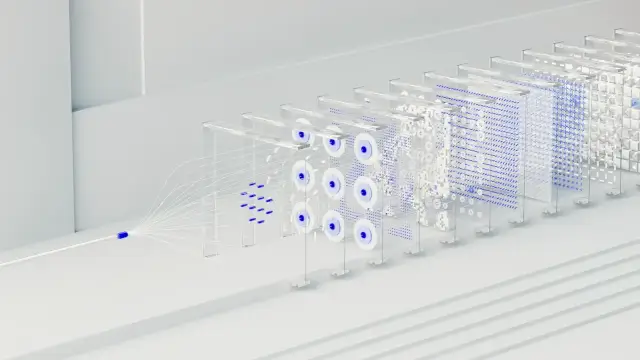
TurboQuant is Google Research's quantization algorithm that cuts LLM memory usage by 6x without accuracy loss. By combining PolarQuant (weight quantization) and QJL Transform (KV cache compression), it enables large language models to run on consumer hardware while maintaining near-state-of-the-art performance.
What Is TurboQuant? The 6x Memory Breakthrough
Every time you run a large language model, it loads billions of numbers (called "weights") into memory. A 70 billion parameter model in standard 32-bit precision needs roughly 280GB just to load - more than most GPUs can handle. The solution is quantization: reduce the precision of those numbers from 32-bit to 16-bit, 8-bit, or even 4-bit.
TurboQuant is Google Research's quantization system built on two core innovations: PolarQuant for compressing model weights, and QJL (Quantized Johnson-Lindenstrauss Transform) for KV cache compression. Together they achieve 6x memory reduction while preserving model accuracy - something standard INT4 quantization cannot match.
| Quantization Type | Memory Reduction | Accuracy Preserved | Use Case |
|---|---|---|---|
| FP32 (Standard) | 1x (baseline) | 100% | Research, enterprise |
| FP16 / BF16 | 2x | ~99% | Standard inference |
| INT8 (Q8) | 4x | ~95-97% | Consumer GPUs |
| INT4 (Q4) | 8x | ~90-93% | Edge devices |
| FP4 (TurboQuant) | 6x | ~97-99% | Consumer + Enterprise |
How TurboQuant Works: The Technical Breakdown
Traditional 4-bit quantization uses integer representation - imagine rounding every decimal number to the nearest whole number. This works, but you lose the subtle differences between numbers that matter for accuracy. FP4 uses floating point representation that preserves those nuances.
Why FP4 Beats INT4 for Accuracy
- Dynamic range preserved: FP4 can represent very small and very large numbers simultaneously
- Subtle value differentiation: Floating point catches gradations that integers miss
- NVIDIA MXFP4 instruction set: Blackwell architecture (RTX 50 series) has native FP4 support
- DeepSeek's fine-tuning: Models specifically trained to recover accuracy after aggressive quantization
The result: DeepSeek V4 achieves 97-99% of FP32 performance at just 1/6th the memory cost. For context on why long context matters, see our context engineering guide.
The Engram Module: KV Cache Revolution
Memory reduction doesn't end at model weights. The KV cache - the memory an LLM uses to track conversation context - balloons with long conversations. A 1 million token conversation context can consume hundreds of gigabytes on its own.
DeepSeek V4 introduces the Engram module with a hybrid attention architecture that solves this:
- Compressed Sparse Attention (CSA): Groups adjacent key-value entries, compresses them, then selects only the most relevant compressed blocks for retrieval
- Heavily Compressed Attention (HCA): Aggressively reduces memory for older tokens while maintaining access to critical information
- Structural separation: Static knowledge retrieval separated from dynamic computation, enabling independent optimization
According to DeepSeek's technical report, this reduces KV cache memory by 10x while maintaining 1 million token context windows - enabling what was previously only possible on enterprise-grade hardware.
DeepSeek V4: The Implementation
DeepSeek V4 is the first production model leveraging TurboQuant at scale. It comes in two variants:
| Model | Total Parameters | Activated Per Token | Context Window | Price |
|---|---|---|---|---|
| DeepSeek-V4-Pro | 1.6 Trillion | 49 Billion | 1M tokens | $5.22/M tokens |
| DeepSeek-V4-Flash | 284 Billion | 13 Billion | 1M tokens | $0.14/M tokens |
The Mixture-of-Experts (MoE) architecture is key: only 49B of the 1.6T parameters activate per token. This means the effective compute is a 49B model, not a 1.6T model - which is why it runs so efficiently. For more on efficient models, see our SLM vs LLM cost comparison.
Real-World Hardware Requirements
Here's the impact: what previously required expensive cloud instances now runs locally.
| Model Size | Traditional Memory | With TurboQuant |
|---|---|---|
| 8B (Llama 3) | 32GB GPU | 4GB GPU / M1 Mac |
| 70B (Llama 3) | 140GB+ (A100) | 24GB GPU (RTX 3090) |
| DeepSeek V4-Flash | Not possible locally | API at $0.14/M tokens |
Who Benefits Most From TurboQuant?
- Solo developers: Run 70B models on a single RTX 3090 instead of expensive cloud rentals
- Small businesses: Access to 1 million token context at roughly $0.14 per million tokens
- Researchers: Process entire codebases, academic papers, or legal documents in one go
- Enterprises: Deploy full-codebase agents without massive infrastructure costs
The Efficiency Race: Why 2026 Is the Turning Point
DeepSeek V4 reframes the AI race. When open models deliver near-state-of-the-art intelligence at 1/6th the cost of closed alternatives, the entire market dynamics shift. Key trends:
- Cost parity: DeepSeek V4-Flash at $0.14/M tokens vs GPT-5.4 at $17.50/M tokens
- Hardware democratization: RTX 3090 owners can now run what required A100s in 2025
- NVIDIA Blackwell: RTX 50 series adds native FP4 hardware acceleration
- Enterprise pressure: Closed-source models must justify premium pricing against efficient alternatives
This efficiency breakthrough expands the addressable market for AI applications that were previously too expensive - full-codebase agents, long-horizon research assistants, document-heavy legal workflows, and scientific literature review systems. Compare this with DeepSeek V4 vs ChatGPT-5 vs Claude 4 benchmarks.
TurboQuant + Authentic Content: The Hybrid Future
While TurboQuant makes AI inference cheaper, authentic human content remains irreplaceable. The combination is powerful: AI handles research and drafts; humans add nuance, experience, and ethical judgment.
For content creators, this means: use AI to process research faster (TurboQuant enables 1M token context), but human voice and authentic stories still build the audience connection that AI cannot replicate.
For more AI efficiency guides, explore our articles on DeepSeek Engram Memory, Small Language Models, DeepSeek V4 comparisons, and Context Engineering.
Questions about TurboQuant or AI efficiency?
Join NowLast Updated: April 29, 2026 | Source: Google Research, DeepSeek (Official)
Frequently Asked Questions

SK Jabedul Haque
Building India's most trusted finance education platform — simplifying news, schemes and market trends so anyone can understand and invest confidently.
Read full bio
Never miss an update
Get our clearest explainers on schemes, markets and money — read what matters, without the noise.
Explore more articles