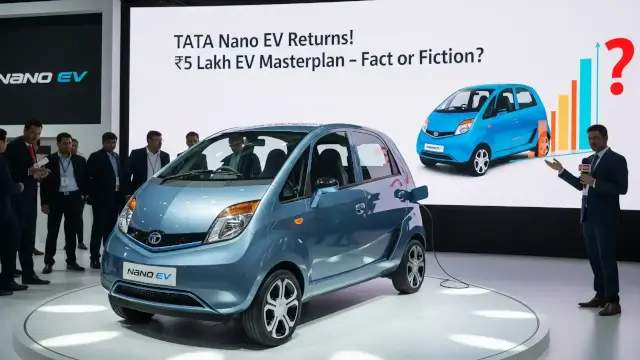
Tata Nano EV Ki Waapsi!
What You'll Learn
- What Tata Motors and Tata.ev officially list instead of a confirmed Nano EV.
- Why the ₹5 lakh price and launch claims remain unverified.
- How Tiago.ev provides a current official compact-EV reference without proving a Nano launch.
- How to check a booking page, subsidy claim, battery claim or dealer message safely.
What Is Confirmed About Tata Nano EV Comeback 2026
The narrow answer is that the reviewed official Tata Motors and Tata.ev pages do not confirm a Tata Nano EV comeback for 2026. They do not provide a Nano EV product page, variant list, battery specification, range certification, booking route or official ex-showroom price in the material reviewed for this article.
That statement is an evidence boundary, not a prediction that Tata Motors will never develop such a vehicle. A manufacturer can keep future plans private, change a product plan or publish an announcement later. The responsible conclusion for a reader deciding whether to book or pay a deposit today is different: there is no official product evidence in the reviewed pages that supports treating the rumour as an available car.
The headline's ₹5 lakh amount is also not an official Nano EV price in the reviewed Tata.ev material. A price claim needs a named variant, battery configuration, ex-showroom basis, applicable taxes, delivery location and an official booking or sales route. Without those details, the number cannot be compared fairly with an actual vehicle price.
Readers should separate three statements. “Tata makes electric cars” is supported by Tata's official portfolio pages. “Tata sells a Tiago.ev” is supported by the Tiago.ev product pages. “Tata has confirmed a Nano EV at ₹5 lakh” is not supported by the official pages reviewed here.
The distinction is similar to the source-first approach used in this financial evidence and timing guide. A claim becomes useful only after its source, date, definition and limits are clear.
What Does Tata.ev Officially List?
Tata.ev's official range page presents a portfolio that includes Sierra.ev, Tiago.ev, Curvv.ev, Harrier.ev, Punch.ev, Nexon.ev, Nexon.ev #DARK, Curvv.ev #DARK and Tigor.ev in its current range presentation. The Tata Motors electric-vehicles page also links to current products such as Tiago.ev, Tigor.ev and Punch.ev.
The presence of those models does not confirm or deny a future Nano EV. It does show how an official product normally appears when a model is being presented to customers. A reader can find a named model page, product overview, specifications or a booking and dealer path. The reviewed Nano EV claim does not have the same first-party footprint.
Tata.ev's digital showroom and product pages carry dynamic model, price and variant information. Such pages can change as a company updates its portfolio. The correct method is to check the official Tata.ev site on the day of a purchase decision, not to rely on a screenshot, social post, video title or search snippet.
The official range page also contains a warning about unauthorised websites and digital channels that use Tata EV branding, offer dealerships or solicit payments and deposits. That warning matters for a rumoured car because an unofficial booking form can appear before a product has a genuine booking route.
| Evidence type | What an official source would show | What the reviewed pages show for Nano EV |
|---|---|---|
| Product identity | Named model page on Tata.ev or Tata Motors. | No Nano EV product entry was found in the reviewed range pages. |
| Specification | Battery, motor, dimensions, range and variant details. | No Nano EV specification sheet was found. |
| Purchase route | Official booking, dealer or enquiry path tied to the model. | No official Nano EV booking route was found. |
| Price | Variant-specific ex-showroom price with terms. | No official Nano EV price was found. |
| Safety notice | Official caution or correction if a false channel is circulating. | Tata.ev warns about unauthorised channels and payment requests generally. |
What Is the ₹5 Lakh Price Claim Based On?
The ₹5 lakh figure should be described as an online estimate or rumoured target unless Tata Motors publishes a price. It is not possible to test whether the number is commercially realistic without knowing the vehicle's battery, motor, safety equipment, body structure, manufacturing scale, warranty, charging hardware and tax treatment.
Price comparisons also need a common basis. A headline may refer to an ex-showroom target, a price after an incentive, a battery-as-a-service plan, a booking amount or an informal estimate. Those are not interchangeable. Tata.ev's Tiago.ev price page says booking prices can change and that a booking amount does not lock or guarantee the final vehicle price.
Do not subtract an old subsidy from a rumoured price and call the result a payable price. Government schemes use eligibility rules, dates, vehicle categories and official approvals. A passenger car may not receive the same treatment as an electric two-wheeler, three-wheeler, bus or truck.
A fair price article would need a confirmed Nano EV variant and official terms. Until that evidence exists, the strongest supported wording is that ₹5 lakh is a claim circulating online, not a Tata Motors price announcement.
For a related example of separating reported information from a decision, see this market-report evidence guide. The topic differs, but the test is the same: do not turn an unverified headline into a decision rule.
Why Is Tiago.ev the Better Official Reference?
Tiago.ev is a useful reference because Tata.ev publishes a current product page with specifications, features, variants, price information and booking links. It is not evidence that Tata Motors is preparing a Nano EV. It simply shows the level of detail a buyer can expect when a Tata electric car is presented as a product.
The official Tiago.ev overview states a 24 kWh battery pack, an ARAI certified full-charge range of 285 km and a real-world C75 range of approximately 205 to 215 km. Tata.ev also states that enhanced faster charging can add 100 km in 18 minutes. These figures come from different test bases and actual results vary with conditions.
The Tiago.ev page lists six airbags as standard and describes features such as iRA.ev connectivity with 40+ connected-car features. Its price page lists variants and notes that equipment can vary. A Nano EV claim cannot borrow those specifications simply because both names refer to small Tata cars.
The reference is useful for another reason. It shows that range is not a single universal number. The battery pack, test cycle, speed, temperature, traffic, load, tyre pressure and use of climate control affect the distance a driver can achieve. A rumoured “150 to 200 km” range is incomplete without a named test basis and battery specification.
Readers comparing products should record the official page date and the exact variant. The same source-first comparison habit prevents a specification from one product being quietly transferred to another.
What Do Battery and Range Claims Need to Show?
A credible EV range claim begins with the battery capacity and test standard. It should identify whether the figure is an ARAI certification, an internal test result or a real-world estimate. It should also identify the vehicle version, wheel and tyre setup, ambient conditions and whether the number is a maximum, average or expected operating range.
Battery size alone does not determine range. Vehicle weight, motor efficiency, aerodynamics, regenerative braking, traffic, speed and temperature all affect energy use. A smaller battery can be adequate for a light city car, but the buyer still needs the approved test figure and the practical charging plan.
Charging claims need the same care. “Fast charging” could refer to a specific battery version, a specified charger, a partial charge window or a laboratory condition. The Tiago.ev page's 100 km in 18 minutes statement is tied to that product and must not be copied into a Nano EV story.
Warranty terms also matter. Tata.ev describes a lifetime HV battery warranty for the Tiago.ev 24 kWh battery pack under stated conditions. A future Nano EV would need its own warranty terms. Buyers should not assume that a current model's battery warranty transfers to an unannounced model.
| Range claim element | Why it matters | Question for a buyer |
|---|---|---|
| Battery capacity | Indicates the stored energy but not the complete vehicle efficiency. | Which variant and usable capacity are covered? |
| Test method | Certification and real-world estimates answer different questions. | Is the figure ARAI, internal testing or an estimate? |
| Charging input | Charging time depends on the charger, battery state and conditions. | What charger and charge window are specified? |
| Warranty | Battery replacement and coverage terms affect ownership risk. | What is covered, for how long and under which conditions? |
| Use case | City traffic and highway driving produce different energy use. | Does the expected range fit the actual daily route? |
Which Features Are Confirmed and Which Are Rumours?
Rumour articles often combine possible features with confirmed features. A low price may be paired with a projected range, a digital dashboard, fast charging, connected services, airbags or a particular launch month. Unless Tata Motors publishes those details for a Nano EV, each should remain labelled as unverified.
The official Tiago.ev pages demonstrate a better way to write specifications. They identify the battery pack, range, charging claim, safety equipment, connectivity and variants on named product pages. A Nano EV report should use the same standard before calling any equipment confirmed.
Expected features are not worthless, but they belong in a clearly marked scenario section. A scenario can explain what a small city EV might need, such as a manageable turning circle, adequate cabin safety, predictable charging, usable boot space and a service network. It cannot be presented as a Tata Nano EV specification.
Safety needs particular caution. Do not claim an airbag count, crash rating, driver-assistance feature or structural standard for an unconfirmed vehicle. A buyer should wait for the manufacturer's specification and approval information.
For a related discussion of technical capability versus product expectation, read this security controls and evidence guide. It illustrates why a stated capability needs a defined control and a verifiable source.
Can PM E-DRIVE Subsidy Be Assumed?
No. The Ministry of Heavy Industries' official PM E-DRIVE portal lists e-2Ws, e-3Ws, e-ambulances, e-trucks, e-buses, charging infrastructure and testing-agency upgrades in its scheme overview. Passenger electric cars are not listed in that overview as an eligible category for an automatic deduction from a rumoured Nano EV price.
The portal also provides model-approval records with the OEM, model name, variant, segment, validity dates and status. A vehicle-specific incentive conclusion should be based on the active scheme rules and the relevant official approval record. A social post that says “after subsidy” is not enough.
Scheme dates and notifications can change. The live PM E-DRIVE portal carries later notices, including an August 10, 2026 amendment relating to the terminal date for e-2Ws. That change does not create a passenger-car benefit for a Nano EV.
The safest consumer wording is conditional. If a Nano EV is officially announced, the buyer should check whether the vehicle category, battery, approval, registration date and state rules qualify under any active programme. Until then, no subsidy should be deducted from the ₹5 lakh rumour.
Readers can use this eligibility and supporting-records guide as a general reminder that a scheme claim needs current rules and supporting records, not just a headline amount.
What Would an Official Nano EV Launch Need?
An official launch would normally create a trail that a buyer can verify. The trail could include a Tata Motors or Tata.ev announcement, a named product page, a specification document, a price or booking page, dealer information and any required approval or homologation record. The exact sequence can vary, but the buyer needs a genuine first-party route.
The product page should answer basic questions. What is the battery capacity? Which charging standards apply? What range is certified? Which variants exist? What safety equipment is standard? What is the warranty? Which cities can book or deliver the car? What is the ex-showroom price and what charges are extra?
A launch claim that answers none of those questions remains a lead for monitoring. It is not a reason to send money. Tata.ev's caution notice is especially relevant because it describes unauthorised channels that solicit payments or deposits under confusingly similar branding.
Check the official domain manually. Do not assume that a website with the words Tata, EV, Nano or dealership in its address belongs to Tata Motors. Confirm the domain, contact route, model page, terms and authorised dealer path before sharing documents or payment details.
A reader can also review this service and access-check guide for a general lesson: a page being reachable does not prove that its claim or service is genuine.
| Launch evidence | Minimum verification | Do not infer |
|---|---|---|
| Announcement | Use Tata Motors or Tata.ev's own newsroom or product page. | Do not treat a third-party headline as a launch notice. |
| Specifications | Check a named variant, battery, range, charging and safety document. | Do not borrow Tiago.ev specifications. |
| Price and booking | Check official terms, ex-showroom basis and authorised route. | Do not pay an unofficial deposit. |
| Approval | Check the applicable official vehicle and registration records. | Do not assume subsidy eligibility. |
| After-sales | Confirm dealer, service, warranty and battery support. | Do not assume the current Tata network covers every future model. |
How Should Buyers Check a Booking Claim?
Start with the official Tata.ev website rather than the link in a social post. Search the current range, news and support sections. A real booking page should identify the model, variant or configuration, privacy terms, payment terms, dealer or delivery process and a customer-support route that matches the official domain.
Next check the claim's wording. A booking amount is not necessarily the final vehicle price. Tata.ev says its booking prices can change and that the booking amount is indicative rather than a guarantee of the final invoiced price. A rumoured Nano EV booking form cannot create a product confirmation.
Do not upload identity documents, bank details or vehicle deposits to an unofficial page. If the page promises dealership rights, asks for a large investment or uses a confusingly similar domain, compare it with Tata.ev's caution notice and contact Tata through a published official route.
Record the date and save the exact official page. Product websites are dynamic. The same page can show a different variant, price, city list or offer after an update. A dated record makes it easier to distinguish an old announcement from a current offer.
Do not confuse “register interest” with booking. A manufacturer may collect interest before a service launches. Interest registration does not prove a final price, delivery date or production allocation.
What Would a ₹5 Lakh EV Trade Off?
A ₹5 lakh electric car, if ever officially announced, would have to balance battery cost, safety hardware, motor and electronics, warranty provision, manufacturing scale, service support, financing, taxes and distribution. The number alone does not reveal whether the vehicle would be practical or whether the price would include a battery, charger, registration or insurance.
Low purchase price can also coexist with different ownership costs. A buyer should compare home charging access, public charging fees, electricity tariff, insurance, tyre cost, maintenance, battery warranty, financing and resale uncertainty. These are general evaluation questions, not claims about a Nano EV that has not been specified.
City use and intercity use place different demands on an EV. A short daily route may work with a smaller battery if charging is reliable. A buyer without home or workplace charging may need public infrastructure and more planning. Highway use may put greater weight on range, charging speed and service coverage.
The current Tiago.ev page gives readers a real product reference with a published battery and range. It should be used for comparison discipline, not as a forecast of what a Nano EV would cost or deliver.
For a broader comparison of evidence, uncertainty and decision limits, see this feature comparison guide. A product with a lower headline price is not automatically better for every use case.
Who Should Wait Before Planning a Purchase
Anyone who needs a car by a specific date should not plan around an unconfirmed Nano EV. A buyer can compare available official models and authorised dealer offers instead. Waiting may be reasonable for a person who has no immediate need and is comfortable with uncertainty, but waiting is not the same as booking.
Buyers with a fixed budget should wait for the final on-road price, not just an ex-showroom headline. Buyers who depend on a subsidy should wait for the active scheme rule and model approval. Buyers who need a particular range or safety feature should wait for the certified specification and variant-level equipment.
Existing Tata EV owners comparing a future product should not assume that the Nano name means the same battery warranty, charging speed, service plan or equipment as a Tiago.ev. Every vehicle needs its own terms.
Investors should also keep the vehicle rumour separate from a decision about Tata Motors shares. A product claim does not provide enough information for an equity valuation, earnings forecast or investment recommendation. This article makes no such recommendation.
A source-first habit also helps when reading technology and market claims. This governance and value guide uses a similar principle: identify what is documented, what is inferred and what still needs evidence.
What Is the Evidence-Based Answer?
As of August 22, 2026, the evidence-based answer is that Tata Motors has not confirmed a Nano EV at a ₹5 lakh price in the official Tata.ev and Tata Motors pages reviewed for this guide. The official portfolio contains other electric models, and the Tiago.ev provides a current compact-EV reference with published specifications.
The ₹5 lakh number, launch timing, battery, range, features and subsidy treatment should remain unverified until Tata Motors publishes the relevant product and policy documents. A future announcement could change the answer. It would not change the status of the claim before that announcement.
Do not pay a deposit or share personal information because a third-party page says the Nano EV is back. Use Tata.ev, an authorised dealer route and the Ministry's live scheme information for current verification. If the official evidence does not answer a question, mark it as unknown rather than filling the gap with an estimate.
The useful conclusion is not that the Nano EV is impossible. It is that a reader cannot responsibly treat the comeback or ₹5 lakh claim as confirmed today. Check the official page, check the date and check the terms before making a purchase plan.
For a final reminder on separating a report from an action, see this screening and verification guide. A shortlist, rumour or search result is a starting point, not proof.
| Question | Evidence available as of August 22, 2026 | Responsible conclusion |
|---|---|---|
| Is a Nano EV product page confirmed? | No Nano EV product entry was found in the reviewed Tata.ev range pages. | Unconfirmed. |
| Is ₹5 lakh an official price? | No official Nano EV variant price was found. | Treat as a rumoured target, not a payable price. |
| Is the battery and range known? | No Nano EV specification sheet was found. | Do not borrow another Tata model's figures. |
| Is a subsidy automatic? | PM E-DRIVE eligibility depends on categories, rules and official records. | Check the active scheme and model approval. |
| Should a buyer book now? | The reviewed official sources do not provide a Nano EV booking route. | Do not pay an unofficial deposit. |
Frequently Asked Questions

SK Jabedul Haque
Building India's most trusted finance education platform — simplifying news, schemes and market trends so anyone can understand and invest confidently.
Read full bio

Never miss an update
Get our clearest explainers on schemes, markets and money — read what matters, without the noise.
Explore more articles