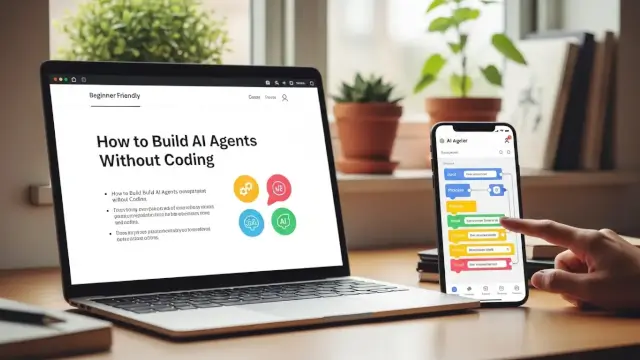
How to Build AI Agents Without Coding
What You'll Learn
- What an AI agent does when it is connected to information and approved actions.
- How retrieval, task, and autonomous agents differ in practical use.
- How to define scope, access, instructions, approvals, and testing before launch.
- Why monitoring, audit logs, pause controls, and recovery plans matter after launch.
What No-Code AI Agents Actually Do
How to Build AI Agents Without Coding starts with a narrower promise than most product pages suggest. You are not removing every technical decision. You are choosing an interface that lets you describe a job, connect approved information, and configure a workflow without writing the full application by hand.
Microsoft describes AI agents as tools that automate and execute business processes using natural-language inputs and data. That can mean answering questions, organizing information, or helping with a process that has several steps. The agent is useful because it can work with a defined task and the information made available to it. It is not useful simply because it has a conversational interface.
A chatbot may return an answer to a prompt. An agent may also retrieve information, follow a set of instructions, and help complete an assigned process. The difference depends on the system around the model. The available tools, the information sources, the permission boundary, and the approval rules shape what the agent can actually do. For a related explanation of the distinction, see AI Agent vs AI Assistant.
No-code describes how you configure the system. It does not guarantee that the system will understand every request, protect every file, or make a safe decision without review. That is why the build should begin with a small, observable job rather than a broad instruction such as “run the business.”
Choose the Right Agent Type
Microsoft groups common AI-agent roles into retrieval agents, task agents, and autonomous agents. These labels describe different operating patterns. They are useful before you choose a platform because the least independent option may be the right fit for the problem.
Retrieval Agents
A retrieval agent focuses on finding relevant information and returning it in a usable form. A support team could use this pattern to locate an approved policy or summarize a document set. The important design question is not whether the answer sounds fluent. It is whether the source material is appropriate, current, and available to the agent under the intended permissions.
Task Agents
A task agent helps carry out a defined process. The work may include preparing a report, organizing incoming information, or moving a request through approved steps. The task should have a clear starting point and a clear expected result. If the agent must decide whether it is allowed to take a consequential action, add an approval step instead of treating the model's first answer as authorization.
Autonomous Agents
An autonomous agent operates with greater independence toward a goal. That can be useful for selected processes, but independence increases the importance of scope, access controls, testing, logs, and human oversight. Autonomy is not a quality score. A narrow task agent that reliably asks for approval can be safer and more useful than a broad autonomous workflow that has unclear boundaries.
These categories can overlap in a real product. Treat them as a planning aid, not as a promise that every no-code platform supports each mode in the same way. For another view of practical agent roles, readers can compare the site’s AI and the future of work analysis.
Define a Narrow Job Before You Build
The first build decision is the job. Write one sentence that names the user, the trigger, the information the agent may use, and the expected result. “Help the service team prepare a draft response from approved help articles” is easier to test than “handle customer service.” The narrow version also makes it easier to spot requests that should be refused or passed to a person.
Next, write down the boundaries. What may the agent read? What may it change? Which actions require approval? What must it never do? Include the conditions for escalation, such as missing information, conflicting records, a request outside the approved topic, or a proposed action that cannot easily be reversed.
Microsoft lists customer service, risk management, forecasting, data entry, reporting, and inventory tracking among areas where organizations use AI agents. These are documented use-case categories, not a guarantee of savings or accuracy. Your own selection should depend on the sensitivity of the data, the cost of a wrong result, the availability of a reviewer, and whether the process has a clear definition of success.
A good first project is often a preparation step rather than a final decision. An agent can gather material, classify a request, or draft a report for review. That gives the team a visible output and a manageable place to learn where instructions, data, and permissions need adjustment.
Choose a Framework Without Chasing a Ranking
There is no defensible “best” no-code platform for every organization. The right choice depends on the job and the systems around it. Start by checking whether a framework supports the kind of instructions you need, the information sources you are allowed to connect, and the actions the agent must propose or perform.
Look for practical controls. Can access be limited to the required apps and records? Can the workflow separate reading from writing? Can a person approve a high-impact step? Are actions visible in an audit log? Can an administrator pause the agent? Can the team recover from an unwanted action? These questions matter more than a long feature list.
Zapier documents a no-code configuration experience for Zapier MCP and plain-language AI steps inside its automation environment. That is evidence about the cited product, not proof that every tool offers the same controls. A careful comparison should also consider documentation quality, support for testing, authentication design, data handling, and the operational work required after launch.
When comparing a no-code tool with a general AI assistant, keep the distinction clear. A chat product may be useful for drafting or research. An agent workflow has a larger responsibility when it can access records or trigger actions. The site’s ChatGPT, Claude, Gemini, and Perplexity comparison can help with the broader assistant question, but it does not replace a workflow-specific security review.
Provide Only the Necessary Information and Access
Information access should be designed with the same care as the job description. Microsoft says agents need access to the right information. The phrase “right information” has two parts. The information must be relevant to the task, and the agent must receive it through an authorized connection that fits the organization’s rules.
Start with a small source set. Remove documents that are unrelated, obsolete, or too sensitive for the first version. Decide how the agent should handle conflicting sources. If the system cannot establish which record is authoritative, the safer result may be an escalation rather than a confident answer.
Zapier’s guidance recommends a defined scope and limited access to the apps, data, and actions needed for a specific job. It also discusses OAuth-managed authentication so the model does not need to see or store raw credentials. Availability and implementation vary by platform, so treat OAuth as a control to look for, not a universal guarantee.
Separate read access from write access wherever the product allows it. An agent may be allowed to read a support article and prepare a response without being allowed to send that response. It may be allowed to identify a record without being allowed to edit it. This separation reduces the number of ways a mistaken instruction can create an external effect. The same principle applies to routine business automation, including the data flows discussed in the site’s AI expense-tracking guide.
Write Operating Instructions and Boundaries
Plain-language configuration still needs precise instructions. Write the agent’s purpose first, then describe the permitted inputs, the information it may use, the output format, and the handoff conditions. Use direct language. Do not ask the agent to “use common sense” as a substitute for a rule that the team can define.
Include examples of acceptable and unacceptable requests. If the agent is preparing a report, state which fields it should include and what it should do when a field is missing. If a source conflicts with another source, state whether it should ask for review, use a named authority, or stop. These rules create a testable contract between the workflow and its operators.
Content safeguards also matter. Zapier identifies screening for personally identifiable information, prompt-injection attempts, and toxic content as examples of safeguards for agent inputs and outputs. Those checks do not prove that the workflow is safe by themselves. They show the kinds of failure a design review should consider before the agent is connected to real systems.
Keep the first instruction set short enough for a reviewer to understand. A large block of vague prose is hard to test. A short set of rules tied to the job, the available information, and the approval boundary gives the team something concrete to inspect when the output is wrong.
Add Human Oversight to Consequential Actions
Human review should be placed where a wrong action would matter. The review point may be before an external message is sent, before a record is changed, before a financial or legal process moves forward, or before sensitive information is disclosed. The exact point depends on the use case.
Zapier recommends human oversight at critical points and suggests separating read and write capabilities. Its safety guidance also recommends draft states over direct irreversible actions. A draft gives a person a chance to check the source, the recipient, the wording, and the requested effect. It is not a guarantee of correctness, but it creates a useful control before the action leaves the system.
Not every step needs the same level of review. A low-risk retrieval answer may need a source link and a way to report an error. A workflow that changes a customer record needs a stronger approval design. Map the action path and mark every step that can affect a person, a payment, a permission, a public statement, or a permanent record.
Make the approval decision visible. The reviewer should know what the agent received, which information it used, what it proposes to do, and what will happen after approval. If the platform cannot expose enough context for a meaningful review, narrow the agent’s responsibility or choose a different workflow.
Test Before Real Deployment
Testing is not a final button click. Microsoft describes training as a process of feedback, test runs, and small adjustments. Use that approach even when the platform does not require code. Build a set of realistic requests that represent normal work, then add cases that are ambiguous, incomplete, conflicting, or outside the allowed scope.
Check the result, not just the wording. Did the agent use the intended source? Did it leave out information it was not allowed to use? Did it follow the requested format? Did it ask for clarification when needed? Did it stop or escalate when the action was outside its job? A fluent answer can still be the wrong operational result.
Test failure paths on purpose. Remove a source, provide two conflicting records, ask for a prohibited action, and submit a request with missing details. Record what happened. Then adjust the instructions, source selection, permissions, or approval step and run the case again.
Keep the early test scope small. A team can review a handful of clear cases more effectively than a large stream of unexamined outputs. Once the behavior is understandable, expand the set and include feedback from the people who will use the workflow every day.
Monitor, Audit, Pause, and Recover
An agent can change when its source information changes, when a connected application changes, or when the business process changes. Microsoft recommends ongoing monitoring so the system remains accurate and aligned with changing goals. Monitoring should continue after the initial release.
Track failed tasks, unexpected outputs, permission errors, user corrections, and actions that need reversal. The point is not to produce a flattering dashboard. The point is to find patterns that a single review would miss. If a certain request repeatedly causes escalation, the job may be too broad or the instructions may be unclear.
Zapier highlights observability, centralized audit logs, on and off controls, and recoverability as elements of trustworthy agent design. An audit log should help a team see what happened, when it happened, and which application was involved. A pause control gives operators a way to stop a workflow while they investigate. A recovery plan explains how to reverse or contain an unwanted action.
Review permissions as the workflow matures. A successful test does not justify giving the agent access to more systems. Expand only when the new responsibility has its own expected output, test cases, reviewer, and recovery path. For teams thinking about automation across everyday records, the site’s AI bookkeeping tools guide provides a separate example of why connected data deserves careful handling.
Practical Starting Areas for Non-Coders
Microsoft identifies several business areas where organizations use AI agents. Customer service is one possible starting point. A narrow agent could retrieve approved information and prepare a response for a representative. The human still decides whether the response is appropriate for the customer and the case.
Reporting and data entry can also be useful preparation tasks. An agent may organize incoming information or help assemble a report for review. The workflow should make missing fields visible and should not silently convert an uncertain value into a confirmed record.
Inventory tracking and forecasting require attention to source quality and timing. An agent can help collect information or explain a change, but the result should be checked against the system of record and the organization’s process. Risk management needs an even clearer escalation boundary because a wrong classification may change what happens next.
These examples are starting areas, not promises of productivity, cost reduction, or accuracy. Choose the case that has a clear owner, an accessible reviewer, and a result that can be checked. If the team cannot say how it will detect a wrong output, the job is not ready for an agent.
Safety Checklist Before Turning On an Agent
- The job is narrow enough for a reviewer to describe in one sentence.
- The intended agent type matches the level of independence the task needs.
- The information sources are relevant, approved, and limited to the job.
- Read and write permissions are separated where the platform supports it.
- Critical actions require human approval before execution.
- Inputs and outputs have safeguards for sensitive or hostile content.
- Testing includes normal cases, missing data, conflicting data, and out-of-scope requests.
- Logs show the agent’s actions and connected applications.
- Operators can pause the workflow and know how to recover from an unwanted action.
- The team has an owner who will review behavior as information and goals change.
The Bottom Line
Building useful AI agents without coding is possible when the work is treated as workflow design rather than a shortcut around engineering judgment. Define the job. Select a framework that fits the information and actions involved. Limit access. Write clear instructions. Add review points where the consequences justify them.
Then test the uncomfortable cases. Monitor the live workflow. Keep an audit trail, a pause control, and a recovery plan. No-code tools can reduce the amount of programming needed for selected builds, but they do not remove responsibility for data, permissions, security, or human decisions. A small agent that people can understand and correct is a better starting point than a broad one that nobody can safely inspect.
Frequently Asked Questions

SK Jabedul Haque
Building India's most trusted finance education platform — simplifying news, schemes and market trends so anyone can understand and invest confidently.
Read full bio

Never miss an update
Get our clearest explainers on schemes, markets and money — read what matters, without the noise.
Explore more articles