
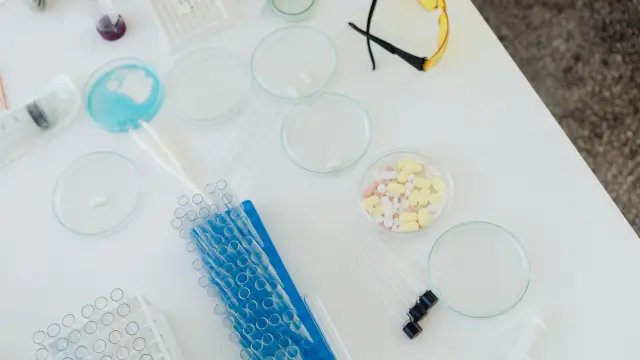
Anthropic launched a Biology Trusted Access Program that gives researchers Fable 5 with life science guardrails removed — meaning biologists, pharmacologists, and drug designers can run protein design queries that the standard model blocks. The program is distinct from Project Glasswing's cybersecurity focus. Cybersecurity safeguards remain in place, but the biology and chemistry classifiers that prevent drug design work are lifted entirely.
The practical impact is significant (Anthropic News). In internal testing, the ungated Mythos 5 model — the same underlying architecture as Fable 5 — produced 9 strong drug design candidates out of 14 protein targets. It accelerated the drug design process by roughly 10x. In blinded comparisons, scientists preferred Mythos-generated hypotheses over Opus-class models 80% of the time. One E. coli protein hypothesis was later independently corroborated by a separate lab working on the same problem — a rare validation of AI-generated biological predictions.
What the Biology Trusted Access Program Actually Provides
The program grants approved researchers access to the same Fable 5 model that powers Claude's multimodal capabilities, but with the life science classifier blocks disabled. This means queries about protein folding, molecular binding, drug-target interactions, and compound design that normally trigger refusals in standard Fable 5 will now execute without restriction.
The underlying model is identical to production Fable 5. The only difference is the classifier layer that blocks biology and chemistry queries. This matters because it means researchers get the full reasoning capability of Fable 5 — including its long-horizon memory and vision capabilities — applied to biological problems without the usual guardrail friction.
For researchers frustrated by standard Fable 5's refusal to engage with protein design questions, this program removes the primary barrier. The model can now analyze protein structures, predict binding affinities, suggest molecular modifications, and generate hypotheses about protein function — tasks that the standard classifier treats as potentially dangerous.
Why Anthropic Removed the Biology Guardrails
The decision reflects a tension in AI safety that Anthropic has been navigating since Fable 5's release. Biology and chemistry knowledge is dual-use: the same information that enables drug design can theoretically enable bioweapon development. Standard Fable 5 defaults to blocking most biology queries to avoid this risk.
But the safety guardrails that prevent bioweapon development also prevent legitimate drug discovery. Pharmaceutical researchers reported that Fable 5 would refuse to analyze protein structures, decline to predict molecular binding, and block discussions about compound design — even when the research had clear therapeutic intent and institutional oversight.
The Biology Trusted Access Program resolves this by gating access through institutional vetting rather than blanket blocking. Approved researchers demonstrate legitimate biology research needs, receive classifier-free access, and operate under institutional accountability. Anthropic retains cybersecurity safeguards — researchers cannot use the model to exploit computer systems — but the biology restrictions are lifted entirely.
The Autonomous Genomics Breakthrough
Beyond drug design, the ungated model demonstrated autonomous genomics capabilities that surprised even Anthropic's researchers. The model compiled single-cell data from millions of cells across 138 animal species, designed its own machine learning model to analyze the data, and outperformed a model recently published in Science — despite being 100x smaller.
This autonomous research capability — where the model independently designs its own analytical approach, selects training data, and validates its own results — represents a fundamentally different kind of AI assistance. Instead of answering researcher questions, the model becomes a research partner that initiates its own investigations.
For competitive positioning against GPT-5.5 and Gemini, this autonomous genomics capability is a concrete differentiator. Neither competitor has demonstrated equivalent autonomous scientific research at this scale.
How to Apply: Requirements and Process
Anthropic has not published a formal application portal, but the requirements can be inferred from their public statements and the Project Glasswing vetting model:
Institutional Affiliation: You must be affiliated with a recognized research institution — universities, pharmaceutical companies, government research labs, or independent research organizations. Individual researchers without institutional backing are unlikely to qualify.
Legitimate Research Need: You must demonstrate that your biology or chemistry research requires access to an ungated model. This means showing that standard Fable 5's guardrails are blocking specific, legitimate research workflows — not just general curiosity about biology.
Institutional Vetting: Similar to Project Glasswing, expect institutional verification. Anthropic will likely require confirmation from your institution that you are engaged in legitimate research and that your institution accepts accountability for your use of the ungated model.
Gradual Expansion: Anthropic has stated that access will expand "gradually in coordination with the US government." This suggests a phased rollout rather than open enrollment, with government-aligned research institutions receiving priority.
The 30-Day Data Retention Problem
The critical limitation for pharmaceutical companies is the data retention policy. Even approved biology researchers face Anthropic's standard 30-day data retention policy. For competitive drug discovery, this is a trade secret nightmare.
When a pharmaceutical company uses Fable 5 to design a novel protein therapeutic, the input data — including proprietary compound libraries, unpublished target structures, and competitive intelligence — is retained by Anthropic for 30 days. In a industry where a single molecular insight can be worth billions, this retention period creates unacceptable IP exposure.
This is where enterprise deployment options become critical. Anthropic's enterprise agreements can negotiate shorter retention periods or zero-retention configurations. But for researchers who need immediate access without enterprise contract negotiations, the 30-day policy remains a barrier.
The Cohere Alternative: Model Vault and Zero Retention
Cohere's Model Vault offers a fundamentally different approach to the same problem. Model Vault deploys AI models directly into a customer's Virtual Private Cloud, where the model runs on infrastructure the customer owns and controls. Data never leaves the customer's network. There is no retention period because Anthropic never sees the data.
For pharmaceutical companies concerned about IP protection, Model Vault eliminates the trust requirement entirely. The model physically cannot transmit data outside the VPC because it has no network path to do so. Fine-tuning happens on-premise, using the company's own data, with zero external data flows.
The tradeoff is capability. Cohere's models — including Tiny Aya's on-device capabilities — are smaller and less capable than Fable 5 for complex reasoning tasks. Pharmaceutical companies must weigh the capability advantage of Fable 5 against the IP protection advantage of Model Vault.
What This Means for Drug Discovery Timelines
The 10x acceleration in drug design reported by Anthropic is consistent with broader industry data on AI-assisted drug discovery. Traditional drug design cycles take 4-6 years from target identification to lead compound. AI-assisted pipelines have compressed this to months in some cases.
But the acceleration comes with caveats. AI-generated drug candidates still require experimental validation. The 9 strong candidates from 14 targets still need to go through clinical trials. The agentic capabilities that make Fable 5 effective at drug design also make it capable of generating confident but incorrect biological predictions — predictions that may look compelling but fail in the lab.
For researchers considering the Biology Trusted Access Program, the value proposition is clear: faster hypothesis generation, broader chemical space exploration, and the ability to screen protein designs that would take months to evaluate manually. The risk is over-reliance on AI predictions that have not been experimentally confirmed.
How to Get Started
Researchers interested in the Biology Trusted Access Program should take three steps immediately. First, document your specific research workflows that are blocked by Fable 5's current guardrails — concrete examples of queries the model refuses to answer. Second, confirm your institution's willingness to accept accountability for ungated AI use in biology research. Third, monitor Anthropic's official communications for application details, which are expected to emerge in the coming months.
For researchers who cannot wait, Fable 5's standard API with its guardrails intact still provides significant value for non-sensitive biology research. The guardrails block the most dangerous applications but permit substantial legitimate research — protein structure analysis, literature synthesis, and experimental design assistance all work within the standard model.
The Biology Trusted Access Program represents Anthropic's acknowledgment that blanket blocking of biology knowledge is not sustainable. The question is not whether AI will transform drug discovery — it already has. The question is whether researchers can access the capability before their competitors do.