Deepfake Detection: How to Spot AI-Generated Videos, Voice Clones and Video Call Scams in 2026
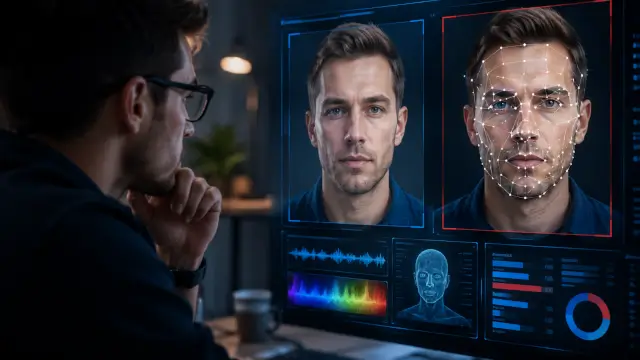
What You'll Learn
- How deepfake detection clues differ across video, audio and images.
- Why an independent callback is stronger than visual confidence.
- How to handle cloned voices and suspicious video calls.
- What households, publishers and businesses should document after a suspected scam.
What Is Deepfake Detection?
Deepfake detection means assessing whether audio, video or an image has been generated or manipulated with AI. A deepfake can replace a face, alter an expression, clone a voice or combine a real person with a synthetic scene. The important question is not whether a file looks unusual. It is whether the content, identity and request can be independently verified.
Detection has two layers. The first looks for technical or visual inconsistencies in the media. The second checks the surrounding claim, sender, timing, account and requested action. A perfect-looking video can still be a scam if the person asks for a transfer through an unfamiliar channel.
The FBI Internet Crime Complaint Center warning describes AI-generated voice messages used in impersonation campaigns and recommends independent verification before responding.
Why Visual Confidence Is Not Proof
People often treat eye contact, realistic lighting or a familiar voice as proof of identity. That is unsafe. Generation tools improve quickly, and ordinary cameras, network compression and poor lighting can create the same defects as synthetic media.
A detection clue should change your next step, not settle the case by itself. A strange mouth movement may be a rendering problem. A clear face may be a stolen recording. Treat both situations as reasons to verify the person through a trusted channel.
Do not forward a suspected deepfake as fact while waiting for a tool result. Save the original file or message when safe, record the sender and time, and avoid editing the evidence. Our synthetic-data analysis covers the wider problem of provenance and evidence quality.
Video Signs Worth Checking
The FBI lists several imperfections that can appear in manipulated images and videos. These include distorted hands or feet, unrealistic facial features, indistinct or irregular faces, accessories that do not sit naturally, inaccurate shadows and unnatural movement.
Check the whole scene rather than staring only at the face. Look at reflections, text on signs, earrings, glasses, hair edges, fingers, teeth and the direction of shadows. Watch whether the face stays aligned with the head during a turn. Listen for audio that does not match the mouth or room.
These clues are not a verdict. A real phone camera can produce blur, rolling-shutter distortions and strange shadows. A synthetic clip can avoid obvious defects. Use the clues to decide that the clip deserves a source check, not to claim certainty from one frame.
How to Assess a Cloned Voice
Voice cloning can sound familiar enough to trigger panic before a person has time to think. A caller may claim to be a family member, executive, public official or service provider. The request may involve an urgent transfer, a password, a verification code or a move to another messaging platform.
Listen for unnatural pauses, odd emphasis, flat emotion, incorrect pronunciation, background noise that does not fit the setting or a voice that does not respond naturally to questions. The FBI also advises looking closely at the number, contact details, links and spelling used in the message.
The strongest response is a separate verification channel. End the call if safe, find a number you already trust and call that number yourself. Do not use a number supplied by the suspicious caller. Ask a private question only the real person would know, but do not treat a correct answer as the only safeguard if an account may be compromised.
What to Do During a Suspicious Video Call
Slow the conversation down. A criminal benefits when the target believes that urgency is proof. Ask the caller to pause the financial or account request while you verify the identity through a known phone number, an internal directory or an in-person contact.
Do not share a one-time password, recovery code, remote-access permission or identity document during an unexpected call. Do not install a new app because the caller says it is required to see or hear them. If a colleague appears on video and requests a transfer, confirm the request through the normal approval process.
If the caller sends a link, inspect the domain without opening it and use the organisation's known website instead. Our technical delivery guide explains why a trustworthy interface still does not prove that a message or sender is authentic.
A Five-Step Deepfake Verification Checklist
First, pause. Treat urgency, secrecy and unusual payment instructions as risk signals. Second, preserve. Save the message, number, profile, URL and time without forwarding the suspected media as true. Third, separate. Contact the person through a known channel that the suspicious message did not provide.
Fourth, compare. Check whether the request fits the person's normal role, language and process. Search for an official notice independently rather than trusting a screenshot. Fifth, report. Contact the relevant bank, platform, employer, family member or law-enforcement reporting channel if money, accounts or safety are involved.
This sequence works even when no detection tool is available. It also reduces false confidence when a tool produces a reassuring score. A result should inform the investigation, not replace identity and transaction controls.
| Signal | Why it matters | Safe response |
|---|---|---|
| Urgent request for money or codes | Pressure reduces time for verification. | Pause and use an independent channel. |
| Voice or video mismatch | May indicate cloning, replay or account compromise. | End the contact and call a trusted number. |
| Odd URL, number or spelling | Impersonation messages often use small identity changes. | Open the known official site manually. |
| Visual artifact | May be synthetic, but real cameras can create artifacts too. | Preserve the file and seek a second source. |
Can Detection Tools Prove a Deepfake?
Detection tools can examine pixels, audio patterns, metadata, frame consistency or known provenance signals. Their usefulness depends on the model, training data, file quality, compression and the type of manipulation. A tool trained on one generation method may perform poorly on another.
Use a tool as one input in a review process. Check whether it explains the result, identifies the media type it supports and states its limits. Do not upload sensitive recordings to an unfamiliar service without reviewing its retention and training terms.
Provenance systems can also help when a file carries a durable record of origin and edits. That record is different from a detector score. Our AI watermarking guide explains why machine-readable marks, visible labels and independent verification are separate controls.
How Publishers Should Handle Suspected Synthetic Media
Publishers should verify the source before embedding or describing a dramatic clip. Record who supplied the file, when it was received, whether the original is available and whether the person shown has been contacted through an independent route.
Do not use a detector score as the headline. Describe what is known, what was tested and what remains uncertain. If the clip cannot be verified, label the uncertainty clearly or do not publish it. A correction after a false allegation may not reach every person who saw the original.
Keep the original file separate from edited versions. Store checksums or an equivalent record where appropriate, and retain the source conversation according to your privacy policy. Our AI policy fact-check uses the same distinction between reported claims and verified evidence.
Business Controls for Voice-Clone and Executive Impersonation Scams
Businesses should assume that a familiar voice or face can be copied. Payment approvals should require a second person and a known channel. High-value changes to bank details should have a documented callback process. Help-desk staff should not reset accounts solely because a caller sounds like an executive.
Train employees with examples of pressure tactics, unusual contact channels, links that move conversations elsewhere and requests for secrecy. Make reporting easy and non-punitive so a person can ask for verification before money or credentials leave the organisation.
Protect the accounts that criminals may use for a second impersonation attempt. Use phishing-resistant authentication where available, review recovery methods and limit public exposure of personal contact details. Our AI safety coverage discusses why operational controls matter alongside model-level safeguards.
What the EU AI Act Changes
The European Commission says Article 50 transparency obligations apply from 2 August 2026. Providers must add machine-readable marks that enable detection of AI-generated or manipulated content. Deployers have separate disclosure duties for specified biometric or emotion-recognition tools, deepfakes and certain public-interest text without human review or editorial control.
That rule does not make every detector accurate, and it does not turn a missing mark into automatic proof of fraud. It creates transparency duties that can support a broader provenance and disclosure workflow. Teams should check their role, system type, media flow and current official guidance.
Legal duties can change with later guidance and the facts of a specific use case. Read the current European Commission transparency guidance before making a compliance decision.
Bottom Line
Deepfake detection works best as a process, not a visual guess. Check the media for inconsistencies, but place more weight on independent identity verification, a second communication channel and controls around money, credentials and account recovery.
When a video call, voice message or image creates urgency, slow down and verify the request through a known route. Preserve evidence, report suspected fraud and describe uncertainty honestly. No detector score can replace a trusted source check.
Frequently Asked Questions

SK Jabedul Haque
Building India's most trusted finance education platform — simplifying news, schemes and market trends so anyone can understand and invest confidently.
Read full bio


Never miss an update
Get our clearest explainers on schemes, markets and money — read what matters, without the noise.
Explore more articles