Skip to Content

Deepfake Detection: How to Spot AI-Generated Videos, Voice Clones and Video Call Scams in 2026
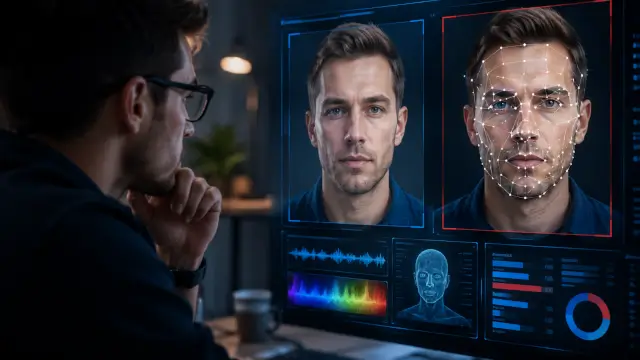
How to Spot AI-Generated Videos, Voice Clones and Video Call Scams in 2026
2026-08-06 21:52:04 Updated 2026-08-17 20:48:07.538897 — min read 73 views
Deepfake Detection: How to Spot AI-Generated Videos, Voice Clones and Video Call Scams in 2026
The deepfake detection is the process of identifying video, audio and images that have been artificially generated or manipulated by AI. In 2026, deepfakes account for roughly one in fifteen fraud attempts globally, and the EU AI Act now legally requires disclosure of AI-generated content. This guide explains how detection works, the best tools and how to spot a deepfake.

What You'll Learn

  • How deepfake detection works and why it matters in 2026
  • The verified 2026 statistics behind the deepfake fraud wave
  • How to spot a deepfake video with your own eyes
  • The best deepfake detection tools and how the EU AI Act regulates deepfakes

What Is Deepfake Detection?

Deepfake detection refers to the tools and techniques used to determine whether a piece of media has been artificially generated or manipulated by artificial intelligence. A deepfake is a video, photo or audio recording that appears real but has been created or altered with AI, replacing faces, synthesizing speech or manipulating expressions so that someone appears to say or do something they never did. The term was coined in 2017 on Reddit and has since grown from a novelty into a documented fraud vector tracked by banks, law enforcement and regulators worldwide.

Detection matters more in 2026 than ever before. Deepfake technology has moved from a niche research curiosity to a mainstream attack tool that criminals use against businesses and individuals every day. The market for detection products has grown from 5.5 billion US dollars in 2023 to an expected 15.7 billion US dollars in 2026, growing at 42 percent annually, according to Bright Defense research. That growth reflects a simple fact: seeing is no longer believing.

The problem has become so serious that in June 2026 the European AI Office published its Code of Practice on Transparency of AI-generated Content, and the EU AI Act now imposes legally binding disclosure obligations on everyone who deploys deepfake technology. This guide covers the current state of deepfake detection, the verified statistics, the tools that work, and the practical steps you can take to protect yourself and your organisation.

Deepfake Statistics 2026: The Scale of the Threat

The numbers behind deepfakes in 2026 are stark, and every figure below comes from verified industry research published in the last twelve months. An estimated 8 million deepfakes now circulate online, up from roughly 500,000 in 2023, a 16-fold increase in two years, according to DeepStrike data cited by StationX. Deepfake fraud attacks increased by 2,100 percent globally, according to the Sumsub Identity Fraud Report 2025-2026, and Pindrop reports that contact-centre deepfake voice attempts grew by over 1,300 percent.

Metric2026 FigureSource
Deepfakes circulating online~8 million (vs 500,000 in 2023)DeepStrike / StationX
Global rise in deepfake fraud attacks+2,100%Sumsub Identity Fraud Report
Organisations hit by at least one deepfake attack62%Netarx (Jul 2026)
Deepfakes as share of all fraud attempts6.5% (1 in 15)Signicat via Trusona
Reported losses from deepfake attacksOver $2 billionNetarx (Jul 2026)
Average cost of deepfake fraud per business~$450,000Eftsure (Jul 2026)
Largest single documented deepfake attack$25.6 millionStingrai
Deepfake detection market size$15.7B (from $5.5B in 2023)Bright Defense

Deepfake fraud accounted for 11 percent of all fraud detected globally in 2025, according to Eftsure research published in July 2026, and deepfakes now represent about 6.5 percent of all fraud attempts, or one in fifteen, up from 0.1 percent just three years earlier, a 2,137 percent increase tracked by Signicat. Resemble research counts 2,031 verified deepfake incidents every quarter, a 317 percent jump. In a widely cited case, a Hong Kong finance worker paid out 25 million US dollars to fraudsters who posed as the company chief financial officer on a video call, a case reported by CNN and documented by the Australian Counter Fraud agency. Deepfake fraud has been called the worst scam of 2026 by investigative journalists, and a Fortune analysis warned that voice cloning has crossed the indistinguishable threshold, making 2026 the year most people will be fooled by a deepfake at least once.

How to Spot a Deepfake Video With Your Own Eyes

Before reaching for software, there are visual and behavioural cues you can check yourself. Researchers at the MIT Media Lab, who run the Detect Fakes project, recommend paying attention to the cheeks and forehead: does the skin appear too smooth or too wrinkly, and does the agedness of the skin match the hair? Look at the eyes and eyebrows, and check whether shadows appear in places that physics would not allow. When the mouth is open, teeth and tongue often look slightly off in generated videos, as the maker of a detection tool told The Guardian.

Blinking is another classic signal. Real humans blink spontaneously every few seconds, while many AI-generated faces stare without blinking for unnaturally long periods. Kaspersky analysts noted in February 2026 that analyzing the movements and behavioural nuances of the person on screen is still the most reliable way to spot a deepfake in real time. Ask the person to turn their head, wave a hand in front of their face, or say something unpredictable. Generated faces frequently glitch around the edges of the face, hair and glasses during such movements.

Audio deepfakes need a different check. Listen for unnatural pacing, missing breaths, robotic intonation on certain syllables, and background noise that fades in and out. Reverse image search remains a powerful free tool: take a screenshot of a suspicious video and upload it to Google Images or Bing Images to see whether the face appears attached to different people or contexts. A quick cross-check with the subject's verified accounts can resolve most celebrity and executive scams within seconds.

How Deepfake Detection Technology Works

Automated deepfake detection relies on several families of techniques that look for traces human eyes cannot see. Forensic AI analysis trains machine learning models to detect the subtle artifacts generated by deepfake software, such as inconsistent noise patterns, colour differences, and spatial irregularities between regions of an image. Techniques range from classic Local Binary Pattern and Scale-Invariant Feature Transform analysis to convolutional neural networks, as documented in a Springer review published in January 2026.

The second major approach is provenance verification, which does not try to detect manipulation at all. Instead of inspecting pixels, it checks whether the media carries a tamper-evident digital record of its origin. The C2PA Content Credentials standard embeds cryptographically signed metadata about how content was created and edited. The European Code of Practice on Transparency of AI-generated Content, published by the European AI Office in June 2026, names C2PA Content Credentials as an example technical mechanism for compliance. This is the same framework the EU AI Act relies on for machine-readable marking under Article 50.

Real-time detection is the newest frontier. Scam.ai launched Halo at Computex 2026 in June 2026, an on-device deepfake detection system that scans video calls in real time on the user's own hardware, with public beta access opened in July 2026, according to Business Wire and the company's announcements. Intel's FakeCatcher claims to detect fake videos by analysing blood flow in the pixels of a face, and Microsoft Teams began rolling out a Report a concern button in August 2026 so meeting participants can flag suspected AI deepfake attendees, as reported by Windows Latest.

How accurate is all of this? Human performance is poor: research by Korshunov and Marcel shows human detection accuracy on high-quality deepfake video sits at roughly 24.5 percent, barely better than guessing, and Scam.ai puts human performance near random chance at about 50 percent. Machine detectors perform far better in the lab. A 2025 review published in MDPI reports 99.64 percent accuracy on the DFDC dataset using Random Forest, and commercial tools claim 95 to 98 percent accuracy in internal benchmarks, according to Fritz.ai. The catch is that academic performance does not survive contact with the real world: NIST's Deepfake-Eval-2024 benchmark found leading detectors lose 45 to 50 percent of their accuracy when moving from academic evaluation to operational deployment. This lab-to-real-world gap is why experts recommend a multi-layered detection stack rather than any single tool.

Best Deepfake Detection Tools in 2026

The deepfake detection tool market has matured quickly, and the tools below are the ones most frequently named in 2026 vendor comparisons and security research. TruthScan markets a free deepfake detector for videos and images with claimed accuracy above 99 percent, targeting face swaps, fake videos and manipulated photos. McAfee's Deepfake Detector focuses on flagging AI-generated audio within seconds, a useful defence for video calls and voice messages.

ToolFocusNotable Detail
TruthScanVideo & image detectionFree tier, claims 99%+ accuracy
DeepwareVideo scanningFree online scanner for suspicious videos
McAfee Deepfake DetectorAI-generated audioFlags cloned voices within seconds
Reality DefenderMultimodal enterpriseNamed Market Shaper by Gartner (Jun 2026)
Intel FakeCatcherVideo livenessAnalyses blood flow in face pixels
Scam.ai HaloReal-time video callsOn-device detection, launched Jun 2026
DeepFakeCheckVideo, audio, image & textFree online AI deepfake detector

Enterprise buyers should look at Reality Defender, which Gartner named a Market Shaper in the deepfake detection market in June 2026, and Diopter AI and Sensity AI, which appear consistently in the top ten lists published by Diopter and DuckDuckGoose in mid-2026. Organisations doing identity verification are increasingly bundling deepfake detection into KYC workflows, a trend documented by deepidv in May 2026. The market's consolidation is also accelerating: Deel acquired the deepfake-detection startup Clarity in August 2026 to fight fake hires in remote recruitment, as reported by The Next Web. For most individuals, the free scanners from Deepware and DeepFakeCheck plus reverse image search are a reasonable starting point. enterprises should pair a multimodal vendor like Reality Defender with provenance checking and human verification workflows.

Deepfake Video Call Scams: How They Work and How to Stop Them

Video call fraud is the fastest-growing and most damaging use of deepfakes. The playbook is consistent: criminals clone an executive's voice and face using publicly available video, then join or hijack a call to authorise urgent transfers, change payment details, or harvest credentials. The most documented case remains the Hong Kong multinational where a finance worker paid out 25 million US dollars after a video call with a deepfake chief financial officer, first reported by CNN in February 2024 and still cited by fraud agencies worldwide in 2026. The Australian Counter Fraud agency documents the same incident, valued at about 20 million pounds (HK$200 million), in its official case study on deepfake video conference fraud.

Real-time audio deepfakes have crossed a dangerous threshold. NCC Group researchers demonstrated in late 2025 that voice cloning can be generated live during a phone call, with no pre-recorded samples needed, and security firms warn the same technique is being used in real-world vishing attacks. This makes voice authentication on phone calls effectively obsolete. Group-IB and McAfee both document deepfake vishing attacks, where the attacker clones the voice of a boss or family member to request money transfers over the phone.

Defences that actually work in 2026: verify the request through an independent channel, meaning hang up and call the person back on a number you know. use a family code word or challenge question. watch for callers who refuse to turn their head or wave. check whether the caller's movements lag the audio. and never authorise payments based on a video call alone. Microsoft Teams' new Report a concern button, rolling out in August 2026, gives meeting participants a way to flag suspected deepfakes directly to administrators. Scam.ai's Halo takes the defence to the user's device, scanning every video call for manipulation in real time without sending footage to a server. For audio-only calls, tools like the ones covered in our AI voice detector guide can screen suspicious calls before they escalate.

Deepfake Law in 2026: EU AI Act and Beyond

Regulation caught up with deepfakes in 2026. The most important development is the EU AI Act, which has been applicable since 2 August 2026. Under Article 50(4), any deployer of an AI system that generates or manipulates image, audio or video content constituting a deepfake must disclose that the content has been artificially generated or manipulated. This is the world's first legally binding deepfake disclosure requirement, and it applies extraterritorially to companies outside the EU that serve EU users, as Netarx and Potomac Law have both noted. Violations of the transparency obligations carry fines of up to 15 million euros or 3 percent of total worldwide annual turnover, while prohibited practices face up to 35 million euros or 7 percent. The European Commission finalised its Article 50 guidelines on 20 July 2026, and the European AI Office's Code of Practice on Transparency of AI-generated Content, published in June 2026, names C2PA Content Credentials as an example mechanism. For a full breakdown of the watermarking side of these rules, see our guide to EU AI Act Article 50 watermarking compliance.

Outside Europe, enforcement is accelerating too. India tightened its deepfake rules in July and August 2026, cutting the content takedown window to 3 hours for platforms and approving 13 responsible AI projects focused on deepfake detection, as reported by ETGovernment and TechGig. The Indian government also asked Meta to explain its algorithms and deepfake systems amid a compliance review, according to Storyboard18. In the United States, federal law still lacks a single comprehensive deepfake statute, but state-level digital replica and deepfake transparency laws continue to emerge, and the US midterm campaign season has become a live stress test: Reuters reported in March 2026 that AI deepfakes are expected to spread widely in midterm campaigns and could erode public trust in real content. Meanwhile the UK government published official guidance on deepfake detection technology in March 2026, aimed at healthcare, public agencies and enterprises. The broader policy climate is covered in our analysis of why regulators are tightening controls on frontier AI, including the story of why the US government blocked GPT 5.6.

What to Do If You Suspect a Deepfake

Knowing the warning signs is only half the battle. knowing what to do next matters just as much. If you suspect a video call or voice message is a deepfake, stop the conversation immediately and do not authorise anything. Hang up and verify through an independent channel you know, never through the number the caller gives you. If money has already moved, contact your bank or payment provider immediately, because many fraud departments can still freeze or recall transfers made within hours. Preserve the evidence: record the call, save the message and take screenshots before anything is deleted. Then report the incident to the platform where the content appeared, to the relevant fraud or cybercrime reporting agency in your country, and to the police if money was lost. Organisations should log the attack internally and share the details with their industry's fraud-sharing networks, since deepfake fraud patterns repeat quickly across targets. Finally, warn the person whose identity was cloned, because attackers often reuse the same stolen footage against their family, colleagues and business contacts. As our analysis of AI models training on their own fake data explains, deepfake-generated content is feeding back into the training pipelines of new AI systems, which means the quality of fakes will keep improving until provenance standards are enforced at scale.

Deepfake Protection Checklist for 2026

Bringing everything together, here is the practical checklist that individuals and businesses should run before trusting any sensitive media in 2026. For individuals: treat unsolicited requests for money, credentials or personal data as suspicious by default, verify through an independent channel, use a family code word for emergency calls, run suspicious videos through a free scanner such as Deepware or DeepFakeCheck, and use reverse image search before sharing or acting on viral clips. For businesses: add deepfake detection to KYC and onboarding, adopt C2PA-based provenance checking for marketing content, train finance and HR teams to challenge video-call payment instructions, deploy real-time call screening such as Scam.ai Halo where budgets allow, and log and report suspected deepfake attacks to relevant fraud agencies. Organisations should also monitor the EU AI Act compliance timeline carefully, because disclosure obligations now apply to any business deploying deepfake or synthetic media technology for EU users, as covered in our analysis of AI models training on their own fake data.

The Bottom Line

Deepfake detection in 2026 is a race between generation and detection, and the gap is closing from both directions. The scale of the threat is verified and sobering: 8 million deepfakes online, fraud attacks up 2,100 percent, one in fifteen fraud attempts now involving synthetic media, and a single documented loss of 25.6 million dollars. Human perception is no longer a reliable defence, with detection accuracy near 24.5 percent against high-quality fakes. Automated tools work, but with a real-world accuracy penalty of up to 50 percent compared with lab results, so the winning strategy is layered: visual and behavioural checks, free scanners, provenance verification with C2PA, and strict verification workflows for anything that moves money. The legal market has shifted decisively in 2026, with the EU AI Act's Article 50(4) making deepfake disclosure a legal obligation in Europe and regulators in India, the UK and the United States building their own responses. The tools, the laws and the techniques in this guide give you a practical defence against the worst scam of 2026.

Frequently Asked Questions

It depends on jurisdiction and how the deepfake is used. In the EU, Article 50(4) of the AI Act makes it illegal to deploy deepfakes without disclosing that the content is artificially generated or manipulated, with fines up to 15 million euros or 3 percent of global turnover. In the US, federal law lacks one comprehensive deepfake statute, but state digital replica laws are expanding. Deepfakes used for fraud, defamation or election manipulation are illegal in most countries.
A deepfake is a video, photo or audio recording that seems real but has been manipulated or created with artificial intelligence. The technology can replace faces, control facial expressions, synthesize new faces and clone voices, so a person can appear to say or do something they never actually said or did. The word combines deep learning and fake.
The 3 finger test is a visual trick used to check suspicious video. Ask the person on screen to raise three fingers and count them aloud, or hold up your own three fingers and ask them to mirror you. AI-generated faces frequently distort hands, especially fingers, because generative models historically struggle with hand anatomy. It is a quick informal check, not a guarantee of authenticity.
Look for unnatural blinking, skin that is too smooth or too wrinkled, mismatched shadows around the eyes, lag between movement and audio, distorted hands or fingers, and faces that glitch at the edges. Kaspersky analysts say behavioural checks are most reliable: ask the person to turn their head or wave a hand, and verify payment requests through an independent channel.
You can run it through free scanners such as Deepware or DeepFakeCheck, which analyse video, audio and images for manipulation artifacts. Take a screenshot and run a reverse image search on Google Images or Bing Images to see if the face appears in other contexts. Check C2PA provenance metadata if present, and verify the content against the person's official accounts.
Yes, by a wide margin. Research by Korshunov and Marcel shows humans detect high-quality deepfake video with only about 24.5 percent accuracy, barely better than chance. Machine detectors reach 95 to 99 percent accuracy in lab benchmarks, though NIST found leading detectors lose 45 to 50 percent of accuracy in real-world deployment, so layered detection remains necessary.
Top 2026 tools include TruthScan for videos and images, Deepware and DeepFakeCheck as free scanners, McAfee Deepfake Detector for AI-generated audio, Intel FakeCatcher for liveness analysis, Reality Defender for multimodal enterprise use, and Scam.ai Halo for real-time on-device video call screening. Gartner named Reality Defender a Market Shaper in June 2026.
Search your name alongside keywords like deepfake, scam and video on Google, Bing and social platforms, and set up Google Alerts for your name. Check reverse image search for your photos appearing on unfamiliar sites. If you find a fake, report it to the platform, the police in serious cases, and in the EU the disclosure rules of the AI Act apply to the creator.
Article 50(4) of the EU AI Act, applicable since 2 August 2026, requires deployers of AI systems that generate or manipulate image, audio or video content constituting a deepfake to disclose that the content is artificially generated or manipulated. The rule applies extraterritorially to companies serving EU users, and violations carry fines up to 15 million euros or 3 percent of turnover.
Reported losses from deepfake attacks passed 2 billion US dollars in 2026, with 62 percent of organisations having faced at least one attack, according to Netarx. The average deepfake fraud incident costs businesses about 450,000 dollars, and the largest single documented attack cost 25.6 million dollars.
SK Jabedul Haque
Written by

SK Jabedul Haque

Founder & Chief Editor

Building India's most trusted finance education platform — simplifying news, schemes and market trends so anyone can understand and invest confidently.

Read full bio


Never miss an update

Get our clearest explainers on schemes, markets and money — read what matters, without the noise.

Explore more articles
In this article