AI Tools for Germany's Hidden Champions
What You’ll Learn in This Guide
- ✓ Why 92% of German executives are increasing AI budgets in 2026.
- ✓ How predictive maintenance saves 20% on energy and repair costs.
- ✓ The shift from manual bookkeeping to straight-through processing.
- ✓ Top AI-powered ERP modules for specialized manufacturing niches.
AI tools for German Hidden Champions are no longer a luxury; they are the backbone of Germany's 2026 industrial strategy. While the term "Hidden Champions" was once synonymous with niche engineering excellence, it now represents a digital-first cohort of world-market leaders. In the heart of the German Mittelstand, a silent revolution is occurring where financial data from the factory floor is being used to drive boardroom decisions through hyper-automation.
As the BaFin AI Act implementation protocols begin to stabilize, manufacturers are finding that AI-driven finance tools provide more than just efficiency. They offer a "system of action" that coordinates work across legacy ERP systems, reducing administrative workloads and allowing highly skilled engineers to focus on product innovation.
AI Adoption in the Mittelstand: 2026 Statistics
The adoption of artificial intelligence among German SMEs has reached a historic high. In 2026, 56% of German firms report active AI use in their finance departments, a figure that has more than doubled since 2023. Even more striking is the commitment to future growth: 92% of German executives plan to raise AI spending this year, with many earmarking budget increases of over 25%.
This trend is particularly pronounced in the manufacturing sector. Approximately 42% of industrial firms now use AI for core operations, ranging from quality control to agentic banking for treasury management. The German federal government has supported this transition with a €1.6 billion investment in AI initiatives, a twenty-fold increase since 2017, aimed at turning Germany into an "AI-nation."
Industry 4.0: Integrating Finance with the Factory Floor
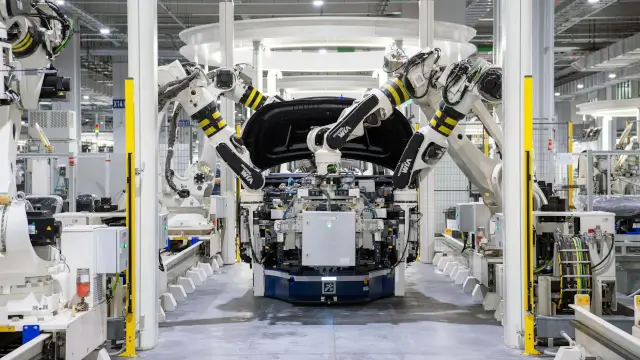
The true power of AI for Hidden Champions lies in the integration of financial forecasting with Industry 4.0 sensor data. Predictive maintenance, for example, is no longer just a technical metric-it is a financial one. By forecasting equipment failure before it occurs, manufacturers can minimize unplanned downtime and extend asset lifespans, directly impacting the bottom line.
| AI Use Case | Financial Impact | Typical Savings |
|---|---|---|
| Predictive Maintenance | Reduction in repair costs & downtime | 20% Lower energy use |
| Inventory Costing | Dynamic pricing & stock rebalancing | 99.99% Machine uptime |
| Automated Reporting | Faster financial close cycles | 38% Full automation level |
| Export Risk AI | Real-time credit guarantees | 15% Higher growth rates |
BMW and Siemens are leading the way by using "digital twins" to optimize production. This level of synchronization ensures that digital accounting systems are always aware of raw material consumption and machine wear, allowing for cent-level precision in inventory costing.
Top AI Tools for Manufacturing Finance Automation
For a Hidden Champion to maintain its edge, it must choose tools that offer both deep niche functionality and broad ecosystem integration. In 2026, the ERP market has split between generalist giants and specialized AI-native platforms.
SAP Analytics Cloud remains a dominant force for larger Mittelstand firms, especially with the 2026 Joule integration that allows AI agents to trigger governed processes directly from financial dashboards. For SMEs, Microsoft Dynamics 365 Business Central has become a favorite due to its native interoperability with the broader Microsoft 365 ecosystem.
Beyond the big names, specialized FP&A (Financial Planning and Analysis) tools like Jedox and Planful are gaining traction in Germany. Jedox is highly regarded for its flexible data modeling and predictive "what-if" scenario tools, which are essential for manufacturers navigating volatile global supply chains.
Automating Export Finance and Risk Assessment
As Hidden Champions typically generate over 70% of their revenue from exports, automating export finance is a top priority. In 2026, Euler Hermes (Allianz Trade) has introduced a "flex&cover" strategy powered by AI. This system overhauls old local content rules, allowing for more flexible export credit assessments based on a company's total German "footprint"-including R&D and tax contributions-rather than just physical parts sourcing.
AI tools continuously monitor international transactions to flag potential compliance issues, such as repeated shipments to high-risk regions. These systems also automatically screen customer records against denied party lists as they change in real-time, preventing the "bad data" risks that often lead to heavy fines for global chip makers and industrial exporters.
The Challenge of Hyper-Automation: Human in the Loop
Despite the shift toward "straight-through processing" (STP), where 38% of German finance teams now automate over half of their document lifecycle, the human element remains vital. German corporate culture prizes reliability over rapid experimentation. This "controlled maturity" approach ensures that while AI handles the heavy lifting, final financial disclosures and regulatory filings are still verified by human professionals.
Hyper-automation is enabling Hidden Champions to overcome the chronic shortage of skilled workers in Germany. By freeing engineers and accountants from tedious paperwork, firms can maintain their global competitiveness without increasing headcount proportionally to their growth targets.
Conclusion
The future of Germany's industrial heartland is being written in code. For Hidden Champions, the transition to AI-driven finance automation is the ultimate competitive differentiator. By 2027, the gap between "AI integrators" and "AI tinkerers" will widen, with the former seeing significantly lower costs and faster market response times. For manufacturers ready to embrace Industry 4.0 finance, the tools are now mature, regulated, and ready for deployment.
Last Updated: May 19, 2026 | Source: CEPR, VDMA, and PwC Business Analytics (Official Statistics)
Frequently Asked Questions

SK Jabedul Haque
Building India's most trusted finance education platform — simplifying news, schemes and market trends so anyone can understand and invest confidently.
Read full bio

Never miss an update
Get our clearest explainers on schemes, markets and money — read what matters, without the noise.
Explore more articles