AI Image Generator Copyright Issues 2026
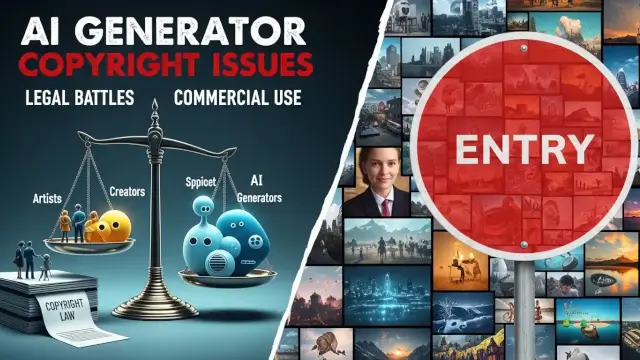
Legal note: I am an AI, not a lawyer. This is a working technology analysis, not formal legal advice. Copyright, trademark, privacy, publicity, contract, and consumer-protection rules differ by country and by use. Have a qualified attorney review a specific image, license, campaign, or dispute before relying on it.
What You'll Learn
- Why copyrightability, commercial permission, and infringement risk are different questions
- What the U.S. Copyright Office says about human authorship, prompts, edits, and arrangements
- What the Andersen v. Stability AI order did and did not decide about training-data claims
- How to build a rights ledger and review gate before publishing or selling an AI image
What Copyright Question Are You Actually Asking?
“Who owns this AI image?” is usually a bundle of separate questions. Can a human claim copyright in the output? Does the provider contract allow the intended use? Could the image copy a third party’s protected expression? Does it include a face, logo, character, or distinctive product that raises a different right? Can the team prove where the reference material came from?
These questions sit at different layers. Copyrightability concerns whether the law recognizes protectable expression and who contributed it. A provider license concerns what the customer and provider agree to do with content. Infringement concerns whether a particular use violates another party’s rights. Provenance concerns whether the team can reconstruct the asset’s inputs, edits, approvals, and release context.
An image can have a broad contractual permission and still contain a third-party logo. An image can include substantial human editing and still create a trademark problem in an advertising campaign. An image can be hard to protect while remaining valuable as a layout, brand asset, or trade secret. A paid plan is not a universal rights certificate.
| Layer | Core question | Evidence to keep | Common mistake |
|---|---|---|---|
| Copyrightability | Is there sufficient human-authored expression? | Human inputs, edits, selection, arrangement, and final files | Assuming a detailed prompt automatically creates copyright |
| Contract | What does the provider allow this customer to do? | Plan, terms version, product, account, and access date | Treating commercial use as proof of ownership |
| Third-party rights | Could the asset affect another party's copyright, trademark, privacy, or publicity rights? | Reference permissions, releases, search record, and review decision | Checking only the generator's terms |
| Provenance | Can the team explain how the final asset was made? | Prompt, source files, model, edits, approvals, and export | Keeping only the final compressed image |
The site's multimodal AI systems analysis makes a related engineering point. A unified interface can hide several internal stages. AI image rights work the same way. The final file may look simple while its input and decision chain is not.
What U.S. Copyright Law Says About Pure AI Output
The U.S. Copyright Office's Part 2 report, issued January 29, 2025, says U.S. copyright protection requires human authorship. It discusses the 2023 D.C. District Court decision in Thaler v. Perlmutter, where an image described in the application as autonomously created by a computer algorithm did not satisfy the human-authorship requirement.
The narrow lesson is not that every image made with an AI tool is outside copyright. The Office says that in many cases an output can be protected in whole or in part when AI is used as a tool and a human determines the expressive elements. The protected scope depends on the human contribution and the final work, not on the fact that a particular model was used.
The Office also says no court has recognized copyright in material created by non-humans. This is a statement about the human-authorship foundation in U.S. doctrine. It should not be expanded into a worldwide claim because other jurisdictions can apply different rules and agencies can update their guidance.
A practical way to read the rule is to ask what the human actually authored. Did the person make expressive visual inputs? Did they direct a process that left meaningful creative choices under human control? Did they select, arrange, crop, paint over, composite, or otherwise modify the generated material? The answer is evidence for a registration or ownership analysis, not an automatic result.
The site's AI and work analysis uses a similar task-level method. Do not classify the whole image as human or machine without identifying the individual steps that produced the final expression.
How Human Input Can Change the Analysis
The Copyright Office identifies three kinds of human contribution to AI-generated outputs: prompts that instruct the system, expressive inputs that can be perceived in the output, and modifications or arrangements of the generated material. The Office treats these as analytical categories rather than a mechanical scoring formula.
Prompts deserve careful treatment. A prompt can be expressive as text on its own, but that does not automatically give the user copyright in the image produced by the system. The Office says simple prompts are generally insufficient to make the user the author of the resulting output. The system may make expressive choices that the user did not control.
Expressive inputs are different. A creator may provide a hand-drawn sketch, a photograph they own, a color study, or another original element that is visibly incorporated into the final image. The analysis then focuses on the human-authored material and how it is used. The provider may have additional rules for uploaded reference material, so the legal and contractual checks must run together.
Modifications and arrangements can also matter. A human may combine several generated elements with original artwork, make detailed changes in an editor, create a larger composition, or select and arrange material in a way that reflects creative judgment. Protection, if available, may cover the human-authored parts rather than every pixel produced by the model.
Training Data Is a Separate Copyright Dispute
The copyrightability of an output is not the same question as whether a model's training process used protected works lawfully. A creator asking for rights in a final image is asking about authorship and expression. An artist or publisher challenging training is asking about copies, access, purpose, market effect, contracts, and possible defenses.
The U.S. Copyright Office Part 3 training report is a pre-publication policy analysis, not a binding court holding. It says several stages in generative AI development involve uses of copyrighted works that implicate exclusive rights. It identifies fair use as the primary defense and says the result depends on multiple statutory factors in the circumstances of each case.
The report says the analysis can depend on what works were used, their source, the purpose, and the controls on outputs, because those details can affect the market. It says commercial use of large collections of copyrighted works to produce expressive content that competes in existing markets, especially when the material was obtained through illegal access, can go beyond established fair-use boundaries.
The Office also says licensing agreements for AI training are emerging in some sectors but are not consistently available. It recommends allowing the licensing market to develop before government intervention, while leaving room for targeted action if market failures appear in particular works or contexts. That is a policy recommendation, not a ruling that settles a specific model or dataset.
Teams should therefore avoid two absolute statements. “All training is fair use” is unsupported. “All training is infringement” is also unsupported. The source, permissions, model process, output behavior, market substitution, and case law all matter. The research question is still active.
What Andersen v. Stability AI Actually Decided
Andersen v. Stability AI is often described in headlines as if it answered the entire AI copyright debate. The verified N.D. Cal. order dated August 12, 2024 was a motion-to-dismiss ruling. Judge William H. Orrick denied the defendants' motions to dismiss the Copyright Act claims. That allowed those claims to continue past that stage.
The same order granted dismissal with prejudice for the DMCA claims, granted dismissal with leave to amend for unjust-enrichment claims, denied Midjourney's motion to dismiss Lanham Act claims, and granted dismissal with prejudice for DeviantArt breach-of-contract and implied-covenant claims. These outcomes show why a case-status paragraph should name the claim and the procedural stage instead of saying that one side won the whole dispute.
The order did not finally decide that training on copyrighted images is infringement. It also did not finally decide that the training process is fair use. Allegations about scraping, training, model behavior, and outputs remain allegations unless a later ruling resolves them. A motion to dismiss tests the legal sufficiency of claims at an early stage.
The official GovInfo record shows the case continued into 2026. Its March 11, 2026 entry records a procedural order granting more time for third parties to seek protective orders regarding materials produced to Runway. That entry concerns discovery procedure and does not decide the copyright merits.
For readers following AI and markets, the site's AI capital-spending analysis provides context on why these disputes matter commercially. Commercial stakes do not change what a court order actually held.
Provider Terms Are Not Copyright Certificates
Image generators publish terms because a service needs rules for uploads, prompts, outputs, accounts, moderation, privacy, and disputes. Those terms can grant a customer permission to use an output under stated conditions. They can also require the customer to have rights in reference material and to avoid infringing uses.
A contract is not the same as a copyright registration. If a provider says a subscriber may use an image commercially, that statement can answer one contractual question. It does not automatically create human authorship in the generated parts. It does not clear a visible third-party mark. It does not remove a model's training dispute. It does not bind a court in a different country.
Terms can also change. Record the provider, model or feature, plan, terms URL, access date, and relevant clause with the asset. Do not rely on a screenshot without keeping the original URL and a copy permitted by the service rules. If a campaign will run for a long period, review whether later changes affect new outputs, stored outputs, or only future use.
Provider terms often place the first review burden on the user. A team needs an internal decision about who checks an image, what evidence they keep, and when the asset must be escalated. The strongest workflow treats the provider contract as one input to a rights decision rather than the decision itself.
Midjourney and Adobe Show Different Risk Layers
Midjourney's official commercial-use page says users own the images and videos they create, even if they cancel a subscription, subject to listed exceptions. It says an upscaled image created by another user belongs to the original creator and requires that creator's permission. It also says a business grossing more than $1,000,000 USD per year needs a Pro or Mega Plan to use images commercially for its company.
Midjourney's page separately says that copyright laws differ between countries and that the service cannot provide copyright guidance. That separation is important. The page describes a product and contract position, while copyrightability still depends on applicable law and human contribution.
Adobe's Generative AI User Guidelines were last updated May 15, 2026. Adobe says users must not create, upload, or share content that violates third-party copyright, trademark, privacy, publicity, or other rights. It specifically includes prompts designed to generate infringing content and reference images containing third-party copyrighted material.
Adobe also tells users to review and validate outputs, avoid sensitive personal information unless the product is designed for it, and preserve Content Credentials that Adobe attaches or publishes for generative-AI content. A Content Credential can help communicate that an asset was generated or modified with AI. It is not, by itself, proof of copyright ownership.
| Provider evidence | What the official page says | What the team still must check | What it does not guarantee |
|---|---|---|---|
| Midjourney commercial-use page | Created images and videos can be used subject to listed exceptions | Other-user assets, business plan, current terms, and third-party rights | Worldwide copyright in every generated pixel |
| Midjourney Terms | User must have necessary rights and avoid third-party rights violations | Reference permissions, faces, marks, and intended publication | That the output is non-infringing |
| Adobe user guidelines | Third-party-rights violations are prohibited and outputs should be validated | Source rights, content credentials, data handling, and human review | That the asset is legally safe in every campaign |
| Any paid plan | Defines access and contractual permissions | Copyrightability, jurisdiction, and clearance scope | A legal opinion or court-approved ownership |
The site's robo-advisor analysis is a useful contrast. A product feature can define how a service operates, but it does not answer every question about the user's broader legal or financial context.
Log Trademarks, Faces, and Reference Images
Copyright is only one part of image risk. A logo or distinctive product design can raise trademark or trade-dress questions. A recognizable person can raise privacy or publicity issues. A photograph can contain a building, artwork, license plate, or private setting that changes the review. A prompt that names an artist or character can create a different risk from a generic visual description.
Do not treat a generator's output screen as a rights search. Record whether a reference image was made by your team, licensed, supplied by a client, or downloaded from a source with unclear terms. Keep model inputs separate from third-party assets. If a person is identifiable, document the release or the business reason for using the likeness where appropriate.
Adobe's guidelines prohibit using generative AI features to create, upload, or share content that violates third-party copyright, trademark, privacy, publicity, or other rights. Midjourney's terms require the user to have necessary rights and permissions for content they provide, edit, generate, and share. These provider rules reinforce a basic engineering control: validate the input before asking the model to make a polished output.
For brands, the highest-risk asset is often not a random background. It is a logo, product hero image, campaign key visual, packaging design, or image that will be reused across markets. Use a human review gate for those assets. A quick search for visual similarity is not a legal opinion, but it can identify a case that needs escalation.
The site's AI screening workflow article shows the same process principle. A tool can narrow a search, but the final decision still needs an accountable reviewer and an evidence record.
Build an Asset Provenance Ledger
A provenance ledger is a small record that lets another reviewer reconstruct the asset. It should be easy to create during production and easy to export when a client, platform, or lawyer asks how the image was made. The ledger is not a safe harbor. It is a control that reduces uncertainty and prevents the team from losing the evidence behind a claim.
Start with the source. Record every reference image, sketch, text fragment, face, logo, and dataset supplied to the workflow. For each item, note the owner, license, permission, restrictions, and whether it is actually embedded in the final file. If the source cannot be identified, do not silently label it cleared.
Record the tool path. Keep the provider and feature, plan, model or version when exposed, prompt, negative prompt if used, seed if available, reference settings, and output identifiers. Record the date and terms URL. If the service uses a public gallery or community feed, note the visibility setting and whether any asset came from another user.
Record human contribution. Save the sketches, edits, masks, compositing steps, typography, layout, color work, and selection decisions that shaped the final result. Store both the unedited output and the final export. If a designer chose one image from many candidates, keep the selection rationale when the decision matters to the project.
| Ledger field | Example record | Why it matters | Review owner |
|---|---|---|---|
| Inputs | Owned sketch, licensed photo, client logo, or no reference | Shows the source and permission boundary | Designer or content producer |
| Generation | Provider, feature, plan, prompt, date, and output ID | Reconstructs the contractual and technical path | Operator or developer |
| Human expression | Masking, painting, composition, typography, and selection | Documents the human-authored contribution | Creative lead |
| Release | Channel, territory, client approval, and retention rule | Connects the asset to the actual use | Publisher or legal reviewer |
Keep the ledger next to the asset rather than in an unrelated chat thread. Use a stable identifier, store the original file hash when practical, and restrict access to sensitive prompts or client material. If the image is regenerated, create a new record rather than overwriting the old one.
Review AI Images Like Production Artifacts
A developer would not ship a generated file without checking the build output, tests, dependencies, and rollback path. Treat an AI image with the same discipline. Inspect anatomy, text, logos, edges, repeated patterns, hidden artifacts, and accidental resemblance. Check the final export at the size and crop that the audience will see.
Review the rights record at the same time as the pixels. Does the final image include a reference element that was not in the first draft? Did an editor add a stock texture? Did a client supply a mark without a license? Did a model or plan change between the test and the final generation? The release record must match the image that will actually be published.
Use staged approval. A low-risk internal mood board can have a lighter review than a product advertisement, editorial cover, logo, political message, or paid campaign. The review level should follow audience, reach, reversibility, third-party exposure, and the cost of a takedown or replacement.
Do not delete the unsuccessful outputs when they explain why the final image was chosen. A short record of rejected results can show the team avoided a recognizable character, mark, or copied reference. Retention still has to follow privacy and security policy, especially when prompts contain client information.
The site's AI infrastructure roadmap coverage is relevant here because system reliability comes from observability and recovery, not only from a successful demo. Asset review needs the same visibility.
When to Ask for Clearance
Ask for legal or rights review before release when the image will become a logo, a product identity, packaging, paid advertising, a high-value client deliverable, a public statement, or a repeated asset across several jurisdictions. Escalate when a recognizable person, brand, copyrighted character, living artist's named style, private setting, or supplied reference image is involved.
Escalate when the provider terms are unclear, when the account plan does not match the business use, or when the asset was generated by a contractor whose account and permissions are not controlled by the company. Check who owns the contract, who can access the original prompt and files, and whether the client agreement addresses AI-assisted work.
Escalate when the source record is missing. A polished image with no provenance is harder to defend than a rough image with a clear chain of inputs and edits. If the team cannot explain a reference asset, a person, a mark, or a major human edit, pause publication until the gap is resolved.
| Escalation trigger | Prepare before review | Release decision |
|---|---|---|
| Brand, logo, character, or product identity | Final asset, intended territory, source record, and similarity concern | Hold until rights review is complete |
| Recognizable person or supplied reference image | Permission, release, source license, and final crop | Confirm consent and permitted use |
| Unclear provider terms or contractor account | Plan, terms date, account owner, and output record | Resolve contract scope before publication |
| Missing provenance or disputed training concern | Inputs, edits, model details, and issue summary | Pause or replace the asset |
Do not ask a lawyer to approve a vague description if the actual file is available. Provide the final image, source inputs, provider terms and plan, prompt history, human edits, intended channel, territory, duration, and any similarity concern. A precise review question saves time and produces a more useful answer.
The site's forecast methodology coverage illustrates the same discipline. A conclusion is only as useful as the assumptions and evidence supplied with it.
Conclusion: Treat AI Images as Rights-Bearing Workflows
AI image generator copyright 2026 questions have no single provider-level answer. The U.S. Copyright Office says current U.S. copyright protection rests on human authorship and that sufficient human expression can matter. It also says prompts alone are unlikely to satisfy the requirement at this stage. Training-data disputes are separate and remain fact-specific. The Andersen order allowed Copyright Act claims to continue past a motion to dismiss, but it did not finally decide the merits.
Provider terms can permit commercial use, set plan conditions, require rights in inputs, and publish content-provenance rules. Midjourney's commercial-use page includes an ownership statement and exceptions. Adobe's guidelines prohibit third-party-rights violations, require judgment and validation, and address Content Credentials. None of those pages replaces a copyright analysis for a particular image and use.
The practical answer is an evidence workflow. Keep the inputs, permissions, model and plan details, prompt, human edits, terms date, Content Credentials, review decision, and intended release. Add a human gate for brands, faces, references, and high-value commercial assets. If a specific dispute or jurisdiction matters, ask a qualified attorney to review the actual file and record.
This article is an informational technology analysis, not formal legal advice. It does not guarantee copyright ownership, commercial clearance, non-infringement, or protection from a takedown. The rule that holds up best in production is simple: if the team cannot explain where the image came from and what the human contributed, it is not ready for an important release.
Frequently Asked Questions

SK Jabedul Haque
Building India's most trusted finance education platform — simplifying news, schemes and market trends so anyone can understand and invest confidently.
Read full bio

Never miss an update
Get our clearest explainers on schemes, markets and money — read what matters, without the noise.
Explore more articles