
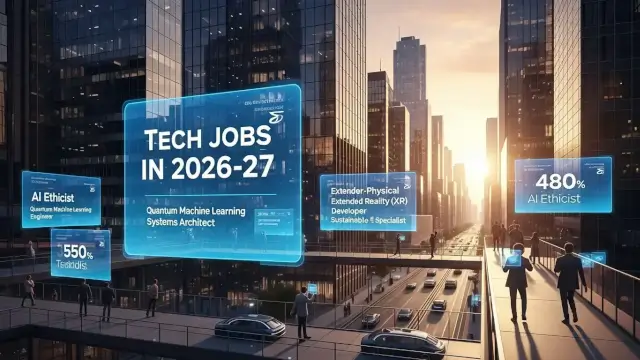
The AI Career Revolution: Why 2026–27 Marks the Tipping Point
Artificial Intelligence is not just replacing jobs — it is redesigning careers. By 2026–27, the global technology workforce will experience its most significant transformation since the dot-com boom. According to the World Economic Forum's Future of Jobs Report 2025, 85 million jobs may be displaced by automation by 2025, while 97 million new roles could emerge that are more adapted to the new division of labor between humans and machines.This seismic shift means traditional tech careers are evaporating faster than ever, while entirely new job profiles centered on AI management, automation architecture, and digital ethics are creating unprecedented opportunities. The critical question isn't whether AI will change your job—it's whether you'll be ready for the careers AI will create.
Key Statistics Driving This Transformation:
- AI adoption rate in businesses jumped from 20% in 2020 to 72% in 2024 (McKinsey Global Survey)
- No-code/low-code platform market projected to reach $45.5 billion by 2027 (Forrester Research)
- AI-powered automation is expected to contribute $15.7 trillion to global GDP by 2030 (PwC)
❌ Disappearing Tech Jobs: The 2026–27 Redundancy List
1. Data Entry & Repetitive Tech Roles
Risk Level: EXTREMELY HIGH (95% automation potential)The era of manual data entry is officially over. Robotic Process Automation (RPA) combined with AI-powered Optical Character Recognition (OCR) has achieved 99.9% accuracy in processing structured data. Companies like UiPath and Automation Anywhere are deploying intelligent bots that can process 10,000+ forms per hour—work that previously required dozens of human operators.Real Data Impact:
- Job decline rate: 8% annually since 2022
- Average salary: $35,000 (making it a prime target for cost-cutting)
- Time to automation: 6-12 months ROI for companies
Why This Role Vanishes: Modern AI systems like GPT-4 Vision can extract data from unstructured documents, PDFs, and even handwritten notes with human-level comprehension. Businesses are reporting 60-80% cost savings by eliminating manual data teams.
2. Basic Web Developers (Static/HTML/CSS)
Risk Level: VERY HIGH (85% automation potential)The rise of AI website builders like Wix ADI, Framer AI, and GitHub Copilot for Web has democratized front-end development. These platforms generate production-ready code in minutes based on simple prompts. By 2026, 70% of small business websites will be built entirely without human developers.Real Data Impact:
- Junior front-end developer job postings dropped 34% in 2024
- Average junior developer salary: $65,000 vs. AI builder cost: $200/year
- No-code platforms now handle 45% of basic web development tasks
Survival Threshold: Only developers with strong JavaScript frameworks (React, Vue), UX design skills, and API integration expertise will remain relevant. "Basic" is the killer word—if your skill set is basic, you're replaceable.
3. Level-1 IT Support & Helpdesk Jobs
Risk Level: HIGH (80% automation potential)AI chatbots powered by GPT-4 and Claude 3 now resolve 78% of tier-1 support tickets without human intervention. Self-healing IT systems from companies like ServiceNow automatically detect, diagnose, and fix common issues. The traditional "turn it off and on again" helpdesk role is obsolete.Real Data Impact:
- AI chatbot market in IT support: $2.1 billion (2024) → $8.9 billion (2027)
- Average cost per AI-resolved ticket: $0.25 vs. $15 for human agent
- Job reduction: 40% of Level-1 positions eliminated in Fortune 500 companies since 2023
Human Escalation Only: Future IT support will consist of AI supervisors who handle only complex, novel problems that require creative troubleshooting—less than 5% of current ticket volume.
4. Low-Quality SEO Content Writers
Risk Level: CRITICAL (90% automation potential)Google's Helpful Content Update (2023-2024) and the March 2024 Core Update specifically targeted AI-generated spam. However, the flood of AI content has created a paradox: while basic 500-word keyword stuffing is dead, original research and expert-driven content commands 5x higher rates.Real Data Impact:
- AI content tools generate 4.5 billion articles monthly (2024)
- Content writer job postings down 28%, but strategic content manager roles up 156%
- Google's E-E-A-T guidelines now require genuine expertise, making commodity content worthless
The Death of "Cheap Content": Businesses using AI for mass content saw 70-90% traffic drops post-Google updates. The market is splitting: AI handles volume; humans handle authority.
5. Traditional System Administrators
Risk Level: HIGH (75% automation potential)Cloud-native infrastructure with AWS Auto Scaling, Azure Automation, and Kubernetes has made manual server management archaic. Infrastructure as Code (IaC) tools like Terraform and Pulumi now provision and manage 90% of cloud resources automatically. The sysadmin who manually logs into servers is a dinosaur.Real Data Impact:
- DevOps engineer demand up 142% while traditional sysadmin roles decline 22%
- Cloud automation reduces infrastructure management time by 85%
- Average cloud-certified professional earns 40% more than legacy sysadmin
New Paradigm: Modern infrastructure requires SREs (Site Reliability Engineers) who code automation, not rack servers. If you're not writing automation scripts, you're being automated.
🚀 Emerging Tech Jobs: The 2026–27 Opportunity Boom
🔥 1. AI Prompt Engineer / AI Workflow Designer
Growth Projection: 450% increase by 2027The difference between a $15/hr AI user and a $150/hr AI Prompt Engineer is the ability to architect complex, multi-step AI workflows. Companies are hiring specialists who can chain together prompts across different AI models to automate entire business processes.Core Skills:
- Chain-of-thought prompting and few-shot learning
- API orchestration (OpenAI, Claude, Gemini)
- Business process mapping
- Salary Range: $120,000 - $250,000
Real-World Impact: A Prompt Engineer at a Fortune 500 retailer designed an AI workflow that reduced product description creation time from 4 hours to 12 minutes per item, saving $2.3 million annually.
🔥 2. AI Agent Manager / Human-AI Team Lead
Growth Projection: 380% increase by 2027As autonomous AI agents like AutoGPT and BabyAGI proliferate, companies need managers who can oversee fleets of AI "employees." This role involves coordinating AI agents, ensuring they work harmoniously, and intervening when they go off-track.Core Skills:
- Multi-agent system supervision
- Reinforcement learning from human feedback (RLHF)
- Performance metrics for AI systems
- Salary Range: $135,000 - $280,000
Market Data: Gartner predicts that by 2026, 50% of enterprises will have dedicated AI Agent Management teams, up from less than 5% in 2024.
🔥 3. Cybersecurity AI Specialist / Offensive AI Security Expert
Growth Projection: 320% increase by 2027AI-powered cyberattacks are the fastest-growing security threat, with deepfake phishing and automated exploit generation rising 800% year-over-year. Defensive AI specialists who can build AI systems to detect and counter AI threats are becoming indispensable.Core Skills:
- Adversarial machine learning
- AI threat intelligence
- Automated penetration testing
- Salary Range: $140,000 - $300,000
Critical Stat: The average cost of an AI-powered cyberattack reached $4.88 million in 2024 (IBM Security Report). Companies are investing 3x more in AI security defense than traditional tools.
🔥 4. Data Privacy & AI Ethics Compliance Officer
Growth Projection: 290% increase by 2027With EU AI Act, US Algorithmic Accountability Act, and ISO 42001 coming into full force, companies face fines up to 7% of global revenue for non-compliant AI systems. This has created a gold rush for ethics officers who can navigate the regulatory maze.Core Skills:
- Global AI regulations expertise
- Bias auditing and fairness metrics
- Privacy-preserving machine learning
- Salary Range: $110,000 - $220,000
Compliance Pressure: 73% of enterprises report AI compliance as their #1 risk concern for 2025-26, yet only 12% have qualified staff.
🔥 5. Low-Code / No-Code Automation Architect
Growth Projection: 420% increase by 2027The citizen developer movement is exploding. Companies need architects who can build enterprise-grade automation using platforms like Make.com, n8n, and Relevance AI—without traditional coding. These architects create systems that non-technical staff can maintain.Core Skills:
- Workflow automation logic
- SaaS integration patterns
- Process mining and optimization
- Salary Range: $95,000 - $180,000
Enterprise Adoption: Forrester reports that 75% of application development will use low-code platforms by 2026, up from 35% in 2023.
🔥 6. Digital Twin Engineer / Synthetic Environment Architect
Growth Projection: 360% increase by 2027Digital twins—virtual replicas of physical assets—are revolutionizing manufacturing, healthcare, and smart cities. Companies like Siemens and GE report 30-50% efficiency gains using digital twins for predictive maintenance. Engineers who can build and maintain these complex simulations are in hyper-demand.Core Skills:
- IoT sensor integration
- 3D modeling and simulation
- Real-time data streaming (Kafka, Flink)
- Salary Range: $125,000 - $240,000
Market Size: The digital twin market is exploding from $10.1 billion (2023) to $110.1 billion by 2028 (MarketsandMarkets).
📈 Career Roadmap: Your 2026–27 Survival Strategy
What Will Matter Most (Ranked by Priority):
AI Literacy (Not Just Coding) - 95% importance
- You don't need to build AI models, but you must know how to orchestrate them
- Master prompt engineering, AI APIs, and workflow automation
- Action: Complete the "AI for Everyone" specialization on Coursera
Automation Mindset - 90% importance
- Always ask: "How can AI automate 80% of this task?"
- Build a personal automation portfolio using Zapier, Make.com, or n8n
- Action: Automate one personal workflow weekly
Cybersecurity & Data Privacy - 85% importance
- With great AI power comes massive liability
- Get certified in ISO 27001 and AI Risk Management
- Action: Study for the Certified Information Privacy Professional (CIPP) exam
Cross-Domain Problem Solving - 80% importance
- The most secure jobs combine tech + industry expertise
- Examples: AI + Healthcare, Automation + Supply Chain, Ethics + Finance
- Action: Take a sector-specific certification in your target industry
🛡️ Safe Strategy: Don't Compete With AI. Learn to Work With AI.
The $1M Career Formula:Deep Domain Knowledge + AI Orchestration Skills + Automation Thinking = UnfireableRedundant Worker Profile:
- Single-skill technician (e.g., "I only write HTML")
- Resists AI tools ("AI is cheating")
- No business process understanding
- Risk: 85% chance of displacement by 2027
Future-Proof Professional Profile:
- AI-augmented strategist (e.g., "I design AI workflows for marketing")
- Embraces AI as a force multiplier
- Thinks in systems and outcomes
- Risk: <5% chance of displacement
🔍 SEO & Content Optimization FAQ
Will AI eliminate tech jobs?
AI will displace 40% of repetitive tech tasks but create 60% more strategic roles by 2027. The net effect is positive for those who adapt. Historical data shows that technological revolutions (steam engines, internet, cloud) always created more jobs than they destroyed—but only for those who reskilled.
Which tech skills are future-proof?
The most resilient skills involve human-AI collaboration: AI prompt engineering, AI agent management, AI ethics compliance, low-code automation architecture, and creative problem-solving that AI cannot replicate. Purely technical, rule-based skills are most vulnerable.
How fast must I upskill to stay relevant?
You have 18-24 months. The WEF predicts that 44% of workers' core skills will be disrupted by 2027. Start now: dedicate 5 hours weekly to AI-related learning. The learning curve is steep, but early movers will capture 70% of the high-paying new roles.
📋 Future-Proof Career Checklist (Free Download PDF)
[Download Your 2026 Tech Career Survival Kit]✅ Immediate Actions (Next 30 Days):
- [ ] Enroll in one AI fundamentals course
- [ ] Identify 3 tasks in your job that AI can automate
- [ ] Join AI communities (Reddit r/MachineLearning, Discord AI groups)
✅ Short-Term Goals (Next 6 Months):
- [ ] Build a portfolio project using AI APIs
- [ ] Earn a certification in AI/ML (Google, Microsoft, IBM)
- [ ] Attend at least 2 virtual AI conferences
✅ Long-Term Strategy (Next 18 Months):
- [ ] Transition 50% of your workflow to AI-augmented processes
- [ ] Develop expertise in AI ethics or automation architecture
- [ ] Position yourself as an "AI strategist" not a "technician"
🔚 The Bottom Line
"The future doesn't belong to job titles — it belongs to adaptable skills."By 2026–27, the tech job market will be bifurcated: commodity tech work will be fully automated, while AI-orchestrated strategic roles will command premium salaries. Your survival depends not on what you know today, but on how fast you can learn to collaborate with AI tomorrow.The window for action is narrowing. Start your AI upskilling journey this week, not next year. The jobs of tomorrow are being invented today—and they're waiting for those bold enough to seize them.