
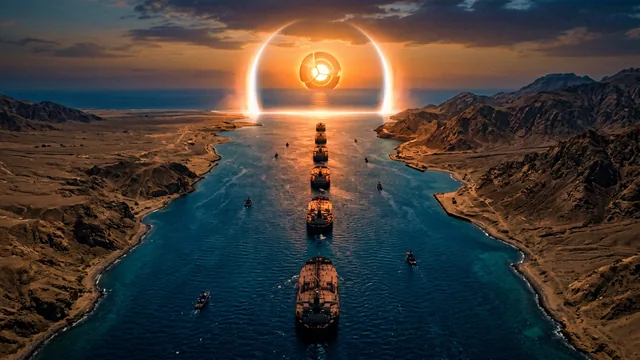
The United States and Iran have signed a preliminary memorandum of understanding (MOU) that opens the Strait of Hormuz to commercial shipping without tolls for 60 days. The deal, expected to be formally signed on Friday in Switzerland, represents the most significant development in US-Iran relations since the outbreak of hostilities. The agreement also includes limited sanctions relief and a framework for talks on Iran's nuclear program.
\n\nWhat Happened
\nUnder the MOU announced on Monday, Tehran will allow the safe passage of commercial ships through the strategic waterway without tolls for exactly 60 days. The US agreed to lift its naval blockade of Iranian ports and provide limited sanctions relief covering oil exports. In exchange, Iran committed to clearing naval mines from the approaches to Hormuz and beginning negotiations on its nuclear program. Vice President JD Vance confirmed the US expectation that the strait would be opened toll-free for the long term, though the text of the agreement only guarantees 60 days. The ceasefire extension gives both sides 60 days to negotiate a permanent settlement, with a final agreement expected by August.
\n\nThe two nations differ sharply on what happens after the 60-day window. Iran's state-linked Tasnim News Agency reported that Iran would hold off on fees for 60 days but would \"begin charging ships for services after that period.\" Iran has already established a \"Persian Gulf Strait Authority\" with Oman to administer the waterway. President Trump, however, insisted the strait would be \"permanently toll-free\" beyond the initial period, contradicting the Iranian position.
\n\nWhy It Matters
\nThe Strait of Hormuz is one of the world's most critical maritime chokepoints, with roughly 20% of global oil shipments passing through its narrow waters. Any disruption to shipping through the strait sends shockwaves through global energy markets. The US-Iran war had effectively closed the waterway, causing oil prices to surge and forcing shipping companies to reroute vessels around the Cape of Good Hope at significant cost. Goldman Sachs estimates that oil exports from the Middle East will not return to normal levels until the end of July.
\n\nThe deal offers relief to energy markets but leaves fundamental questions unanswered. Shipping industry associations are urging caution despite the political agreement — insurance costs remain elevated, and the waters still contain mines that must be cleared before normal traffic can resume. Markets reacted positively to the news, with oil slipping $4 as the deal reduced geopolitical risk premium.
\n\nWhat's Next
\nThe next 60 days will determine whether the preliminary agreement becomes a lasting peace or collapses into renewed hostilities. During this period, Iran, Oman, and Gulf states will negotiate the \"future administration and maritime services\" in Hormuz under the supervision of the US. A senior US official acknowledged that Iran will likely \"assert their rights as aggressively as they can\" in these talks. The US has committed to lifting naval blockade and releasing frozen Iranian assets as part of the deal, removing much of its leverage for the follow-on negotiations.
\n\nIf the 60-day period succeeds in clearing mines and establishing a working ceasefire, both sides have indicated willingness to discuss a broader normalization of relations. However, the disagreement over tolls represents a fundamental clash of interests — Iran sees revenue collection as its sovereign right, while the US wants to prevent any nation from controlling the vital waterway's access fees. Markets will be watching oil inventory levels and shipping rates closely as the deadline approaches. The current 60-day toll-free period ends in early August.
\n\n\n\n\n