Option Chain Kaise Samjhe?
What You'll Learn
- What an option chain shows and how calls, puts, strikes and expiries are arranged
- How to interpret Open Interest, change in OI, volume, LTP, bid-ask data and IV without treating one field as a forecast
- How PCR and Max Pain are calculated and why their meaning depends on the measurement basis
- How to build a short educational reading routine while respecting liquidity, leverage and derivatives risk
Option Chain analysis is the process of reading exchange-listed call and put contracts by strike price and expiry. The NSE interface shows contract-level fields such as Open Interest, volume, implied volatility and last traded price. These fields describe positioning, trading activity and option pricing. They do not reveal a certain future direction.
SEBI describes an option as a derivative that gives the buyer a right, but not an obligation, to buy or sell the underlying at a predetermined date and price. The buyer pays a premium. The seller takes the other side of that contract. This basic structure explains why option-chain data needs context. A large number of contracts can represent hedging, speculation, spreads or positions that will be closed before expiry.
Key Facts at a Glance
| Item | Practical meaning |
|---|---|
| Option chain | A strike-wise view of available call and put contracts for an underlying and expiry |
| Call option | Gives the buyer the right, but not the obligation, to buy the underlying at the contract terms |
| Put option | Gives the buyer the right, but not the obligation, to sell the underlying at the contract terms |
| Open Interest | Outstanding contracts that have not been closed, exercised or otherwise removed from the open position |
| Volume | Contracts traded during the session |
| Implied Volatility | A volatility input or estimate embedded in an option premium under a pricing model |
| Max Pain | A calculation from open interest and strike prices, not a guaranteed price target |
What Is an Option Chain?
An option chain is a structured table for one underlying instrument and one or more expiry dates. Each row generally represents a strike price. The call side and put side show the terms and activity for contracts linked to that strike. The centre of the table often makes it easier to compare the underlying level with strikes near the current price.
The chain is useful because it puts several pieces of evidence in one view. Open Interest can show where contracts remain open. Change in OI shows whether the open position count has changed during the reporting period. Volume shows trading activity. Implied volatility and the last traded price help describe the premium. Bid and ask quotes indicate the price at which a participant may be able to transact.
None of these fields identifies the intention of every participant. A put can be bought for protection or sold as part of a spread. A call can be bought for a directional view or sold against a share position. Read the chain as a record of contracts and prices, then form a cautious interpretation.
Where to Find the Official NSE Option Chain
The primary public source for an Indian exchange option chain is the NSE India option-chain page. The page provides selectors for an underlying, symbol, expiry date and strike price, and it offers a CSV download option. The visible equity-derivative choices include NIFTY, NIFTYNXT50, FINNIFTY, BANKNIFTY, MIDCPNIFTY and NIFTYFPI.
Open nseindia.com/option-chain by typing the domain into the browser and check that the page is on the NSE website. Select the underlying and expiry before comparing strikes. Do not copy a displayed live value into a general article or a permanent note without recording when it was observed. The page is dynamic, so spot price, option premium, volume, OI and IV can change during the session.
Broker and analytics interfaces may present the same contract data in a different layout. Use them for convenience, but compare an important observation with the exchange page. For broader context, an option-chain reading can sit alongside a market article such as the tariff impact guide or an explanation of the Federal Reserve outlook and the gold-price analysis. Those articles provide context, not option data.
How the Option Chain Layout Works
| Area | What to inspect | Question to ask |
|---|---|---|
| Underlying and expiry | Selected instrument and contract date | Am I comparing contracts for the same underlying and expiry? |
| Strike price | Rows running through the chain | Which strikes are near the current underlying level? |
| Call side | Call premium, OI, volume, IV and quote fields | Is activity concentrated at a particular strike, and is liquidity adequate? |
| Put side | Put premium, OI, volume, IV and quote fields | Does the same observation remain after checking price and change in OI? |
| Download or chart view | Exchange-provided data export or visual display | Is the data timestamp clear enough for the comparison? |
Calls are commonly displayed on one side and puts on the other, with the strike column between them. The exact layout can change as the exchange updates its interface. The reliable habit is to confirm the column heading rather than infer a field from its position.
Open Interest: Meaning and Limits
Open Interest is the number of outstanding contracts at a strike and expiry. It is different from volume. Volume counts contracts traded during a session. Open Interest describes contracts that remain open after accounting for positions that have been closed or otherwise removed.
Every open contract has a participant on each side. Therefore, a high OI number alone does not tell you whether the market is bullish or bearish. It also does not identify whether the contracts are held by a hedger, a market maker, a spread trader or a directional trader. Use OI to locate areas for further inspection, not as a standalone signal.
The NSE market summary labels volume and Open Interest in shares or contracts. The unit matters when comparing two observations. A chain from one instrument or expiry should not be compared with another without checking contract specifications and the reporting basis.
Calls, Puts, Support and Resistance
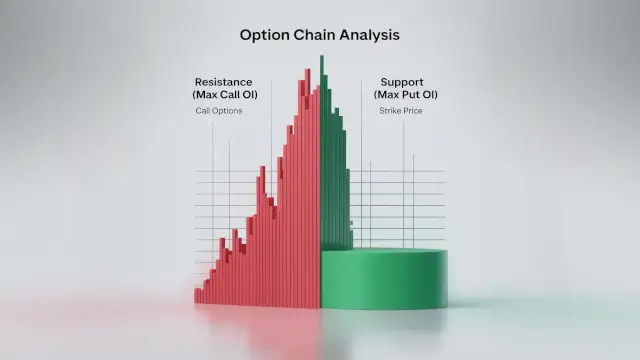
Traders often describe high call OI above the underlying as possible resistance and high put OI below the underlying as possible support. This is a useful observation framework, but it is not a mechanical rule. The position may be part of a hedge or spread, and the level can change when participants roll, close or add contracts.
| Observation | Possible interpretation | Required confirmation |
|---|---|---|
| High call OI near an upper strike | Market participants have significant open call exposure at that strike | Check change in OI, price, volume, expiry and quote liquidity |
| High put OI near a lower strike | Market participants have significant open put exposure at that strike | Check whether the level remains important across more than one observation |
| OI rises while the underlying approaches a strike | New exposure may be forming, but its direction is not visible from OI alone | Review contract prices, both sides of the chain and the wider market |
| OI falls at a previously watched strike | Some positions may be closing or moving to another strike | Check whether volume, price and nearby strikes support the explanation |
Support and resistance are labels for levels that may matter in a particular observation. They are not guaranteed floors or ceilings. A fast move, news event, expiry adjustment or change in liquidity can make an earlier level less relevant.
Change in OI and Price Confirmation
Change in OI is more informative when it is read beside the underlying price and the option premium. Rising OI may mean that new positions are being opened, while falling OI may reflect closing positions. The chain does not show the full reason for the change, so the interpretation must remain conditional.
A simple comparison is to note whether the underlying and the option premium rose or fell while OI changed. Then check both call and put sides rather than selecting the field that supports an existing view. A single intraday update can be noisy. A sequence of observations with a consistent timestamp is more useful for study than one isolated number.
For example, if call OI increases near a watched strike while the underlying stalls, the area may deserve attention. It does not prove that the strike will cap the market. If put OI increases while the underlying remains above a lower strike, the area may deserve attention as well. It does not prove that the strike will hold.
Premium, Liquidity and Implied Volatility
Volume measures contracts traded during the session. A high volume number can reflect opening trades, closing trades, intraday turnover or a combination of transactions. It should not be treated as a direct measure of conviction.
LTP means last traded price. It is a record of the latest transaction and may not be the price at which a new order can be executed. Bid and ask quotes provide more information about the current market for a contract. A wide spread can raise the cost of entering or exiting a position and can make an apparent premium comparison less useful.
For a clean comparison, keep the underlying, expiry and strike basis constant. Check whether the quote is active, whether volume is meaningful and whether the displayed time is recent. The Amazon market-reaction explainer illustrates why a news event can alter the underlying context quickly, but it does not supply a substitute for the live chain.
Implied Volatility and Option Premiums
Implied Volatility is linked to the option premium through a pricing model. It expresses the volatility level embedded in the observed premium under the model's assumptions. A higher IV can accompany a higher premium, but IV by itself does not prove that an option is expensive or cheap compared with future realised movement.
The official NSE page states that it applies a ten percent interest rate while computing implied volatility on its option-chain display. This is a source-specific calculation note. It should not be presented as a universal interest-rate assumption for every option-pricing system or every broker screen.
IV can change before a scheduled event and after the event. A buyer can be correct about direction and still lose if the premium falls because the volatility embedded in the price changes. A seller also faces material risks if the underlying moves sharply or if volatility expands. Study IV with time to expiry, premium, liquidity and the underlying rather than using a fixed percentile rule.
Put-Call Ratio: How to Calculate It
Put-Call Ratio, or PCR, can be calculated as put Open Interest divided by call Open Interest when both totals use the same underlying, expiry and time. Some platforms use volume rather than OI. Always state the numerator, denominator, expiry scope and timestamp before comparing a ratio.
| Step | Calculation or check | Why it matters |
|---|---|---|
| Choose the basis | Select put OI divided by call OI, or another clearly labelled basis | Different bases can produce different ratios |
| Match the scope | Use the same underlying, expiry and observation time on both sides | Mixed scopes make the comparison unreliable |
| Interpret cautiously | Compare the ratio with price, OI distribution, volume and liquidity | A ratio is a summary, not a direction guarantee |
| Record the timestamp | Save when the data was observed and whether it was live or end-of-session | PCR can change as positions and prices change |
A PCR above or below one is not automatically bullish or bearish. Market structure, hedging, spreads and expiry can affect the number. Do not use a universal extreme threshold as a trading instruction. The ratio is best treated as one descriptive measure in a wider review.
Max Pain: Calculation and Limits
Max Pain is a calculation that estimates the strike at which the aggregate intrinsic payout across the observed open call and put contracts would be lowest at expiry. A typical calculation tests each strike and sums the relevant option payouts using the selected OI and contract scope.
Max Pain is not a force that makes the underlying move. It is sensitive to the strikes included, the expiry selected, the OI snapshot and the treatment of contract details. A displayed Max Pain value can change as OI changes. The underlying may also move away from it because of news, hedging, liquidity or a directional imbalance.
Use Max Pain as a reference for studying the distribution of open contracts. Do not describe it as where the market wants to go, and do not use it alone to choose an option position. Compare it with the underlying price, the chain's OI concentration and the time remaining to expiry.
A Five-Minute Option-Chain Reading Routine
A short routine can make the analysis repeatable without pretending that the chain gives certainty. The sequence below is for observation and education, not a recommendation to trade.
- Confirm the underlying, expiry, timestamp and unit shown by the exchange page.
- Locate the underlying level and note nearby call and put strikes.
- Compare OI and change in OI at nearby strikes, then check the option premium and volume.
- Review bid-ask quotes and avoid treating a thin or stale quote as a reliable price.
- Record IV, PCR and Max Pain only after confirming their calculation basis and scope.
- Write a conditional observation with an alternative explanation and no guaranteed outcome.
Keep a small log with the date, time, underlying, expiry, watched strikes and the reason each strike was selected. A record makes it easier to see whether an interpretation worked across different conditions. It also exposes hindsight bias, where a reader remembers the level that worked and forgets the levels that did not.
Risks, Common Mistakes and Limitations
SEBI explains that derivatives may be used for hedging, speculation and arbitrage, and it highlights market, credit, liquidity and operational risks. Because the amount paid for an option can be small compared with the value of the underlying, profits and losses can be multiplied. A chain-reading skill does not remove those risks.
- Confusing OI with volume: OI is outstanding exposure, while volume is session activity.
- Treating OI as intent: OI does not reveal whether a position is a hedge, spread or directional trade.
- Using LTP as an executable price: Check bid, ask, spread and quote freshness.
- Mixing expiries: OI, PCR and Max Pain must be read with a clearly stated expiry scope.
- Following fixed thresholds: A ratio or IV level has no universal meaning outside its context.
- Ignoring the underlying event: News and macro conditions can change the chain quickly. A guide to RBI repo-rate transmission shows why policy context can matter for markets.
Use paper observation or a simulator if the goal is learning. Do not risk money merely because one strike appears to have large OI. This article is educational information and is not personalised financial advice.
Frequently Asked Questions

SK Jabedul Haque
Building India's most trusted finance education platform — simplifying news, schemes and market trends so anyone can understand and invest confidently.
Read full bio


Never miss an update
Get our clearest explainers on schemes, markets and money — read what matters, without the noise.
Explore more articles