
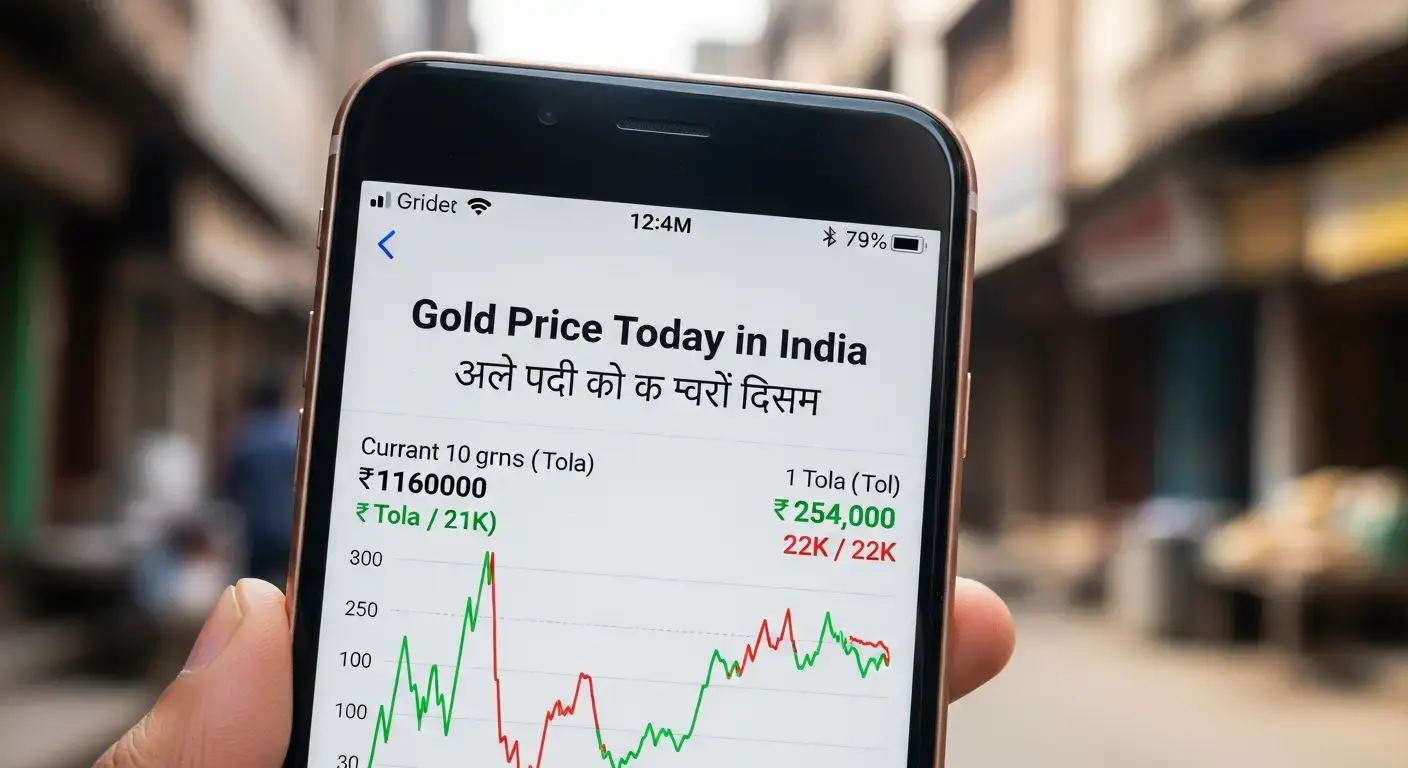
Gold prices extended their losing streak to five consecutive sessions on Thursday, June 11, 2026, as the precious metal fell below the critical $4,300 per ounce mark for the first time this year. The decline, which has now erased all gains made in 2026, has rattled commodity markets worldwide and pushed gold into negative territory for the year.
What Happened: Gold Plunges Below Key Support
Gold futures on the Multi Commodity Exchange (MCX) in India fell by Rs 277 to settle at Rs 1,47,740 per 10 grams on June 11, tracking a sustained downturn in global spot markets. In the international market, gold dropped by $126.27 per ounce, pushing prices into the $4,200 range before recovering marginally. By the end of the trading day, spot gold was quoted around $4,088.32 per ounce, according to USA Today market data.
The precious metal fell below its 200-day moving average — a key technical indicator — signalling to traders that the broader trend may have shifted bearish. In Pakistan, 24-karat gold per tola declined by Rs 12,627 to settle at Rs 4,42,436, reflecting the synchronized global selloff affecting bullion markets across Asia.
Metal-linked stocks felt the immediate impact. Shares of Muthoot Finance, IIFL Finance, and Manappuram Finance fell by up to 6 percent, while Hindustan Zinc and other commodity-focused equities slipped up to 4 percent in the subsequent sessions. The broad-based weakness in gold financing and jewellery stocks mirrored the physical market decline.
Meanwhile, gold price movements in India often diverge from global trends due to currency fluctuations and local demand patterns.
Why It Matters: Multiple Headwinds Converge
The gold selloff is being driven by a convergence of macro factors that have historically weighed on non-yielding assets. Persistent US inflation data released this week reinforced expectations that the Federal Reserve may need to maintain or raise interest rates, increasing the opportunity cost of holding gold — an asset that pays no interest or dividend.
Rising US real yields have made Treasury bonds more attractive relative to gold, prompting ETF investors to liquidate their positions. Analysts at Standard Chartered, led by Suki Cooper, warned that gold could face further declines as the rate environment continues to favour yield-bearing assets. The surge in Brent crude oil above $96 per barrel — itself a product of renewed US-Iran hostilities — added to the complex geopolitical backdrop affecting precious metals demand.
The West Asia factor has added another layer of uncertainty. While traditional wisdom suggests geopolitical tensions boost gold as a safe haven, the current environment has produced mixed signals. Oil prices have risen on supply disruption fears, which initially supported commodity markets broadly, but the inflationary impulse from higher energy costs has simultaneously strengthened the case for tighter Federal Reserve policy — a net negative for gold.
What's Next: Key Levels to Watch
Analysts are closely monitoring the $4,250 and $4,100 per ounce levels as immediate support zones. A break below $4,100 could open the door to a deeper correction, with some traders targeting the psychologically significant $4,000 round figure as the next major floor. The $4,250 level now represents resistance — a dramatic reversal from the $4,300-$4,400 range that gold occupied just weeks ago.
Central bank buying and softer US dollar demand have been cited as potential stabilising factors, but so far these traditional gold supports have failed to arrest the decline. Market observers note that the current correction follows a similar pattern to earlier episodes of volatility this month, with changing international market conditions and shifting interest rate expectations remaining the primary near-term drivers of gold price movements.