UP Awasiya Vidyala Yojana 2025
What You'll Learn
- Complete eligibility criteria — parent Labour Card, student age, domicile, and academic requirements
- Step-by-step admission process — from form download to entrance test to joining
- All required documents and the 18 division-wise school locations
- Full list of free benefits, daily life inside the school, and how it compares to Navodaya or Kasturba Gandhi schools
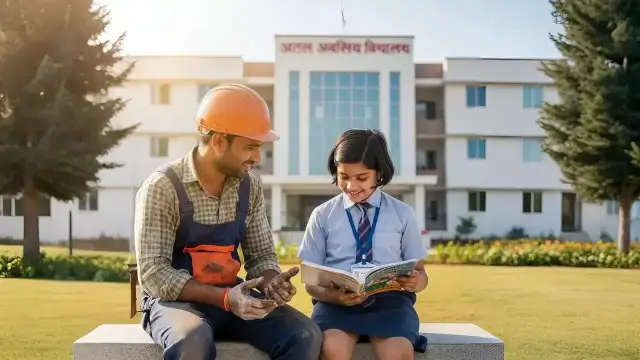
UP Atal Awasiya Vidyalaya Yojana 2026 is one of the most ambitious free-education initiatives in India. Launched by the Uttar Pradesh Government under Chief Minister Yogi Adityanath, the scheme provides completely free residential education to children of registered construction workers — including migrant labourers who move across the state for work. A parent who holds a valid UP Labour Card 2026 can secure their child a seat in a world-class boarding school at zero personal cost. The scheme is operated by the UP Building and Other Construction Workers Welfare Board (UP BOCW), and today runs 18 Atal Awasiya Vidyalayas, one in each of the state's 18 divisions, with a combined capacity of around 18,000 students.
What makes the scheme remarkable is its scope. Every student receives free CBSE-pattern education from Class 6 to Class 12 — covering Science, Commerce and Arts streams — along with free hostel accommodation, free meals, free uniform, free textbooks and stationery, free coaching for competitive exams, and free sports and co-curricular facilities. There is no registration fee, no exam fee, no annual charge, and no donation at any stage. For a family that earns daily wages on a construction site, this is the difference between a child dropping out and a child becoming the first graduate in the family.
What Is the Atal Awasiya Vidyalaya Scheme?
The scheme was conceived as a "dream project" to give the children of construction workers the same quality of education that affluent families buy at private boarding schools. Each Atal Awasiya Vidyalaya is built on roughly 15 acres of land, with a planned capacity of about 1,000 students per school and a project cost of around Rs 65 crore per campus. The schools are equipped with smart classrooms, science and computer laboratories, libraries, sports grounds, and even astronomical observatories — facilities that most government schools in rural India can only dream of.
The model is fully residential, meaning students live on campus during the academic term. This is critical for children of migrant construction workers, whose families often move from district to district following work. A residential school gives these children a stable, continuous education that does not break every time the family relocates. PM Narendra Modi inaugurated 16 of these schools together from Varanasi on 23 September 2023, and the network has since expanded to 18 schools covering all 18 divisions of Uttar Pradesh.
Each campus is designed like a small university township rather than a conventional government school. Beyond classrooms, the infrastructure includes separate hostels for boys and girls, a dining hall, an auditorium, indoor and outdoor sports facilities, a sick room with a resident nurse, and teacher quarters so that faculty live on site. The idea is to recreate the boarding-school experience that middle-class families pay lakhs for — but delivered free of charge to the child of a daily-wage labourer. Because the schools are spread one-per-division, a child from any corner of Uttar Pradesh is within reasonable reach of at least one campus.
Why This Scheme Matters for Construction Workers
Construction work is among the most precarious forms of employment in India. Workers are hired on a contract basis, migrate for months at a time, and rarely have access to steady schooling for their children. Girls, in particular, drop out at higher rates once the family moves. By guaranteeing a fixed seat, a fixed address, and free boarding, the Atal Awasiya Vidyalaya removes the two biggest reasons these children leave school: cost and mobility. A child who enters in Class 6 and stays through Class 12 effectively receives seven years of fully funded, high-quality education — the single strongest predictor of escaping intergenerational poverty. The scheme is therefore not just an education programme; it is a structural anti-poverty intervention aimed at the most mobile, most invisible segment of the workforce.
Key Benefits — Everything Is Free
For families weighing the long-term value, it is worth noting that the same PM SVANidhi Scheme 2026 and other central welfare programmes rarely extend to construction-worker children — which is exactly why this dedicated UP initiative matters. The scheme is designed to remove every financial barrier between a construction-worker's child and a quality education. Here is exactly what is covered at zero cost:
- 100% Free Education: CBSE-pattern English-medium schooling from Class 6 to Class 12, all streams included.
- Free Residential Hostel: Secure on-campus accommodation with 24/7 supervision, study halls, and recreation facilities.
- Free Meals: Nutritious breakfast, lunch, and dinner served daily in the school mess — the child is fed throughout the term.
- Free Uniform and Study Material: School uniform, shoes, bag, textbooks, notebooks, and stationery are all provided.
- Free Coaching and Sports: Competitive-exam coaching, Olympiad preparation, sports training, and personality-development programmes.
- No Hidden Charges: No registration fee, no exam fee, no annual charges, no donation — the education is genuinely free.
Eligibility Criteria for Atal Awasiya Vidyalaya 2026
The scheme is exclusively for children of UP Labour Card holders. It is not open to the general public, and it is not a quota within existing government schools — it is a dedicated residential track for the children of registered construction workers. All of the following must be met at the time of application, and the admission cell cross-checks each one against the UP BOCW database before issuing a hall ticket for the entrance test:
| Criteria | Details |
|---|---|
| Parent's Status | Father or mother must be a registered construction worker under the UP Building and Other Construction Workers Welfare Board (upbocw.in) with a valid, active Labour Card that is Aadhaar-linked. |
| Student's Age | The scheme covers children of construction workers between the ages of 6 and 16. For admission to Class 6, the student must have passed Class 5; age is typically around 10–12 years as on 1 April of the admission year. |
| Academic Level | Primary entry is to Class 6 (after Class 5). Admission to Class 9 and to other classes is possible subject to seat availability and clearing the entrance test. |
| Domicile | The student must be a permanent resident of Uttar Pradesh. A Niwas Praman Patra (domicile certificate) issued by the Tehsildar or BDO is required. |
| Priority Groups | Children of workers who were rendered destitute during COVID, and children of differently-abled or deceased registered workers, are given priority in allocation. |
Important: If you have applied for a Labour Card but have not yet received it, wait until the card is issued. Applications without a valid Labour Card are not accepted. The card must be active (not expired) and linked to the parent's Aadhaar at the time of submission. Notably, the Labour Card also unlocks other welfare cover — including the Pradhan Mantri Suraksha Bima Yojana (PMSBY) accident insurance — so registering the parent correctly is the first step for the whole family.
Admission Process — Step by Step
Admission to the Atal Awasiya Vidyalaya follows an annual cycle. For the 2026–27 session, the application window closed around 15 February 2026 and the entrance examination was held on 8 March 2026 (dates vary slightly by district). Here is the exact process you should follow when the next notification opens:
Step 1: Download the Application Form
The admission form is released on the UP BOCW website under the Atal Awasiya Vidyalaya Admission section, usually between late January and mid-February. You can also collect a physical copy from your District Labour Office (Zila Shram Karyalay). Many district administration portals — such as Lucknow, Prayagraj and Kanpur Dehat — also publish the advertisement and form directly.
Step 2: Fill and Submit the Form
Fill in the student's details, the parent's Labour Card number, and contact information. Submit the form with all required documents at the District Labour Office. Always collect the acknowledgement slip with your application number — you will need it to check the result. Do not delay: the window is short and late forms are not accepted.
Step 3: Entrance Test
Selection is through a written entrance test pitched at the Class 5 level. The test covers Hindi, English, Mathematics and General Knowledge, is two hours long, uses an MCQ format with no negative marking, and follows the NCERT Class 5 syllabus. Previous-year papers are published on the UP BOCW website for practice. In the 2024–25 session, each school admitted around 140 students to Class 6, so the entrance test is competitive.
Step 4: Result and Joining
The merit list is published on upbocw.in within three to four weeks of the test. Selected students receive a joining letter stating the school name, reporting date, and medical-checkup requirements. Original documents are verified at the time of joining — the photocopies submitted during application are not accepted for final verification, so carry every original.
Life Inside an Atal Awasiya Vidyalaya
Understanding the daily routine helps parents trust the residential model. A typical day begins early with a wake-up bell, followed by morning prayer, breakfast in the mess, and four to five academic periods in smart classrooms. After lunch, the afternoon combines laboratory work, library reading, and supervised self-study. Evenings are reserved for sports, music, or coaching for competitive exams such as JNVST, NTSE, and Olympiads. Dinner is served before a fixed lights-out, and trained wardens and matrons supervise the hostels around the clock. Medical checkups, counselling, and periodic parent-teacher meetings are built into the calendar so that children who live away from home are supported holistically. During vacations, students travel home to their families, and transport is arranged by the school so that no child is stranded. This structured environment is precisely what allows a child from a migrant family to build the discipline and confidence needed for competitive exams later on.
For families comparing this with other free residential models, the closest cousins are the central government's Jawahar Navodaya Vidyalayas and the state-run Kasturba Gandhi Balika Vidyalayas — but those target different beneficiary groups. A child who has finished Class 12 here and wants to pursue competitive coaching can also look at state schemes such as Yogyashree Scheme West Bengal if they relocate, or central scholarships for higher studies. The mid-day nutrition standard inside these campuses is modelled on the national PM POSHAN Scheme, ensuring children from poor homes are never undernourished while they study.
Required Documents
Documentation is where most avoidable rejections happen, so prepare the set carefully well before the deadline. Keep the following ready. All photocopies must be self-attested:
- Filled and signed Application Form with acknowledgement
- ✔️ Student’s Aadhaar Card (Photocopy)
- Student's two recent passport-size photographs
- Parent's valid UP Labour Card (original + photocopy) — the single most important document
- Student's Class 5 Marksheet and Passing Certificate (original + photocopy) for Class 6 entry
- Domicile Certificate (Niwas Praman Patra) issued by Tehsildar or BDO
- Parent's mobile number and email ID
- Caste Certificate, if applying under a reservation category
Atal Awasiya Vidyalaya Locations — All 18 Divisions
The schools are established at division headquarters across all 18 divisions of Uttar Pradesh: Agra, Aligarh, Prayagraj (Allahabad), Ayodhya (Faizabad), Azamgarh, Bareilly, Basti, Chitrakoot (Banda), Devipatan (Gonda), Gorakhpur, Jhansi, Kanpur, Lucknow (the model school), Meerut, Mirzapur, Moradabad, Saharanpur, and Varanasi. For the exact campus address in your division, visit upbocw.in or contact your District Labour Office.
How It Compares to Navodaya and Kasturba Gandhi Schools
Parents often ask how Atal Awasiya Vidyalaya differs from Jawahar Navodaya Vidyalaya (JNV) or Kasturba Gandhi Balika Vidyalaya (KGBV). All three are free residential models, and all three aim at disadvantaged groups — but they serve different children and are run by different bodies. The table below clarifies the distinctions so a family can understand exactly where the Atal Awasiya Vidyalaya fits in the wider landscape of free schooling in India:
| Feature | Atal Awasiya Vidyalaya | JNV | KGBV |
|---|---|---|---|
| Who it serves | Children of registered construction workers | Talented rural children (merit test) | Girls from SC/ST/OBC/minority groups |
| Classes | 6 to 12 | 6 to 12 | 6 to 8 (residential) |
| Admission basis | Labour Card + entrance test | JNVST merit test | Enrolment drive |
| Cost | Completely free | Free (nominal Vidyalaya Vikas Nidhi for some) | Free |
| Run by | UP BOCW Board | Navodaya Vidyalaya Samiti (Central) | State Education Departments |
The key differentiator is the beneficiary group: Atal Awasiya Vidyalaya exists specifically for the children of construction workers — a group that traditional schemes often miss because of their migrant lifestyle. That focused mandate is what makes it unique.
Who Should NOT Apply — Clearing Misconceptions
A few common misunderstandings cause wasted applications every year. First, this is not a scholarship that pays fees at a school of your choice — admission is only to the designated Atal Awasiya Vidyalaya campuses, and the child must live on campus. Second, children of government employees, farmers, or shopkeepers are not eligible; the parent must genuinely be a registered construction worker with a Labour Card. Third, the scheme does not admit children directly into Class 11 or 12 from outside — entry is mainly at Class 6, with limited lateral entry to Class 9. Fourth, private tutoring is unnecessary and unwanted; the free coaching inside the school is sufficient. Knowing these boundaries saves families from disappointment and helps them apply to the right scheme the first time.
Common Reasons Applications Get Rejected
- Parent's Labour Card is expired, under-process, or not yet issued.
- Labour Card is not Aadhaar-linked, so identity cannot be verified.
- Domicile certificate is missing or issued by the wrong authority.
- Submitted photocopies without self-attestation.
- Applying after the district deadline — the window is short and strict.
- Name mismatch between Aadhaar, Labour Card, and school marksheet.
Fee Concession and Other BOCW Welfare Linked to the Labour Card
The Labour Card that unlocks Atal Awasiya admission is also the key to a wider basket of Uttar Pradesh BOCW welfare benefits. Registered construction workers and their families can access maternity assistance, a pension under the state social security scheme, disability and death compensation, tool-kit grants for skill training, and post-matric scholarships for children studying beyond Class 10. For a family living on uncertain wages, these benefits act as a financial safety net that complements the free education the child receives at the vidyalaya. Parents are strongly advised to renew the Labour Card on time every year and keep the Aadhaar linkage active, because a lapsed card can interrupt both the school seat and the family's other entitlements. Treating the Labour Card as a single, always-current credential is the smartest habit a construction-worker household can build.
What After Class 12? Higher Education Pathways
Graduating from an Atal Awasiya Vidyalaya does not end the support. Students who complete Class 12 with strong marks can sit for JEE, NEET, CUET, and other competitive exams, and many go on to central and state scholarship schemes for undergraduate study. Because they have studied in an English-medium CBSE environment with coaching exposure, these students are well positioned for both professional courses and government recruitment. The UP BOCW Board also runs separate post-matric scholarship and tool-kit schemes for children of registered workers, so the welfare net continues beyond school. Families should keep the parent's Labour Card active throughout, because most of these downstream benefits are linked to that single credential.
How to Track Your Application and Result
After you submit the form at the District Labour Office, the acknowledgement slip becomes your most important document because it carries your application number. When the entrance test is done, the UP BOCW Board publishes a division-wise merit list on upbocw.in, usually within three to four weeks. Selected candidates receive a joining letter by post and sometimes via SMS to the parent's registered mobile number. If your child's name does not appear in the first list, wait for the waitlist or second round — vacancies created by no-shows are often filled from the reserve list. Keep a scanned copy of every submitted document on your phone so that if the board asks for clarification, you can respond quickly without travelling back to the labour office.
The Bottom Line
UP Atal Awasiya Vidyalaya Yojana is a genuine lifeline for children of construction workers in Uttar Pradesh — providing not just free tuition but a complete residential environment with hostel, meals, uniform, books, and coaching across 18 schools and 18,000 seats. If your parent holds a valid UP Labour Card and you have passed Class 5, you are eligible. Watch for the admission notification between late January and mid-February, download the form from upbocw.in or collect it from your District Labour Office, and prepare for the entrance test using NCERT Class 5 textbooks. Every benefit is 100% free — and the only document you truly cannot do without is your parent's Labour Card.
Frequently Asked Questions

SK Jabedul Haque
Building India's most trusted finance education platform — simplifying news, schemes and market trends so anyone can understand and invest confidently.
Read full bio

Never miss an update
Get our clearest explainers on schemes, markets and money — read what matters, without the noise.
Explore more articles