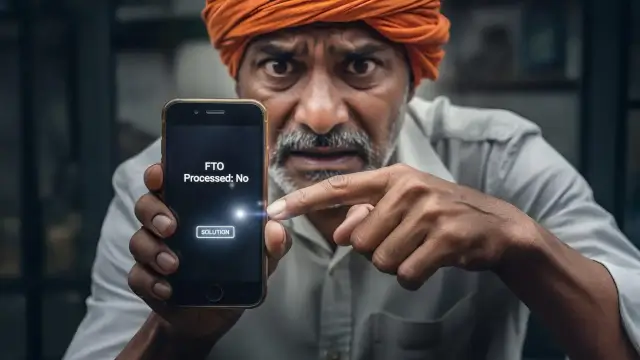
PM Kisan FTO Processed No Solution 2025
What You'll Learn
- What an FTO means in the PM-KISAN payment workflow and why an online label alone is not a final diagnosis.
- How to check beneficiary status, eKYC, land records, bank details and payment information safely.
- How official PM-KISAN grievance channels and local authorities fit into the resolution process.
- Which old claims about guaranteed timelines, personal case success rates and unofficial links should be avoided.
If your screen shows PM Kisan FTO Processed But Money Not Received, do not assume that one status label explains the entire problem. PM-KISAN payments pass through multiple records and authorities. A record can require state verification, a correction, an update or a bank-side check before the payment can be completed.
The official PM-KISAN material describes a process in which State or Union Territory authorities identify and verify eligible beneficiaries, upload approved data, and use the payment system for transfer. The official FAQ says that the Public Financial Management System issues the Fund Transfer Order after the Request for Transfer stage. The payment then moves through the designated banking route.
This guide uses the official PM-KISAN portal, the beneficiary-status page and the government grievance form as the primary reference points. Pages, labels and local procedures can change. Always check the live official page instead of relying on an old screenshot, social-media post or unofficial “instant fix” service.
What an FTO means in PM-KISAN
FTO stands for Fund Transfer Order. In the official PM-KISAN workflow, it is generated after beneficiary data has passed through earlier stages, including state-level processing and the Request for Transfer stage. It is part of the payment process. It is not the same thing as a bank statement, a confirmed credit entry or a guarantee that funds will appear immediately.
An FTO-related label should be read together with the other fields on the beneficiary-status page. Look for the payment period, beneficiary approval, eKYC, land-record or seeding indicators, bank information, transaction status and any rejection or correction message. Different versions of the portal may display labels differently, so do not treat one phrase without its surrounding fields as a final explanation.
| Screen or record | What it generally indicates | What to check next |
|---|---|---|
| FTO not generated or FTO status is not complete | The transfer-order stage is not shown as complete in the record. | Review beneficiary status, eKYC, land or eligibility data and any displayed reason. |
| FTO or transfer process shown as complete | The government payment workflow has reached a later stage. | Check the bank account, transaction details and whether the credit actually appears. |
| Payment failed, rejected or returned | The payment record needs further verification or correction. | Read the exact reason and contact the responsible authority or bank through official channels. |
| Status is pending or unchanged | The record may still be awaiting an update, verification or action. | Save the status date and use the official grievance route if the delay remains unexplained. |
The table is a reading aid, not an official replacement for the status page. Only the live record attached to your beneficiary details can show the current position of your case. Never share your Aadhaar number, OTP, bank password, debit-card PIN or full banking credentials with a person claiming to “release” an FTO.
What the status page can and cannot confirm
A status page can show whether the system has recorded a particular stage. It cannot by itself confirm that a bank has credited the money, that every eligibility condition remains satisfied, or that a displayed date applies to every beneficiary. The result should be checked against the bank account and the official payment details shown for the beneficiary.
There is also a difference between a missing update and an adverse decision. A pending field may require time or action. A rejected field should be read with its stated reason. An FTO-related label may reflect an upstream data issue, a state verification step, a bank detail problem or a payment-system response. The safest repair is therefore diagnostic rather than automatic.
Take a screenshot or download the status information for your own records, but remove sensitive numbers before sending it to anyone. The record date, the visible field name and the exact error wording are usually more useful for a complaint than an unedited document containing personal identifiers.
For a separate explanation of finding a beneficiary record, see our PM-KISAN status-check guide. Use it for navigation context, then confirm the result on the official portal.
How to check your official beneficiary status
Open the official PM-KISAN beneficiary-status page from the government portal. The page states that an OTP is sent to the registered mobile number. Use only your own device and the official domain. If the page asks for an OTP, enter it only on the official government page and never tell the OTP to a caller, agent or messaging contact.
- Open the official PM-KISAN beneficiary-status page.
- Use the identification option shown by the live page and complete the registered-mobile verification when requested.
- Record the visible beneficiary, payment, eligibility, eKYC, land and bank-related fields without sharing sensitive values publicly.
- Read the exact reason beside any pending, rejected, failed or incomplete field.
- Compare the result with your bank statement or account notification, not with a promise made by an unofficial intermediary.
If the registered mobile number is no longer available, do not try to bypass the verification through a third-party website. Follow the official correction or grievance route and ask the responsible local or state authority what document or verification is required.
How to confirm eKYC without using an unofficial service
The current PM-KISAN homepage states that eKYC is mandatory for registered PM-KISAN farmers. It also says that biometric-based eKYC is available through listed official channels, including the PM-KISAN mobile application, CSC VLE logins and State Authorized User logins. The available route for a person can depend on the live portal and local authorization.
Check whether the beneficiary-status page shows eKYC as complete, pending or rejected. If it is incomplete, use the official route displayed by PM-KISAN. Do not install an application from a forwarded link, provide an OTP to an agent or pay a person who promises to change a government status instantly.
eKYC is one part of the record, not the only condition for payment. A beneficiary may still need valid land information, correct bank details, eligibility under the scheme and successful processing through the transfer system. Correcting eKYC alone does not guarantee that an FTO will be created or that money will be credited.
Keep the date of the eKYC attempt and any acknowledgement shown by the official channel. If the status does not change, include that information in a grievance rather than repeating the same payment to multiple unofficial operators. Our safe government-form handling guide explains why the official source and document route should be checked before any submission.
How land records and eligibility affect payment records
The official PM-KISAN FAQ and operational guidelines describe landholding and state or Union Territory verification as part of beneficiary identification. A land record that is not updated, a name mismatch or a change in ownership can affect the beneficiary record. Local land-record processes differ by state, so the correct office and document list cannot be guaranteed from a national article.
Check the land or eligibility field shown on the official status page. If it indicates a mismatch, ask the designated revenue or agriculture authority in your area which correction process applies. Take the relevant land record and identity documents only to the official office or authorized channel. Do not upload personal documents to an unknown website offering an FTO fix.
The scheme guidelines also contain exclusion criteria. The official documents describe categories such as institutional landholders, certain government office holders and employees, some pensioners, income-tax payers and registered professionals. Eligibility is fact-specific and can be assessed by the responsible authorities. Do not use an article to certify yourself as eligible or ineligible.
Ownership changes require particular care. The guidelines distinguish succession after the death of a landowner from ordinary transfers such as sale, partition or gift. If your land record changed, ask the state authority how the current rules apply. A generic online promise that every ownership change can be fixed in a fixed number of days is not reliable.
How bank details and DBT records fit the FTO process
The official PM-KISAN FAQ says that bank-account details are required for direct credit of the benefit. It describes a transfer route that uses the beneficiary’s bank information and the government payment system, with banking transactions monitored through NPCI. That does not mean that an individual can repair a bank record by entering sensitive details on any website carrying the word “NPCI.”
Compare the bank account recorded in the official beneficiary record with the account you actually use. Check the account holder name, account status and whether the bank has the correct Aadhaar or DBT mapping where the official process requires it. Ask your bank which form or verification is needed. The bank, not a private website, should confirm the account-side status.
If the account is closed, frozen, inactive, incorrectly mapped or recorded with a name or number mismatch, ask the bank for a written acknowledgement or reference where available. Keep that reference with the PM-KISAN status screenshot. Never publish a full account number, Aadhaar number or OTP in a complaint screenshot.
Our government-scheme document checklist explains why document handling and official-source verification matter. It is not a substitute for the bank’s own requirements.
How the official RFT and FTO workflow works
The official PM-KISAN FAQ describes several steps before a payment reaches a beneficiary. State or Union Territory authorities identify and verify records. The data is uploaded through the PM-KISAN system. The State Nodal Officer signs the Request for Transfer. The PFMS then issues the Fund Transfer Order, after which the department issues the relevant sanction and the payment is routed to destination banks.
This sequence explains why an FTO label should not be interpreted as a simple switch that a private agent can turn from “No” to “Yes.” Different institutions control different stages. A correction made in a land record, beneficiary record or bank system may need to flow through the government process before the status changes.
The same official FAQ says that failed transactions are reported back for verification and reprocessing. That wording supports a careful next step: identify the failed field or transaction reason, contact the responsible authority, and retain the acknowledgement. It does not support a guaranteed three-day, seven-day or fifteen-day payment promise.
Do not pay anyone for a “priority FTO,” “guaranteed installment” or “instant DBT unlock.” PM-KISAN status and payment decisions belong to the official system and responsible authorities. A person who asks for an OTP, PIN or full banking login is a security risk.
What to do when every visible field says yes
If the status page shows the expected fields as complete but the bank account has no credit, first confirm that you are checking the correct beneficiary and account. Compare the payment period, transaction reference, bank statement and any failure message. A screenshot that shows “yes” without a credit entry does not prove that the funds have settled.
Next, ask the bank whether it received, rejected or returned a government credit. Request the bank’s exact response and reference number where possible. If the bank sees no such transaction, the issue may still be at an earlier government processing stage. If the bank returned it, the reason may point to an account or mapping correction.
Use the official PM-KISAN grievance form when the live status and bank response do not explain the missing payment. The form allows a grievance or registration number, grievance date, category, description, status and document upload fields. The page also notes that a Temporary ID can be used when a registration is new or pending for approval at any level.
Describe facts rather than accusations. Include the beneficiary reference, payment period, visible status, date checked, bank response and the correction already attempted. Redact Aadhaar, account numbers, OTPs, passwords and other information that is not necessary for the complaint.
How to use the official grievance route
Open the official PM-KISAN grievance form. Choose the category that best matches the live issue and write a concise description. If the form requests an identification or registration value, enter it only on the official government page. Save the grievance reference and do not submit duplicate complaints to random websites.
- State the exact status label and the date on which you checked it.
- Explain whether eKYC, land or eligibility fields and bank details show complete, pending, rejected or failed.
- State whether the bank account received, rejected or did not locate the expected government credit.
- Attach only necessary documents, with sensitive numbers redacted where possible.
- Save the grievance ID, submission date and any reply for follow-up with the responsible office.
The official FAQ also describes state and district-level grievance mechanisms. If the portal route does not resolve a record issue, ask the designated agriculture or revenue office for the appropriate escalation path. Procedures can differ by state and district, so this article does not invent a universal office, fee or resolution time.
Our PM-KISAN status reference can help you find the relevant portal section. The official PM-KISAN page remains the authority for the live form and current instructions.
Common mistakes and fraud risks to avoid
The first mistake is treating an article, video or social post as the government record. Use the official domain and check the date. The second is assuming that an FTO label guarantees an immediate credit. The third is repeatedly changing details without knowing which field is wrong, which can create additional mismatches.
The fourth is sharing sensitive data. No legitimate helper needs your OTP, UPI PIN, debit-card PIN, internet-banking password or full account credentials to explain a public status page. Crop or redact screenshots before asking for help. Use a bank branch or official office when identity verification is required.
The fifth is trusting fixed-timeline claims. Official sources describe processing stages and verification responsibilities. They do not make a universal promise that every land correction, eKYC update or payment will complete in a particular number of days. Treat “five-minute fix,” “guaranteed payment” and “priority approval” language as warning signs.
The sixth is confusing a correction route with an application route. A person can be registered in a system and still require eligibility or record verification. If the live portal does not show the needed option, use the official grievance or local-authority route instead of a third-party form. For another example of why a scheme article must distinguish verified status from an application claim, see our official-status and fake-link protection guide.
Final checklist for PM-KISAN payment issues
Before contacting anyone, record the exact beneficiary status and payment period. Confirm the registered mobile access, eKYC result, land or eligibility field, bank-account information, transaction message and bank response. Keep only the minimum documents needed for a formal complaint.
- Use the official PM-KISAN portal and beneficiary-status page.
- Read every displayed field, not only the FTO label.
- Confirm eKYC through an official channel and keep its acknowledgement.
- Ask the responsible land or agriculture authority about land-record mismatches.
- Ask the bank whether a government credit was received, rejected or returned.
- Submit a factual grievance through the official PM-KISAN form when the cause remains unresolved.
- Save references and never share OTPs, PINs, passwords or full identity details with an intermediary.
There is no safe universal “FTO No to Yes” button. The correct remedy depends on the field that has not passed and on the authority responsible for that field. A careful record, official-source check and properly described grievance are safer than a fast but unsupported promise.
Final assessment of PM Kisan FTO Processed But Money Not Received
When PM Kisan FTO Processed But Money Not Received appears in a beneficiary’s experience, the status should be investigated across the full payment chain. FTO is part of the government transfer workflow, not proof that a bank credit has settled and not proof that the beneficiary has been permanently rejected.
The most reliable path is to check the official beneficiary record, confirm eKYC and eligibility-related fields, review land and bank information, ask the bank for its transaction response, and use the official grievance route when the record remains unexplained. The PM-KISAN official FAQ describes state verification, the Request for Transfer, PFMS-issued FTO and banking stages. Those stages explain why a correction may need to pass through more than one authority.
Use current official instructions, protect sensitive information and avoid fixed-time guarantees. The objective is not merely to change a label. It is to identify the exact unresolved record and send it to the authority that can verify or correct it.
Frequently Asked Questions

SK Jabedul Haque
Building India's most trusted finance education platform — simplifying news, schemes and market trends so anyone can understand and invest confidently.
Read full bio


Never miss an update
Get our clearest explainers on schemes, markets and money — read what matters, without the noise.
Explore more articles