HBM Memory Chip Supercycle 2026: How SK Hynix, Micron, and Samsung Formed the Newest $1 Trillion Club
What You'll Learn
- What high-bandwidth memory does inside an AI accelerator system.
- How HBM3E and HBM4 differ in bandwidth, packaging, power and product readiness.
- What Micron, SK hynix and Samsung actually disclosed in their 2026 results and product releases.
- Why an AI-memory supercycle can produce strong earnings and still carry valuation, supply and cycle risk.
What HBM Memory Actually Is
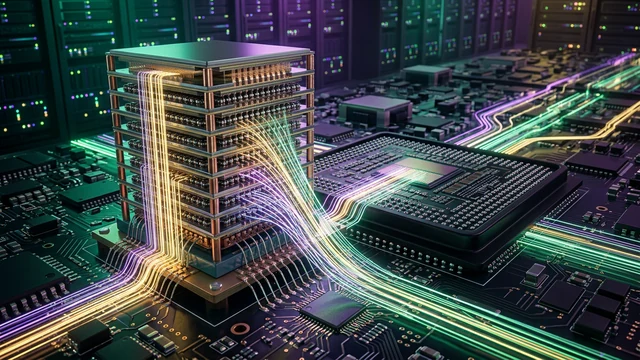
HBM memory chip supercycle 2026 refers to the growing importance of high-bandwidth memory in AI infrastructure. HBM is a form of 3D-stacked DRAM. Multiple memory dies are stacked vertically and connected using through-silicon vias and microbumps. The stack is then placed close to a processor inside a system-in-package rather than being installed as a distant conventional memory module.
Micron explains that HBM is designed to move very large amounts of data through a wide interface. That design changes the trade-off between bandwidth, physical space and energy per bit. It does not make a processor faster in every workload. It gives an accelerator a better chance of receiving data quickly when the workload is limited by memory movement.
A useful distinction is between compute and data supply. An AI accelerator may have large arithmetic capacity, but the system still needs to move model weights, activations and intermediate values to the compute units. If data arrives too slowly, the arithmetic hardware can sit underused. HBM addresses one part of that problem through wider interfaces and close physical integration.
The technology is not the same as ordinary DDR5. DDR5 remains important for server system memory, while HBM is a specialized memory layer placed near an accelerator. The two products can exist in the same server and serve different paths through the system.
| Memory layer | Primary role | Why it matters in AI systems |
|---|---|---|
| HBM | High-throughput memory near an accelerator | Moves large volumes of data close to the compute engine |
| DDR5 | General server system memory | Supports CPUs, operating systems and broader application state |
| NAND and SSD | Persistent storage | Stores datasets, checkpoints, retrieval data and service state |
| SOCAMM2 and related modules | Low-power or specialized server memory | Targets capacity, serviceability and power constraints around AI servers |
Why AI Accelerators Need HBM
AI training and inference workloads repeatedly move data between memory and compute. Larger models raise the amount of data that must be available, while long-context and reasoning workloads can increase the amount of intermediate state that must be retained or revisited. That does not mean HBM is the only constraint. Packaging, interconnects, power delivery, cooling, software scheduling and memory capacity also influence the result.
SK hynix describes HBM as a memory layer positioned close to AI accelerators for large-scale training and high-performance inference. The explanation is technically useful because it places HBM inside a system rather than presenting it as an isolated chip. The best HBM specification cannot compensate for a weak accelerator design, poor packaging yield or a data-center power limit.
NVIDIA's Vera Rubin documentation lists HBM4 as part of the Rubin GPU platform. NVIDIA describes the platform at rack scale, where GPUs, CPUs, networking and cooling are designed together. That context matters for investors reading HBM demand claims. A memory supplier participates in a larger system whose final economics depend on many companies and deployment decisions.
The commercial question is therefore not simply how many gigabytes a stack contains. Customers also evaluate bandwidth, power, thermal behavior, reliability, qualification time, package yield, supply commitments and the cost of integrating the part into a complete accelerator platform.
HBM3E and HBM4: The Product Transition
HBM3E is the established high-bandwidth generation used in current AI accelerator platforms. HBM4 increases the interface and brings more attention to the base die, logic integration, power distribution, thermal control and system qualification. The transition is not only a race for a larger bandwidth number. It is also a manufacturing and packaging test.
Samsung's February 2026 product release says its HBM4 has a consistent 11.7 gigabits-per-second transfer speed, can reach 13 gigabits per second, and offers up to 3.3 terabytes per second of bandwidth per stack. Samsung also describes 12-layer products from 24GB to 36GB and a future 16-layer option up to 48GB. These are Samsung's own product claims.
Micron's HBM4 release describes a 2048-bit interface, more than 2.0 terabytes per second per stack and more than 20% better power efficiency than its prior HBM3E product. Its current HBM page describes a 36GB 12-high product with more than 2.8 terabytes per second per stack. The different figures reflect product versions, test conditions and release dates, so they should not be blended into one universal benchmark.
SK hynix's Q2 2026 results state that HBM4 achieved customer-required operating speeds, power efficiency and cost competitiveness. The company said mass shipments began in Q2 and production would ramp in the second half. This is evidence of commercial progress, but it is not independent proof that one supplier will retain a fixed market share.
| Topic | HBM3E context | HBM4 context | Evidence boundary |
|---|---|---|---|
| Interface and bandwidth | Established high-bandwidth product generation | Wider interfaces and higher vendor-reported throughput | Vendor numbers use different products and test bases |
| Base die | Earlier design choices remain important | Logic and base-die capability become more prominent | System results depend on package and customer design |
| Power and thermals | Already material in dense accelerator systems | Higher I/O and bandwidth increase design pressure | Efficiency claims are product-specific |
| Supply status | Established in current platforms | Ramping through qualification and production | Shipment announcements do not equal unconstrained supply |
What Micron Reported in Fiscal Q3 2026
Micron's June 24, 2026 results provide the clearest financial evidence that AI memory demand had reached the income statement. Micron reported fiscal Q3 revenue of $41.456 billion, compared with $23.860 billion in the prior quarter and $9.301 billion in the year-ago quarter. GAAP net income was $28.243 billion and operating cash flow was $25.388 billion.
The company also reported a strong data-center mix. Its Cloud Memory Business Unit generated $13.769 billion of revenue with an 83% gross margin and 78% operating margin. Its Core Data Center Business Unit generated $11.524 billion with an 87% gross margin and 83% operating margin. These figures show strong reported profitability, although segment performance is not the same as a pure HBM margin.
Micron said HBM4 built on 1-beta DRAM was in high-volume shipments for its lead customer's platform and that qualification samples had shipped to multiple end customers. It also said HBM4E development was underway, with volume production expected in calendar 2027. The first statement describes present company-reported shipments. The second is a forward-looking company expectation.
Micron's fiscal Q4 outlook called for $50.0 billion plus or minus $1.0 billion of revenue and approximately 86% gross margin. Management guidance can be useful for understanding the company's operating assumptions, but it is not a guaranteed result and should not be treated as a personal investment signal.
The old article's $1,625 UBS target and “top memory stocks to buy” framing did not belong in a research article. A price target is a time-sensitive opinion. It can be included only as attributed analysis with date, methodology and uncertainty. It cannot substitute for reported earnings, shipment evidence or valuation work.
What SK hynix Reported in Q2 2026
SK hynix's July 29, 2026 results show a different but related part of the cycle. The company reported Q2 revenue of KRW 79.3187 trillion, operating profit of KRW 60.5426 trillion and net income of KRW 93.9226 trillion. It reported an operating margin of 76%, year-over-year revenue growth of 257% and year-over-year operating-profit growth of 557%.
SK hynix said first-half revenue crossed KRW 100 trillion for the first time. It reported cash and cash equivalents of KRW 88 trillion, total debt of KRW 18.6 trillion and net cash of KRW 69.4 trillion at the end of the quarter. These figures are from the company's preliminary release and are subject to the audit and forward-looking caveats printed in that release.
The HBM statement was direct. SK hynix said HBM4 had achieved customer-required operating speeds, industry-leading power efficiency and cost competitiveness. It said mass shipments began in Q2 and production would ramp in the second half. It also said HBM4E sample shipments were completed in the first half.
The same release described demand as exceeding supply capabilities and said the company had signed long-term agreements with around 10 customers. That supports a picture of strong customer demand and supply planning. It does not establish that the shortage will last indefinitely. New capacity, competitor qualification, customer concentration and memory pricing can change the economics.
What Samsung Reported About HBM4
Samsung's Q1 2026 results reported consolidated revenue of KRW 133.9 trillion and operating profit of KRW 57.2 trillion for the quarter ended March 31. The company said its Device Solutions sales increased 86% quarter over quarter and that the Memory Business set an all-time quarterly revenue and operating-profit record.
Samsung attributed the result to high-value-added AI demand and higher average selling prices while also noting limited supply availability. It said it had initiated mass product sales of HBM4 and SOCAMM2 for NVIDIA's Vera Rubin platform. It further said first HBM4E samples were scheduled for Q2 and server-memory demand was expected to remain strong in the second half of 2026.
Samsung's February HBM4 release gives more product detail. It says the product uses a 4nm logic base die, supports 11.7 gigabits per second consistently and can reach 13 gigabits per second. It describes 2,048 I/O pins, up to 3.3 terabytes per second per stack, 12-layer products from 24GB to 36GB and a planned 16-layer option up to 48GB.
Samsung also claims a 40% power-efficiency improvement, 10% better thermal resistance and 30% better heat dissipation compared with HBM3E. Those claims are useful for understanding the product's intended design goals, but they are not independent lab results. The company also said HBM sales could more than triple in 2026 compared with 2025. That is management's outlook, not a realized result at the time of the release.
| Company | 2026 disclosure used here | What it supports | What it does not prove |
|---|---|---|---|
| Micron | Q3 revenue $41.456B and HBM4 high-volume shipments for a lead platform | Strong reported demand and commercial product progress | A permanent margin or market-share outcome |
| SK hynix | Q2 revenue KRW 79.3187T and HBM4 mass shipments beginning in Q2 | Strong reported results and product ramp activity | That demand will always exceed supply |
| Samsung | Q1 revenue KRW 133.9T and HBM4 mass product sales for Vera Rubin | Memory contribution and commercial HBM4 activity | That vendor-reported product claims equal application results |
Why Packaging and Supply Matter
HBM is a package-level product. DRAM dies, a base die, interconnects, an interposer, testing and thermal design must work together. A supplier can have a good DRAM process and still face challenges in yield, package assembly, qualification or customer integration.
SK hynix's technical explainer says HBM4 makes the logic function of the base die more important. It also connects HBM with AI-DRAM, SOCAMM2, DDR5 and AI-NAND. This full-stack view is useful because AI infrastructure consumes more than one memory product. The winning supply chain may be the one that delivers a complete set of parts at the right quality and power profile.
Capacity expansion is also slow relative to a news cycle. Cleanrooms, advanced packaging facilities, equipment, skilled labor and customer qualification take time. Micron said it was investing at record levels in technology, products and supply. SK hynix described M15X, packaging facilities and phased investment. Samsung said it was expanding HBM4 capacity. These commitments can improve supply, but they also raise capital intensity and create risk if demand normalizes before the new capacity earns an acceptable return.
The result is a market with two opposing forces. AI infrastructure can keep increasing memory content per system. At the same time, suppliers can add capacity, customers can redesign systems, and alternative architectures can change the amount or type of HBM required.
Why the Three Suppliers Are Not Interchangeable
The three companies share exposure to AI memory, but they do not represent the same business model. Micron is a U.S.-listed memory and storage company with data-center, client, mobile and automotive exposure. SK hynix combines DRAM, NAND and advanced packaging activities. Samsung Electronics has a much broader portfolio beyond memory, including devices and other technology businesses.
That difference matters when a market headline groups them into one club. The same HBM demand can affect each income statement differently because product mix, geographic exposure, capital spending, currency, customer concentration and reporting scope are not identical. A common theme is not a comparable valuation model.
Readers comparing the three should place the reporting period, business segment, currency and accounting basis beside every number. A single market-cap threshold hides those distinctions. It can be a useful prompt for research, but it is not a substitute for company-specific analysis.
What the Trillion-Dollar Headline Actually Tells You
The title of this article reflects the market headline around the three companies' valuations in 2026. The body does not independently verify the exact date on which each company crossed a $1 trillion market capitalization. That calculation requires a defined share price, share count, currency conversion, treatment of treasury shares and a timestamp. A headline can be directionally interesting while still being too imprecise for an investment conclusion.
Market capitalization is not revenue, profit, cash flow or enterprise value. It is the quoted equity value at a particular moment. It can rise because earnings expectations improve, because the market assigns a higher multiple, because a currency moves or because the share count changes. A market-cap milestone therefore says something about investor expectations, but it does not tell a reader whether the valuation is attractive.
The old article also treated the three companies as a single pure-play HBM group. They are not identical businesses. Micron has memory and storage operations across data-center, client, mobile and automotive markets. SK hynix has DRAM, NAND and packaging activities. Samsung Electronics has a much wider business portfolio that includes devices and other technology operations. Their HBM exposure, reporting structures and valuation drivers differ.
For a broader site context, the Finance section, Markets section and Bitcoin analysis show why a market headline should be separated from a decision framework. The exact market-cap story is a starting point for research, not a conclusion.
How to Read Earnings During a Memory Supercycle
Revenue growth is important, but a memory-cycle analysis should ask several questions at the same time. Are higher prices driven by durable customer demand or temporary inventory rebuilding? Are gross margins rising because of product mix, pricing, manufacturing yield or a low comparison base? Are capital expenditures creating future supply that could later pressure prices? How concentrated are the largest customers?
The 2026 disclosures provide evidence for strong conditions. Micron's fiscal Q3 results showed a large sequential and year-over-year revenue increase. SK hynix reported record profitability and long-term agreements with around 10 customers. Samsung reported record Memory Business results and limited supply. Those facts support an unusually strong period. They do not establish the duration of the next upcycle.
Investors also need to distinguish management guidance from realized results. Micron's $50.0 billion plus or minus $1.0 billion fiscal Q4 revenue outlook and Samsung's expectation that HBM sales could more than triple are forward-looking statements. SK hynix's demand outlook and capacity plans are also subject to changes. The companies themselves include risk language for a reason.
A practical research table should therefore record the reporting period, currency, business scope, reported result, guidance and source. It should not mix a quarterly number from one company with a market-cap figure from another date and call the combination a comparable valuation.
Risks That Could End the Supercycle
The first risk is supply response. If Micron, SK hynix and Samsung expand capacity successfully, the shortage premium can narrow. More output is good for customers, but it can pressure pricing and margins for suppliers.
The second risk is customer concentration. HBM products are qualified for specific accelerator platforms. A delay in one platform, a change in an AI customer's procurement plan or a shift from one accelerator architecture to another can affect shipment timing.
The third risk is technology substitution and architecture change. HBM may remain central while system designers use more custom ASICs, different memory hierarchies, compression, larger system memory or storage layers. A higher model count does not automatically translate into the same HBM demand per system.
The fourth risk is execution. HBM4 has more demanding interface, packaging, base-die and thermal requirements. A supplier may announce a product and still face yield, qualification or ramp challenges. Commercial shipment evidence is stronger than a roadmap, but it is not the same as a complete production audit.
The fifth risk is valuation. When expectations are high, reported earnings can improve and the share price can still fall if the improvement is already reflected in the multiple. That is why a $1 trillion market-cap headline is not a substitute for examining earnings, cash flow, capital intensity, balance-sheet risk and the price paid for those outcomes.
| Risk | How it could affect the market | Evidence to monitor |
|---|---|---|
| New capacity | More supply can reduce scarcity pricing | CapEx, cleanroom progress, packaging output and customer qualification |
| Customer concentration | A platform delay can change shipment timing | Customer agreements, qualification status and product mix |
| Product transition | HBM4 ramp issues can delay revenue or raise costs | Yield, production volume, sampling and commercial shipments |
| Valuation compression | Strong results can fail to offset a lower earnings multiple | Free cash flow, earnings revisions, price and valuation assumptions |
Conclusion: What the Evidence Supports
The evidence supports a strong AI-memory cycle in 2026. Micron reported record fiscal Q3 results and HBM4 high-volume shipments. SK hynix reported record Q2 results, HBM4 mass shipments and long-term customer agreements. Samsung reported record Memory Business performance and HBM4 mass product sales for NVIDIA's Vera Rubin platform. Their disclosures show why HBM has become strategically important in AI infrastructure.
The evidence does not support the stronger claims in the old article. It does not prove that the exact $1 trillion market-cap timing was independently calculated, that one supplier will keep a fixed HBM share, that a price target will be reached, or that any reader should buy a particular stock. HBM4 performance figures are vendor claims and must be interpreted in the context of product version, test method and system design.
A useful conclusion is narrower and more durable. HBM demand is tied to AI accelerator deployment, but the supplier outcome depends on qualification, yield, packaging, pricing, capital expenditure, customer concentration and valuation. This is research and analysis only, not personalized financial advice. See the site's disclaimer and editorial policy for publishing boundaries.
Frequently Asked Questions

SK Jabedul Haque
Building India's most trusted finance education platform — simplifying news, schemes and market trends so anyone can understand and invest confidently.
Read full bio


Never miss an update
Get our clearest explainers on schemes, markets and money — read what matters, without the noise.
Explore more articles