Physical AI and Embodied Robotics: How AI Is Finally Entering the Real World in 2026
What You'll Learn
- What Physical AI means and how it differs from ordinary software AI
- How VLA models, embodied reasoning and robot foundation models work together
- Where first-party evidence shows humanoid and other intelligent robots operating
- Why simulation, safety, data quality and human oversight still determine deployment
What Is Physical AI and Why Does It Matter in 2026
Physical AI is the use of artificial intelligence in systems that sense and act in the physical world. A model may interpret camera input, understand a spoken instruction, plan a sequence and send commands to motors or other actuators. The result is not just a generated answer on a screen. It is a physical action that can succeed, fail, collide with an object or affect a person.
BMW describes Physical AI as digital AI connected with real machines and robots. The International Federation of Robotics uses a related idea when it describes AI and autonomy as forces making robots more independent, adaptable and capable of natural-language or vision-based interaction. These descriptions are useful because they place the model inside a larger system that includes sensors, control software, hardware, data, testing and people.
The phrase is broad. It includes mobile robots, robot arms, warehouse systems, agricultural machines, surgical platforms and humanoids. A humanoid is only one possible body. The value of Physical AI depends on the task, the environment, the safety case and the ability to maintain reliable performance over time. For a wider technology context, see the site's Technology archive.
| System layer | Role in Physical AI | Failure to control |
|---|---|---|
| Perception | Reads images, depth, audio and other sensor signals | The robot misunderstands objects, people or distance |
| Reasoning | Interprets goals and chooses a sequence of actions | The plan is incomplete or unsafe in a new situation |
| Control | Converts a plan into movement and force | The action is inaccurate, unstable or too fast |
| Operations | Connects the robot to people, IT, safety and maintenance | A technically capable robot cannot run reliably at work |
How Physical AI Differs From Regular Software AI
Software AI can often produce a result that a person reviews before anything changes in the outside world. Physical AI has a tighter feedback loop. A camera view can change as a hand moves. A box can slip. A person can enter a workspace. A plan that looked correct a moment ago may need to be revised immediately.
This makes latency, calibration, force control and recovery as important as model accuracy. A robot must know what it can see, what it cannot see and when to stop. It also needs a way to recover from partial success instead of assuming that a task is complete because a command was issued.
Physical AI also has a higher cost of mistakes. A wrong answer in a draft can be corrected before publication. A wrong movement can damage a component or injure a worker. That is why the best current evidence emphasizes constrained tasks, simulation, human oversight and staged pilots rather than a claim that a general-purpose robot can safely do everything.
How VLA Models Turn Instructions Into Action
A vision-language-action model, or VLA, connects visual information and language with motor control. Google DeepMind describes Gemini Robotics 2 as a VLA that converts vision and language input into motor control. In practical terms, the model can use what a robot sees and what a person asks it to do as inputs to a control process.
DeepMind separately describes Gemini Robotics ER 2 as an embodied reasoning model for understanding physical spaces, making detailed plans and coordinating with humans and other robots. Its page also describes Gemini Robotics On-Device 2 as a more efficient VLA model optimized to run locally on robotic hardware. These are distinct roles. Reasoning can decide what should happen, while action control must produce movement that respects the robot and the environment.
DeepMind lists whole-body humanoid control, dexterity, adaptation to unfamiliar tasks, long-horizon planning, natural-language interaction and multi-robot collaboration as capabilities of the Gemini Robotics 2 family. These are first-party descriptions of the models' intended or demonstrated capabilities. They should not be read as an independent guarantee that every robot using the models will perform every task safely.
Robot Foundation Models: Gemini Robotics and GR00T
Robot foundation models provide a reusable starting point for learning skills across tasks or embodiments. NVIDIA describes Isaac GR00T N1 as an open and fully customizable foundation model for generalized humanoid reasoning and skills. Its release says System 2 reasons about the environment and instructions, while System 1 translates the plan into continuous robot movement.
NVIDIA says GR00T N1 uses human demonstration data and synthetic data generated with Omniverse. The release lists grasping, moving objects with one or both arms and transferring items between arms as example skills. It also identifies material handling, packaging and inspection as application areas. The model still has to be adapted to a particular robot, task, sensor arrangement and safety process.
The difference between a model and a product matters. A foundation model can reduce the amount of task-specific software a developer writes. It does not remove the need for data collection, evaluation, hardware integration or operational controls. That distinction is also relevant when comparing Physical AI with ordinary AI assistants. For a separate article on AI interfaces, see the ChatGPT guide.
Why Simulation and Synthetic Data Are Central
Real-world robot data is expensive and slow to collect. A physical demonstration requires hardware, space, supervision and a safe reset after failure. Simulation lets developers test more variations without exposing people or equipment to every early mistake. NVIDIA Isaac describes a development stack that includes simulation, robot-learning frameworks, AI models and workflows for building, training, simulating, deploying, operating and optimizing robot systems.
NVIDIA says Isaac Sim provides a physically based virtual environment for autonomous machines and that Isaac Lab is optimized for robot learning and foundation-model training. The same platform page describes Isaac GR00T as an open reference platform that combines data pipelines, a robot foundation model, simulation frameworks, middleware and accelerated runtime libraries.
NVIDIA's GR00T N1 release reports 780,000 synthetic trajectories created in 11 hours, equivalent to 6,500 hours or nine continuous months of human demonstration data. It also reports a 40% performance improvement when synthetic data was combined with real data compared with real data alone. These are NVIDIA-reported results from its own development work. They are not an independent benchmark for the whole robotics industry, and sim-to-real transfer still requires physical validation.
| Development stage | What simulation can help with | What still needs physical testing |
|---|---|---|
| Perception | Vary lighting, object position and scene layout | Sensor noise, glare, occlusion and unusual materials |
| Planning | Test long sequences and rare edge cases | Changing people, timing and unexpected obstacles |
| Manipulation | Generate contact and motion examples | Friction, deformation, force and hardware wear |
| Deployment | Evaluate policies before a live pilot | Safety validation, maintenance and worker interaction |
Where Humanoid Robots Are Working in Production
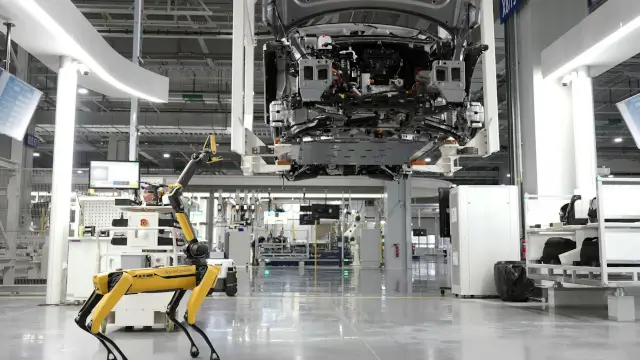
The strongest deployment evidence in the research is from BMW's own press releases. BMW says its first humanoid pilot at a plant took place at Spartanburg in the United States in 2025 with Figure AI. The company says Figure 02 supported production of more than 30,000 BMW X3 vehicles within ten months, moved more than 90,000 components and covered approximately 1.2 million steps in around 1,250 operating hours.
BMW says the task involved removing and positioning sheet-metal parts for a welding process. It describes the work as repetitive, physically demanding and dependent on speed and accuracy. BMW also says the pilot involved production IT, occupational safety, process management and shop-floor logistics. That is a more useful definition of deployment than a demonstration video because it includes the surrounding operating system.
BMW's February 2026 release describes a pilot project at Plant Leipzig with Hexagon Robotics' AEON. It says an initial test deployment took place in December 2025, with a further test deployment planned from April 2026 and the pilot phase expected in summer 2026. The stated use cases include high-voltage battery assembly and component manufacturing. BMW's June 2026 release also says Figure 03 would be used at Spartanburg for sequencing work in logistics.
Why Traditional Industrial Robots Still Matter
Humanoids attract attention because their body shape can fit workplaces designed for people. They may be able to move between tasks without rebuilding an entire line. That flexibility is valuable when the environment changes or when many small tasks must be completed by one system.
IFR cautions that humanoids must prove reliability and efficiency. It points to cycle time, energy consumption, maintenance, safety, durability and consistent performance as industrial requirements. IFR also says traditional industrial robots are likely to remain the backbone of high-speed, precision-driven manufacturing because specialized machines can be faster and more reliable for a narrowly defined task.
The practical future is therefore likely to be mixed. A factory can use fixed automation for precise repetitive operations and Physical AI for tasks that require mobility, perception or flexible handling. The right question is not whether humanoids replace all industrial robots. It is whether a particular task justifies the additional complexity of a more general machine.
China's Robotics Strategy and the Limits of Demonstrations
The International Federation of Robotics says China's 15th Five-Year Plan covers 2026 to 2030 and places robotics at the centre of its modern industrial system. IFR reports that China's manufacturing industry has an operational stock of around 2 million industrial robot units and that 54% of annual industrial robots installed worldwide were deployed in China.
IFR also reports that local suppliers' share of domestic industrial robot installations rose from 30% in 2020 to 57% in 2024. The organization distinguishes industrial deployment from staged humanoid demonstrations. It says many humanoid capabilities remain limited to demonstrators or pilot projects and that wide adoption of AI with traditional industrial robotics is expected over the next five to ten years.
This distinction prevents two common errors. A country can lead in industrial robot volume without every humanoid project being commercially mature. A public demonstration can show that a movement is possible without proving cycle-time economics, maintenance, safety certification or reliability over long operating periods.
Safety, Security and Human Oversight
Physical AI changes the safety problem because the model is connected to machines that can move, lift, cut, heat or carry. IFR says AI-driven robotics requires testing, validation and human oversight. It also highlights cybersecurity, sensor data, opaque model decisions, liability and the need for clearly defined frameworks.
Safety needs to be layered. The model should have bounded actions and clear stop conditions. The robot controller should enforce speed, force and workspace limits. The facility should define safe zones, emergency procedures, access controls and maintenance checks. Operators should know when the robot is autonomous, when it is being supervised and how to take over.
BMW's deployment description reinforces that safety and production teams must be involved early. The engineering achievement is only one part of the work. A system that cannot explain its operating envelope, recover from errors or protect sensitive video and sensor data is not ready simply because its demonstration looks smooth.
| Risk | Control to require | Evidence to collect |
|---|---|---|
| Unexpected movement | Speed limits, emergency stop and supervised launch | Test logs and incident-free operating records |
| Model error | Bounded action space and human approval for high-risk steps | Scenario tests and failure-recovery results |
| Cyber intrusion | Network segmentation, authentication and update controls | Access logs and security assessments |
| Worker impact | Training, consultation and clear task ownership | Safety review and worker feedback |
What Physical AI Robots Are Doing Today
First-party sources show several practical categories. BMW describes sheet-metal handling and logistics sequencing in automotive production. NVIDIA highlights material handling, packaging, inspection, surgical robotics, agriculture, warehouse palletizing, underwater perception and household-task research across its robotics ecosystem. The examples are not all at the same maturity level. Some are production pilots, some are research projects and some are platform demonstrations.
In the near term, tasks with clear boundaries are easier to validate. Examples include moving a known part between fixed locations, sorting components into a defined trolley, inspecting a repeatable area or moving through a mapped environment. Tasks involving open-ended conversation, crowded public spaces or unpredictable contact require stronger safeguards and more extensive testing.
For readers tracking the wider AI industry, the site also covers AI job changes, AI and employment and enterprise AI agents. Those software stories should not be treated as direct evidence about robot deployment.
What Market Numbers Actually Tell Us
Market headlines can mix industrial robots, service robots, humanoids, simulation software, chips and investment forecasts into one number. That makes comparisons unreliable unless the category and measurement are clear. IFR's January 2026 release offers a narrower reference point by reporting that the global market value of industrial robot installations reached US$16.7 billion.
That figure describes industrial robot installations, not the total Physical AI economy and not the expected value of humanoid robots. The same IFR release focuses on technology and operating requirements rather than a single humanoid market forecast. A disciplined article should label a vendor claim, an industry statistic and a forecast separately.
The old version of this article included several unsupported market-size, shipment and long-range unit estimates without a sufficiently clear primary basis. Those figures are not repeated here. The more durable signal is that robotics is gaining new AI capabilities while deployment still depends on task economics, data, safety and reliability.
| Evidence type | What it can establish | What it cannot establish alone |
|---|---|---|
| Company press release | A vendor or operator reported a named pilot, product or result | Independent performance or industry-wide adoption |
| Industry association data | A defined market measure or sector trend | Readiness of every robot platform |
| Research or simulation result | A method, capability or measured experiment | Safe production operation without deployment tests |
| Demonstration video | A movement or interaction was shown in a setting | Reliability, maintenance cost or long-term economics |
Conclusion: A Practical Physical AI Checklist
Physical AI in 2026 is best understood as a system, not a single robot model. VLA and embodied reasoning models can connect language, vision, planning and action. NVIDIA's tools show how foundation models, simulation and synthetic data can shorten development. BMW's pilots show that humanoids are being tested in real production conditions. IFR's analysis shows why reliability, safety and maintenance determine whether pilots can scale.
Before accepting a deployment claim, ask what the robot actually did, in which environment, for how long, under whose supervision and with what measured result. Separate a company report from an independent statistic. Treat a demonstration as evidence of possibility, not proof of general readiness. The path from digital intelligence to physical action is real, but it is still an engineering and governance process.
Frequently Asked Questions

SK Jabedul Haque
Building India's most trusted finance education platform — simplifying news, schemes and market trends so anyone can understand and invest confidently.
Read full bio


Never miss an update
Get our clearest explainers on schemes, markets and money — read what matters, without the noise.
Explore more articles